The deadly Flatirons: Why rock climbers risk their lives to climb Boulder’s most popular landmark
By Etienne Dunoyer, contributing reporter
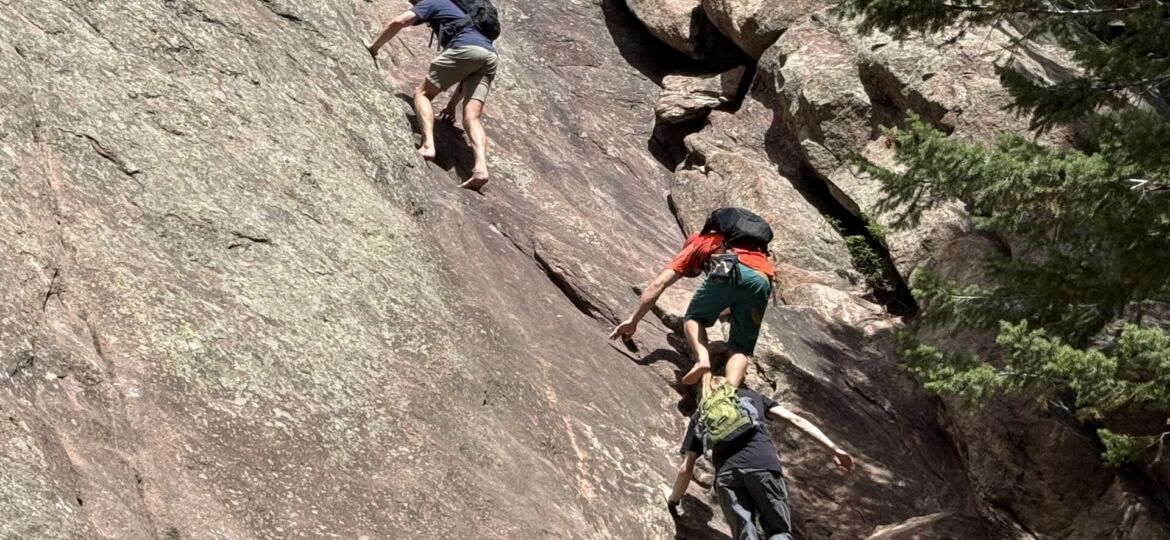
For most people, the death of a free solo climber would be enough reason to stay off the Flatirons.
This audio documentary explores why Boulder climbers continue returning to the rock without ropes and what happens when a climb turns into a rescue.
AUDIO FEATURE TRANSCRIPT
Boulder, Colorado’s Chautauqua Park gets over 1 million visitors per year, according to the park’s website. The main attraction to the park is the Flatirons, which are these massive, slanted rock slabs that tower over the city. This landmark draws the attention of hikers and rock climbers, and some of them are “free soloists” who climb without ropes. The sport is dangerous and requires a lot of skill. Most people make it down safely, but some do not.
I’m Etienne Dunoyer, and welcome to the podcast.
The Death of Ryan Kelly
On May 14, 2026, 33-year-old Ryan Kelly was climbing Boulder’s Second Flatiron at Chautauqua Park. The particular route is very popular for “scramblers” — people who climb without ropes or special gear. On that afternoon, something went wrong. No one knows exactly for sure because Kelly was alone. But somehow, he fell, crashed onto the base of the rock and died. He had no safety gear.
For most people, myself included, the news of Kelly’s death is more than enough reason not to climb the Flatirons. But pretty much every day, you can see people scrambling up the same rock — without ropes, without protection and in some cases, without anyone who knows they are there.
After hearing about accidents happening on the Flatirons from free soloing, I got curious. I spent the summer of 2026 exploring the Flatirons and Chautauqua Park with local scramblers and talked to rescue crews who put their own lives at risk to help others to safety.
Meeting Climber John Kennedy
In the start of the summer, I hiked up the Second Flatiron trail hoping to find someone to talk to about free soloing and to get more information about Ryan Kelly.
When I got to the top, I didn’t see any climbers, which had me pretty bummed out and wanting to go home.
But right before I turned back, I had the urge to go between a ridge of the Second Flatiron to get a better view of the city, and that’s the moment I saw the hand — a hand shot up from the other side of the rock like a zombie from a grave. The climber gripped the edge and pulled himself up. This is how I met John Kennedy, a 57-year-old oncologist from New Orleans.
Kennedy moved to Boulder in 2019 with his son, who was then going to college. He fell in love with the mountains and now takes six months off from work every year to free solo climb.
Like everyone else, he had to work his way up to his current skill level.
John Kennedy: “But, um, yeah, the first time I saw somebody climbing this, I thought I would never in a million years. And then I kept watching people climb it. And then I found that there was a place you could kind of like sneak onto the Flatiron, the Second Flatiron and there was a big ridge below you. So it was kind of like a little safety area. And so l thought, well, I’ll just climb up a little ways and I’ll climb up a little ways further. And then that first day, I kind of, you know, didn’t get very far. And I found a way I could exit back into the woods. So I did that. But, uh, you know, then eventually my curiosity just got the better of me.”
Reporter: Ryan Kelly may have been climbing one of the more advanced routes on the Second Flatiron before his unfortunate death. Kennedy didn’t know Kelly but says the climbing community feels sympathy.
Kennedy: “I feel terrible for the person who fell, but I pretty much stick to the Freeway route because it is, uh, it’s like fourth class, maybe, maybe sometimes very low fifth class, but it’s, you know, not something that I’m likely to fall on. So, I’m pretty comfortable doing that one route.”
Reporter: Climbing grades are categorized into five classes. Class 1 is essentially a hike. Class 2 is basic scrambling. Class 3 is a scramble where climbers sometimes carry a rope. Class 4 is climbing on a route with some exposure. And Class 5 is where serious climbing begins. The terrain is more technical and at this stage, it is important to use a rope.
Students who Frequent the Flatirons
Aiden Bowman studies finance and accounting at the University of Colorado Boulder. He loves to scramble the Flatirons, despite the risks of climbing without ropes.
Aiden Bowman: “As soon as I finished the second Flatiron, it started to become more and more like who I was, um, just because I got to a point where like doing this stuff felt made me feel so good about, you know, my mental health. It was a great escape from things. And then it just became my natural hobby where I’d get out of school and the first thing l’d do is just head over here and start climbing.”
Reporter: Kennedy says it’s important to stay calm and pay attention on the route.
Kennedy: “If somebody comes up and they’re climbing and they get way up there, it’s just. I don’t want to be up there and suddenly just panic, you know?
Reporter: “Yeah. Has that ever happened before?”
Kennedy: “Oh, yeah. Sometimes you kind of get a panicky feeling and, uh. I’m sure you know who Alex Honnold is.”
Reporter: “Yeah.”
Kennedy: “Yeah, I was listening to him one time on some video, and he was saying, ‘When I’m climbing something, I never think to myself ‘I’m 1,200 feet off the ground, and if I fall, I’m going to die.’ He said, I never think to myself, l’ve got 1,000 feet to go. He says all I think is next handhold, next foothold, next foothold, next handhold all the way up. So I always try to do that.”
Reporter: He used this advice when he was climbing Crestone Needle.
Kennedy: “The last thing you do before you get to the top of Crestone Needle is there’s a headwall that’s almost vertical. That’s about 120 high that you have to climb. And that’s all I thought the whole way up was next handhold, next foothold, next handhold, next foothold. And the next thing you know, you’re at the top and it’s really not that bad.”
Deadly Flatirons by the Numbers
Reporter: According to the Boulder Reporting Lab, six people died free soloing the Flatirons over the past 10 years. The two most recent deaths happened while climbers took the Freezeway on the second Flatiron, a technical route rated 5.7. And even more climbers are injured. According to the sherriff’s office, about 10 people are seriously injured each year climbing the Flatirons. At least nine people have been injured so far this year.
Rescue Operations
When there is an emergency at the Flatirons, rescue teams such as Rocky Mountain Rescue Group, Open Space and Mountain Parks, and Boulder Emergency Squad respond to the calls.
Park Ranger Dave Gustafson explains how Open Space and Mountain Parks rescues injured climbers on steep terrain.
Park Ranger Dave Gustafson: “So on the face a lot of times if they can get to a, um, a lowering point from the top and come from the top, it’s a lot easier than to start to try to climb climbing from the bottom to pitch climate, that’s going to take a lot forever. And, and the cool thing about the Flatirons too is, you know, they like the first and second, they have that trail that runs diagonally between them. So, there’s a lot of places where they could get up on the first or second and get above the climber or even, um, parallel with them, and then work their way over to them. So that coming from the top is usually the best thing that they can do, because they can just rope in and rappel down. It’s a lot quicker.”
Reporter: When emergencies happen in Boulder County, the sheriff’s department coordinates the response. For example, if a rescue requires high-angle climbing, Rocky Mountain Rescue, which is equipped with special gear for steep terrain, will be dispatched to the site. Gustafson explains what that looks like.
Ranger Gustafson: “Everybody that um gets put in a litter ends up um, on what we call a break and it’s a device that we, um, hook to a tree and then the rope runs through there and one person is able to hold the weight of the litter. And what we’ll do is we’ll have like six people on the litter, three people on each side. And we don’t usually pick people up and walk them down switchbacks. It’s going to take us so much longer. So, if we’re at the top of a switchback, we’re just going to go off of this switchback and everybody’s going to lean back and the person running the brakes is just controlling all that weight as they bring somebody down. Okay. And then when it gets to the end of the brakes, they say, you know, you know, we have to break. So, then we’ll put the litter down and then they’ll hook up new brakes.”
Reporter: A litter is a stainless-steel stretcher with curved side rails — a cage-like device with netting and an air mattress to comfort the injured person and keep them stable. Getting the injured climber off the mountain is not an easy job. The litter is heavy, so rescue volunteers rotate carrying them.
Using Personal Cellphones and Apple Watches to Find Fallen Climbers
Reporter: You might wonder how rescue teams can find injured climbers on the mountain. When someone calls 911, the emergency dispatch center uses the caller’s cell phone coordinates to locate the exact spot of the accident.
Gustafson: “Most of the time for fallen climbers or people that are hurt, like in the backdrop of Boulder, it’s about at least usually only like about twenty minutes before we can get to them on foot.”
Finding Ryan Kelly
Reporter: What happened when Ryan Kelly fell to his death? How did rescue teams find his body? When Kelly fell off the second Flatiron, his Apple Watch sent out a crash detection alert to the Boulder County Communications Center. That agency dispatched first responders to Chautauqua Park to talk to hikers and climbers, hoping that someone had seen Kelly. But the responders couldn’t find Kelly or any witnesses. Not long afterward, an off-duty member of Rocky Mountain Rescue happened to be climbing on the Second Flatiron and spotted Kelly’s body in a gully.
Gustafson: “We rely heavily on the public. Um, there’s the thing about our system. We have over 6 million visits a year, So a lot of times we rely on, um, visitors to, to find folks that, um, when something happens, they hear someone yell or hear someone fall or witness it. And so most of the time, that’s how we end up getting those reports of people that are injured on the trail.”
Reporter: When Kelly fell, his watch alerted emergency services that something happened. The volunteers with Rocky Mountain Rescue received alerts on their cell phones from dispatch, kind of like a pager back in the day. Anyone like you or I can download a police scanner or dispatch app and get the coordinates on incidents just like the rescuers do. Because the Flatirons are right in town, rescue teams get there quickly, and, depending on the situation, responders from different rescue teams work together on a single incident.
Gustafson: “Most of our rescues have what we call a staging area. So everything that happens on the first, second, third, Flatiron, the staging area is the Blue Bell Shelter picnic area, which is just right up from Chautauqua. So we unlock the gate at Chautauqua and drive that mile up to the picnic area, and that’s where we all start to park. And then we can start to walk in and perform the rescue.”
If You Must Climb, Heed this Advice
Reporter: While rescue teams work hard to get injured climbers out safely, some climbers like Ryan Kelly never make it home. Park Ranger Gustafson has advice for those who dare to scramble the Flatirons.
Gustafson: “We have a lot of people that free solo the first, the second and the third when it’s open and they get up there and then they turn around and realize coming back down is a lot harder than going up when you’re free solo and so now they’re ledged out. So, it’s one of the things that we definitely recommend for folks is to know your limits and always use ropes, it’s the best thing. And I know a lot of people don’t like to do that because it’s the thrill of it, but there’s a lot of people that aren’t around anymore that ropes probably could have saved them.”
Reporter: CU Boulder graduate student Gabika Watson has climbed the second Flatiron a handful of times. On a warm morning in late June, she was preparing for her scramble with a friend visiting from England who had never done the climb before. She imparted some advice for him and others who want to tackle this popular route.
Climber Gabika Watson: “Don’t be stupid … three points of contact at all times, know where you’re going, be familiar with the route, be comfortable with yourself, know your body and have really good balance and always look at your feet before you move your hands.”
Reporter: Climbers Aiden Bowman and John Kennedy agree that it’s important to know your own abilities.
Bowman: “But I have to know my limits of like, I’m not an experienced climber, right? Just because I live in Boulder and I’m able to do this stuff now, it doesn’t mean that like I automatically get a free pass and all this.”
Kennedy: “If you wanted to do the first or the second, it’d probably be a good idea to hire somebody and do it on ropes first so you know kind of what it’s like.”
Reporter: Ryan Kelly’s death reminds us about the potential dangers of climbing the Flatirons. It’s important to understand the risks that come with scrambling and free soloing, and to be mindful of how fragile the human body is.
Thanks for listening. I’m Etienne Dunoyer.