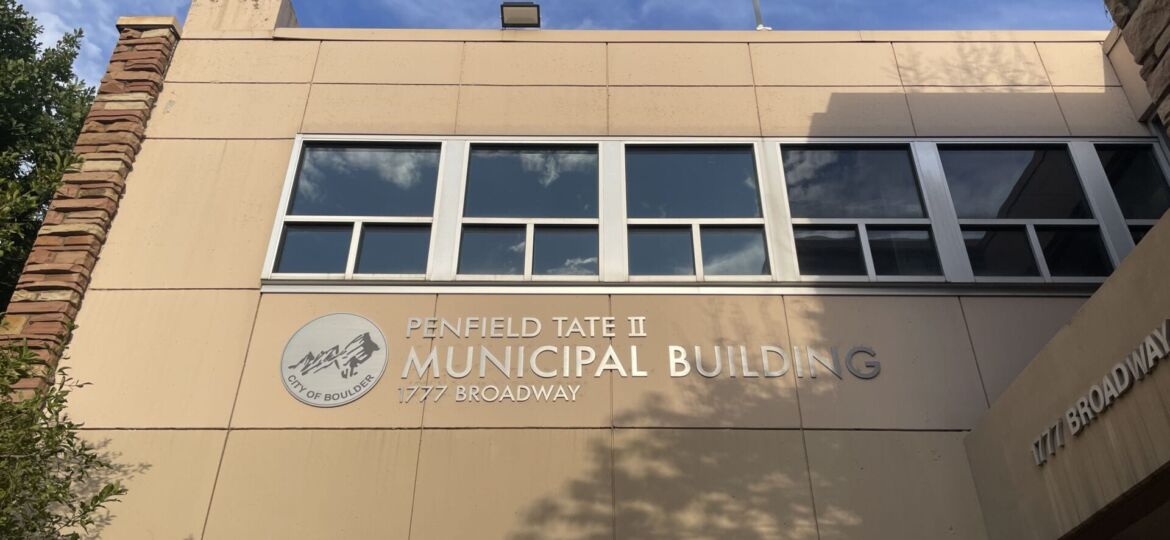
The Penfield Tate II Municipal Building in Boulder, Colorado, shown here on Oct. 6, 2026, houses the mayor’s office, city council chambers and city council offices, among other municipal departments. (Photo by The Bold staff)
Affordability, budget cuts and wildfire risk shape Boulder’s 2026 mayoral race
As Boulder residents prepare to turn in their ballots for the midterms, they are facing a major decision in a local election. The city’s top elected position is up for grabs, and a few familiar questions are on candidates and voters’ minds are the city budget, housing affordability and wildfire risk.
The candidates for Boulder mayor are incumbent Aaron Brockett; Taishya Adams, a current city council member; CU Boulder student Jameson Goldstein; real estate agent Lisa Ann Jacobs; Aquiles La Grave, a local business owner; and Fred Smith.
While the six candidates entered the race with different priorities, one issue has repeatedly surfaced in conversations with voters: the cost of living in Boulder.
According to the Economic Research Institute, the overall cost of living is roughly 30% higher than the national average. The median home price is $1 million, and the median household income is $87,493.
“It is very expensive to live here in Boulder,” said Rebecca Dickson, a former CU writing and rhetoric professor and Boulder resident. “It’s very expensive to buy a house and expensive to rent. And that has real consequences. When you can’t bring in new people because housing is expensive it’s difficult for people to move ahead and succeed.”
In February 2026, the city council voted for the possibility of developing the Area III Planning Reserve, a 493-acre rural area east of U.S. 36. According to the city, “Area III was established in 1977 to protect Boulder’s rural character and prohibit urban development.” However, data shows that Boulder’s population has been declining, Axios Boulder reported.
Brockett and Adams are among the candidates who support developing part of Area III for middle-income housing.
In an Oct. 14 mayoral forum hosted by the Boulder Reporting Lab, KGNU and the Boulder County Film Commission, Brockett, Adams, La Grave, Goldstein and Jacobs responded to a question about their positions on developing Area III Planning Reserve.
“The opportunity there is for middle-income ownership housing. The land prices in the planning reserve are low enough that if we allow annexation there with strict terms, we could get affordable family housing,” Brockett said.
Jacobs said the voters she talked to told her to vote no, so she will side with her constituents in not developing Area III.
“Residents are faced with high densification of their neighborhoods and are now told we must look at Area III without consideration of whether we can afford Area III monetarily or from the perspective of our water or power,” said La Grave. “We need to slow down and relook at what we have been sold and how we fill these problems.”
Adams was open to the idea of developing as a relocation site for neighborhoods at high risk of wildfires, and also talked about developing the area with Indigenous peoples in mind to display ancestral history.
Budget is top of mind for voters
As the city goes into its third year of major budget cuts, Boulder’s budget issues have been a major talking point during campaign season. Most candidates have called for greater transparency in the city’s budgeting process.
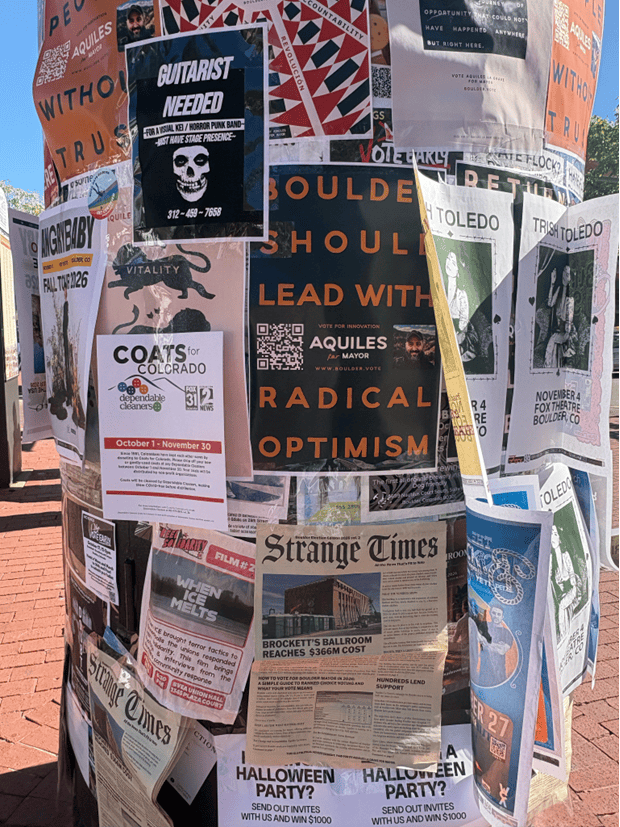
The City Council approved the 2027 budget of $552.6 million in a 7-1 vote in October. Due to flattening city revenue, the budget is meant to close the $6.3 million gap between city expenses and revenue with spending reductions that could affect both city employees and services, including funding and service hours for city pools and the elimination of 24 city positions.
Brockett was in favor of the budget and acknowledged the slowing revenue and increasing tax to cover projects for future development. He also said that any funding increases proposed had a tradeoff that included position and funding cuts elsewhere.
Adams was the only council member to vote against the approved budget, saying it lacked council direction. Adams pushed for a two-year budget cycle instead of an annual budget cycle. She also raised concerns over impact on water sources and how the city’s investments are misaligned with climate and social policies, as reported by the Boulder Daily Camera.
La Grave has been adamant throughout his campaign that the city has experienced poor financial management and unnecessary spending on large city projects such as the Alpine-Balsam project. La Grave has advocated for more transparency with city funding and tighter control of spending instead of more funding cuts.
Goldstein has emphasized reforming financial oversight and wants to reevaluate the city’s spending priorities. Goldstein told Better Boulder he wants to prioritize workers such as police and firefighters rather than retaining city positions solely because they have appeared in previous budgets.
Goldstein also wants residents to be able to see how much money goes into each city program and what the outcomes those programs produce to improve transparency.
The city is also asking voters to approve a $400 million bond measure to repair or replace aging city buildings. The bond would be repaid through higher property taxes.
This measure has been a dividing line between candidates, with some saying it’s too aggressive. Brockett supports it, while La Grave, Adams and Goldstein do not support the bond, according to Boulder Reporting Lab.
Preparing for a changing environment
Boulder’s next mayor will have to make decisions about how much of the city’s budget should be allocated in environmental programs and preparing for environmental threats.
According to the National Oceanic and Atmospheric Administration, Colorado experienced the warmest winter on record in 2025-2026. With high temperatures and low precipitation, wildfire danger remained high throughout the summer.
The city already supports multiple programs that oversee water quality, clean air and wildfire safety. La Grave and Adams have both supported the city’s programs to maintain clean water and wildfire prevention.
La Grave said in the mayoral forum that he supports Boulder residents in making their homes more fire-resistant by replacing siding and roofing. La Grave said funding for this project can come from the federal government, county partners and a temporary allocation of climate funds.
Brockett supports requiring homeowners to make their homes more fire-resistant by managing vegetation and preventing fires inside a home, specifically in high-risk wildfire areas. He says that roofs in Boulder are already fire resistant and replacing siding is too costly.
Adams similarly supported vegetation management as a way to reduce wildfire risk. She said the city can use reserve funds to support mitigating fire risk through a loan program. She also mentioned looking at evacuation protocols, recovery and relocation as part of wildfire prevention.
Dickson, an environmental activist, said to earn her vote, the candidate must prioritize environmental issues.
While each candidate has different approaches to the city’s challenges, the election raises a question about the leadership Boulder needs moving forward.
For Dickson, effective leadership goes beyond campaign promises. She emphasized the need for the mayor to work and cooperate with the City Council successfully and with respect while maintaining strong relationships within the community to advance meaningful solutions.