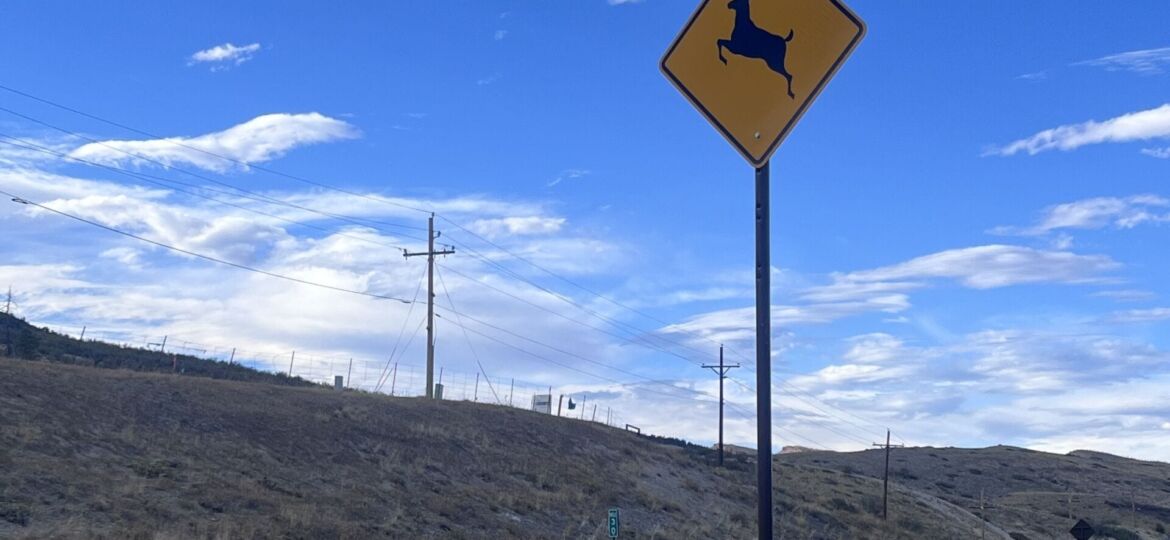
A wildlife crossing sign at the front of Highway 36 leaving Boulder, Colorado on Sept. 19, 2026. (Photo by Gean Chambers)
Why does Boulder County want to implement a wildlife crossing system along U.S. 36?
By Gean Chambers
Imagine a deer standing at the edge of U.S. 36 as traffic moves between Boulder and Lyons. In seconds, it leaps onto the highway, forcing drivers to brake and evade an animal that has nowhere else to go.
Encounters like this are a reminder that highways don’t just carry people through the Colorado landscape, roads also cut though the habitat that wildlife depend on.
As Boulder County considers moving forward with a potential wildlife crossing along U.S. 36, officials and residents are exploring ideas that could provide a safer way for animals to move though the surrounding area and reduce encounters with vehicles.
“Wildlife crossings are important because they give these animals a safe, irrigated way to move,” said Dante Przybylski, a volunteer naturalist at Flagstaff Nature Center in Boulder.
What do wildlife crossings look like?
Wildlife crossing structures are designed to give animals a way to cross major areas for motorized traffic.
“Instead of having to find their own way across a major road, they are strategically guided,” said Przybylski.
Crossings can take different forms like bridges, fences and other guardrails. But the crossing itself is only a part of one system.
Fencing can be placed along the highway to prevent animals from entering the roadway and guide them toward the designated crossing. The idea is to create a safer and more predictable path for wildlife, while keeping animals and vehicles separated.
Do they work?
A 2022 report done by Banff National park and the Canadian government said since the park implemented fencing and wildlife crossings, wildlife-vehicle collisions have dropped by more than 80%. For elk specifically, collisions have dropped 96%.
According to the Federal Highway Administration, wildlife fencing combined with crossing structures can reduce collisions by about 87%.
“In this case, for the 36 Highway, they do want to build a fence up there,” said Przybylski. “Now it’s not going to completely eliminate the possibility of hitting wildlife, it drops it like crazy. It’s super simple and a proven way to protect everyone.”
What should drivers be aware of?
Utilizing wildlife crossing signs on roads is a popular tactic in animal-heavy areas.
“I actually do pay attention and look out for signs because there are a lot of animals from where I’m from and I definitely don’t want to hit them,” said Rebecca Shlomo, a CU student from Long Island, New York.
However, simply cautioning drivers that wildlife is nearby doesn’t always mean drivers fully comprehend those warnings.
“For me I would only slow down if I actually see a deer on the road. If I see a deer sign I know they live here but I’m still going to keep driving,” said Chloe Frishman, a CU student from French Field, Connecticut.
That difference is one reason wildlife crossings focus on changing the environment around the highway, rather than relying entirely on drivers to react in time.
Instead of asking the drivers to avoid animals at all costs, the crossings limit the encounters from happening in the first place, while still providing a designated path for wildlife to travel.
“Animals are already moving through these areas to find food, water, shelter,” said Przybylski. “So a well-placed, well-designed crossing works and helps develop a great environment.”