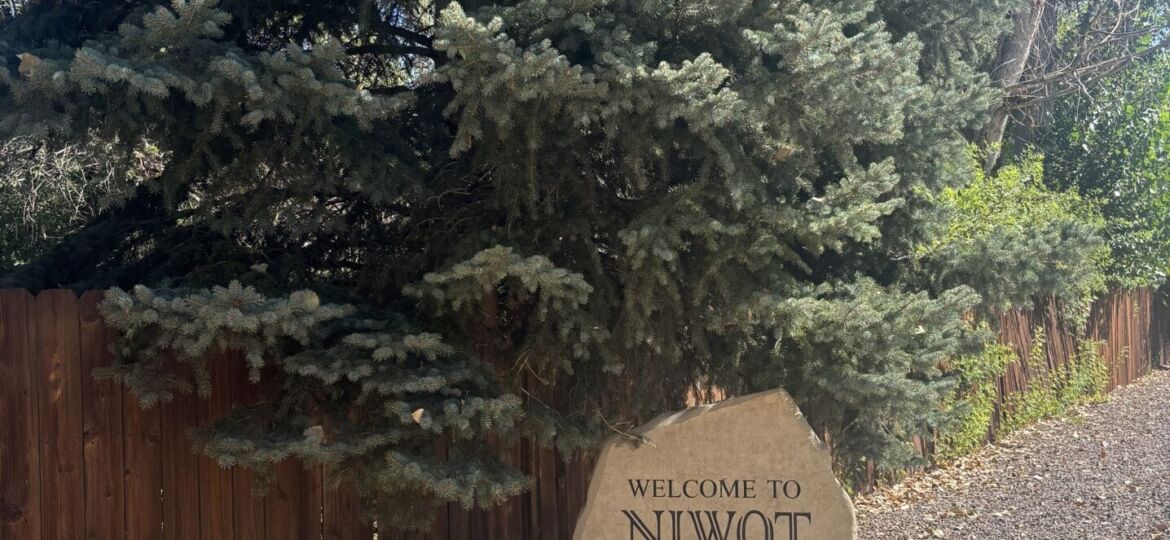
The Niwot welcome sign is located on the north side of Niwot Road across from Peppertree Drive on Sept. 20, 2026. (Photo by Caitlyn Garza)
Niwot has been under Boulder County rule. How could voters change that?
By Caitlyn Garza
Niwot, Colorado, is as homey as you can imagine: charming buildings housing local small businesses, open fields at every intersection and a vibrant community. It’s a picturesque town.
Except it’s not a town. It’s an unincorporated community within Boulder County.
On the 2026 midterm ballot, Niwot residents will decide whether to incorporate Niwot. Incorporation means becoming a municipality that has its own government and provides services separate from the county.
What incorporation means to Niwot
Niwot residents seek incorporation to have a say in government affairs. As a Boulder County community, they follow county government, which isn’t always representative of Niwot.
The incorporation would create a more representative government, elected by Niwot residents.
“We have no political voice; we are 1.4% of the population of Boulder County,” said Nicholas Little, a Niwot resident and president of the Niwot Incorporation Committee. “We are always going to be voiceless.”
If the incorporation wins on the ballot, Niwot will have a mayor and city council. Niwot could fix its roads and address issues with Boulder County policies, like land use or minimum wage.
The journey to incorporation
The incorporation started with Boulder County’s minimum wage. The County set a minimum wage policy that aimed to increase by 2030. This impacted local businesses, which caused Niwot to lose two restaurants.
Residents partnered with local farmers to change this policy.
Some residents sought to fix the roads by passing a property improvement district. Boulder County also placed a temporary delay on downtown development. Residents then joined forces to seek change in their community.
“That became the beginning of what we now call the Niwot Incorporation Committee, which is a group of residents that are trying to basically use incorporation as a mechanism to solve these various challenges,” Little said.
The committee began the journey to get incorporation on the ballot with a petition that got 250 signatures.
“We want local residents to have control and a voice over how their community works,” said Little.
The other side
Neighbors for Niwot is a registered issue committee that is against the incorporation effort for a few reasons, including the cost.
Incorporation would bring sales taxes, marijuana taxes and property taxes. Property taxes could impact staple local businesses like the Niwot Market.
“This would raise their rent by about 4%, and they’d have to start charging sales tax on some of the items,” said Ari Adler, Neighbors for Niwot committee chair and Niwot resident.
Another concern is paying for the government, which would include tax increases that have to be voted on.
“If the voters say, ‘No thanks, we don’t want to pay any more taxes,’ then small-town governments often look to annex land or increase development,” said Adler.
For individuals against the ballot measure, incorporation comes at the cost of Niwot residents.
The undecided
While Niwot residents differ in their opinions about incorporation, residents like Pat Kneale will have to make their choice on Nov. 3.
“I think either way, Niwot will survive,” Kneale said.