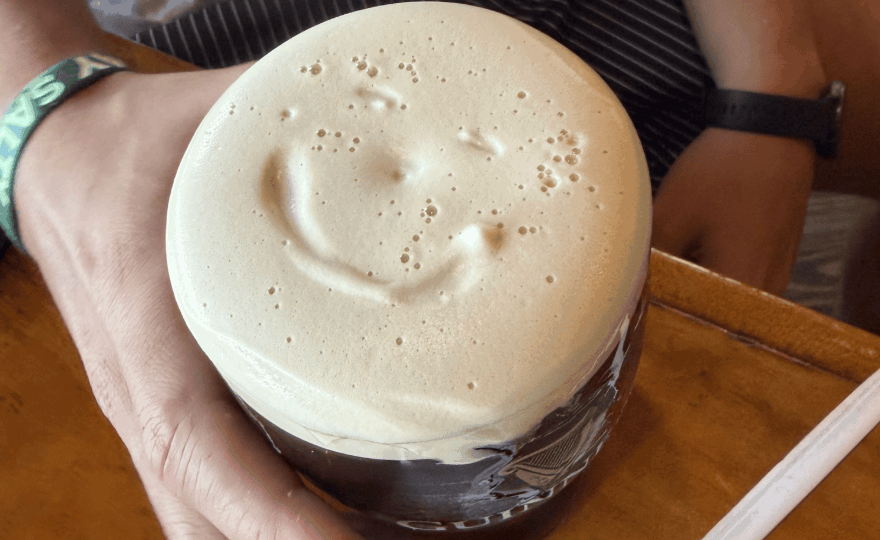
A pint of Guinness foams at Flats Beer Garden in Boulder, Colorado. (Photo by Aerin Genatt)
Does high altitude make hangovers worse?
By Aerin Genatt
For students drinking at 5,430 feet above sea level, a night out in Boulder comes with an especially rough morning after. Headaches, nausea, exhaustion and extreme thirst have helped fuel one of Colorado’s most repeated drinking rules: One drink at altitude equals two at sea level.
The rule is a myth. The miserable morning behind it is not.
Altitude does not make alcohol stronger or double the amount of alcohol entering the bloodstream. Instead, elevation and alcohol place separate stresses on your body that produce the same symptoms.
Lower oxygen availability, dry conditions and disrupted sleep overlap with alcohol’s effects, intensifying the morning after even though the drink’s strength has not changed.
What is happening to your body?
At higher elevations, decreased air pressure lowers the amount of oxygen available to your body. The Centers for Disease Control and Prevention’s Yellow Book identifies hypoxia, caused by decreased oxygen pressure, as the primary concern at high altitude. High-altitude environments also expose people to low humidity.
Alcohol creates its own problems. The National Institute on Alcohol Abuse and Alcoholism reports that alcohol increases urination and contributes to dehydration. It also fragments sleep, irritates the stomach and increases inflammation, all factors behind classic hangover symptoms, including thirst, fatigue, headache and nausea.
Camille Angiel, a 21-year-old CU Boulder student who grew up in Manhattan, said the difference between drinking in New York and Boulder is dramatic.
“In New York, I can have four, maybe five drinks over a night and wake up like a normal person,” Angiel said. “Here, three is my limit, and three is still a gamble.”
Angiel also described intense headaches, nausea and extreme dryness after drinking in Boulder, symptoms she experiences far less at sea level.
Why does it feel different for everyone?
Zoey Gassner grew up in Flagstaff, Arizona, at 6,900 feet — about 1,500 feet higher than Boulder. She said her hangovers barely changed after moving to Colorado.
“Same number of drinks, same next morning, give or take whether I ate and how much water I had,” Gassner said.
Gassner’s experience challenges the idea that crossing a certain elevation suddenly makes alcohol hit harder.
Boulder represents a major environmental change for someone arriving from Manhattan, while Gassner moved to a lower elevation than the one her body had experienced throughout her life.
Is one drink at altitude really equal to two?
No. There is no scientific two-for-one rule.
Tim O’Brien, a patrol medic who has worked in Breckenridge for three seasons, regularly encounters visitors who blame alcohol for symptoms associated with altitude.
“If you write down the symptoms of acute mountain sickness and you write down the symptoms of a hangover, the lists are almost the same,” O’Brien said. “Headache. Nausea. Fatigue. Dizziness.”
The CDC confirms that overlap exists; acute mountain sickness resembles an alcohol hangover. The CDC specifically lists alcohol hangover and dehydration among conditions considered when diagnosing altitude illness.
O’Brien sees the problem as several stresses stacking together: travel, inadequate hydration, elevation, physical activity, poor sleep and alcohol.
“I don’t think the drinks got stronger,” O’Brien said. “I think the person got weaker.”
That distinction explains Boulder’s notorious altitude hangover. Alcohol contributes to dehydration, disrupted sleep, stomach irritation and inflammation while elevation adds lower oxygen availability, low humidity and its own overlapping symptoms.
The result is not alcohol magically becoming twice as powerful. Several physiological stresses hit your body at once.
The alcohol is the same. The environment around it is not.