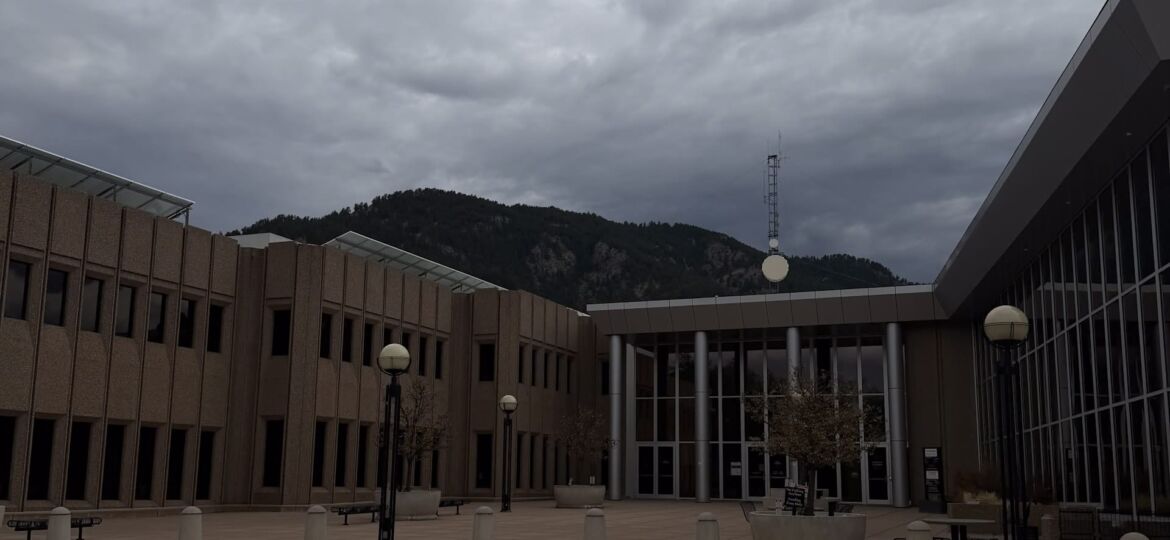
Some students who face minors in possession of violations may be required to appear at the Boulder Municipal Court, shown here on Sept. 24, 2026. (Photo by Annalise McIntosh)
What happens when a student gets an MIP in Boulder?
By Annalise McIntosh
Colorado law prohibits the possession or consumption of alcohol for individuals under 21. A possession charge does not necessarily mean police have to see someone actively drinking. Alcohol found in someone’s hand, pocket or backpack can qualify as possession.
For CU Boulder students, what happens next depends largely on the type of citation they receive.
Here’s how the process breaks down.
What happens if you get a CU-A citation?
There are two possible paths for CU Boulder students who receive a minor in possession charge. If the ticket number starts with “CU-A,” it is a CU administrative citation, meaning the case is handled through CU Boulder’s Student Conduct process rather than in court.
Possible outcomes include educational programs or workshops, a written warning, probation or other consequences depending on the nature of what a student was doing.
However, if a student received an actual MIP summons, it is different; students may be required to appear in Boulder Municipal Court.
What happens if you get an MIP summons?
The consequences of an MIP can vary depending on the circumstances of the case, a student’s prior history, their plea agreement and the judge’s final ruling. The city of Boulder has procedures for expending MIP records in a qualifying case.
“If a cop contacts you and gives you a summons, it will most likely be written into the Boulder County Municipal Court,” said Marcy Bigsby, a paralegal at CU Student Legal Services. “When you get a court date, you will be one of many in court at that date.”
For students, the consequences can also go beyond the initial citation. Missing a required court appearance, failing to meet the community service hours or missing a conduct meeting could result in additional problems, making the process more difficult to resolve.
“After receiving an MIP, I faced 40 hours of community service and I had to complete 20 hours of an online drug course,” said Chase Mclachlan, a junior at CU Boulder. “I even had to sit in a courtroom for multiple hours.”
Mclachlan’s experience demonstrates one possible outcome of a student’s MIP case, but his specific penalties should not be viewed as standard for all students. Court requirements can differ from student to student.
What else might you deal with if you get either?
The CU Police Department has developed a specialized process for MIP cases, where they conduct substance-use screening, where defendants wait for the plea to offer to be made.
An MIP is also different from more serious alcohol related cases such as a DUI. Receiving an MIP does not automatically mean a student will be suspended from CU Boulder or a permanent record. Boulder Municipal Court handles MIP cases, while drinking-and-driving cases are handled outside the municipal court system.
“I think students know how easy it is to get one, but I don’t think they understand what it truly means,” said Neve Burke, a junior at CU Boulder. “They have to discipline students, but I don’t think they should go to court.”
Students at CU Boulder are no strangers to MIPs but knowing what happens after receiving one can make the difference between viewing a citation as a simple ticket and genuinely understanding the legality of the process that can follow.
Laws can depend on where you are, so students should do their research before making decisions that could lead to legal consequences.