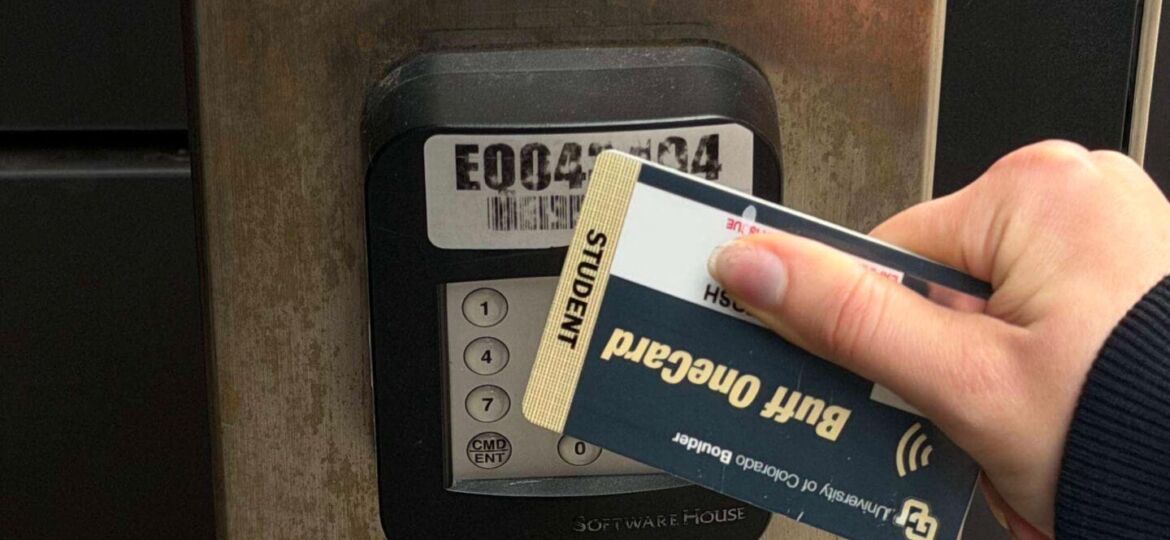
A University of Colorado student scans their Buff OneCard at an electronic card reader to gain access to a campus building on Oct. 22, 2026. (Photo by Annalise McIntosh)
CU Boulder students have a hidden digital footprint
A University of Colorado Boulder student can leave their dorm room in the morning, tap their Buff OneCard to enter a campus building and walk past a security camera on their way to University Hill to meet their friends.
Throughout a seemingly ordinary day, students don’t realize how many different forms of data might be tracked.
CU Boulder uses technology, including Buff OneCards, security cameras, body-worn cameras and license plate readers to monitor campus safety.
Many of these systems are designed to ensure the safety of a college student on campus, but together it raises a larger question: How much of a college student’s life can be recorded, stored or reconstructed?
For students, a Buff OneCard can be used for everyday purposes. The card serves as a student ID, a meal swipe, a way to rent out university equipment and it can provide electronic entry into most campus affiliated buildings. Each tap may seem like an easy way to unlock a door, but the electronic access systems also raise the question about what information is being stored when a card is in use.
But that’s only one layer of surveillance students may encounter; cameras are another.
CU Boulder has several policies regulating campus security, including building access control, emergency management and security cameras, according to Jade Young-Tucker, a public information officer at the university. Young-Tucker said these policies are intended to prioritize the safety and well-being of the campus community.
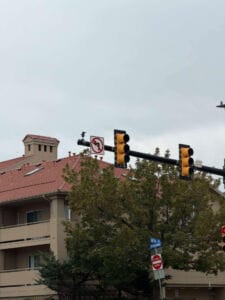
The Boulder Police Department uses automated license plate technology that records plates along with vehicle characteristics like make, model, color and year. According to the department’s website, this information is retained for 14 days and is used, if needed, for criminal investigations.
The department operates over 30 automated license plate readers supplied by Flock safety. These readers are positioned along major trafficked areas in Boulder.
A July 2026 snapshot of Flock Safety’s public transparency portal listed 31 cameras used by the Boulder Police Department, with 635,878 unique plate reads recorded over the preceding 30 days.
This technology has become the subject of an ongoing debate in Boulder regarding public safety and the balance against concerns of privacy. In September 2026, the city paused their process for selecting new readers so the city could conduct a community wide discussion regarding safety about the program.
“I feel like I’m being recorded when I’m in the halls of my dorm,” said Payton Earnhart, a freshman at CU Boulder. “I have a BuffOne scanner, along with a deadlock at my door. Every single entrance of Cheyenne has certain times you can or can’t come in.”
For a CU Boulder student, this can create a complicated environment. Students can feel as though they are being watched while simply walking to their rooms. A system that is designed to control access to their residence hall is different from a police body camera, or a traffic camera following their every move.
Surveillance is not limited to students living in residence halls. In August 2025, CU Boulder reported that it could house approximately 8,700 undergraduate students on campus, including 1,500 upperclassmen. For students traveling between campus, or their off-campus residences, surveillance can extend beyond university security systems.
The question is not whether students feel they are being watched, but what information is allowed to be collected through these systems, and who has access to it.
For some students, it is less about who has access to the surveillance, but how clearly the university communicates itself.
“I think if there were less of a communication gap between us and them, then I would feel safer,” said Genevieve Geller, a junior at CU Boulder. “I don’t think it necessarily makes me feel unsafe. I just think there needs to be more communication.”
According to a statement from CU Today, the university has said these systems are used to support campus safety, crime deterrence and ongoing investigations. But some students still may not know what information is collected and stored. The gap between the surveillance simply existing and students understanding of how it works has become an integral conversation on campus.
Surveillance does not only take physical forms. Everyday technologies, such as Wi-Fi networks, can also collect and store information about students’ online activity and their use of campus networks.
CU Boulder has openly acknowledged that their Wi-Fi system can collect information about students’ identities, devices and relative locations on campus. CU Secure collects certain data, but this does not automatically mean CU Boulder is actively watching and gathering students’ online data.
Because CU Secure records information about the access points a device connects to, it can potentially track a student on a certain area of campus at a particular time.
The university retains user and device information for 18 months, while operational network information is typically stored for 30 to 365 days.
The university controls the systems that collect and store this information. This means that students have limited control over that process, creating an imbalance between institutional authority and individual privacy.
As surveillance technology continues to develop, the question for students is no longer whether they are being watched, but how much they now about what happens to their information after it is collected.