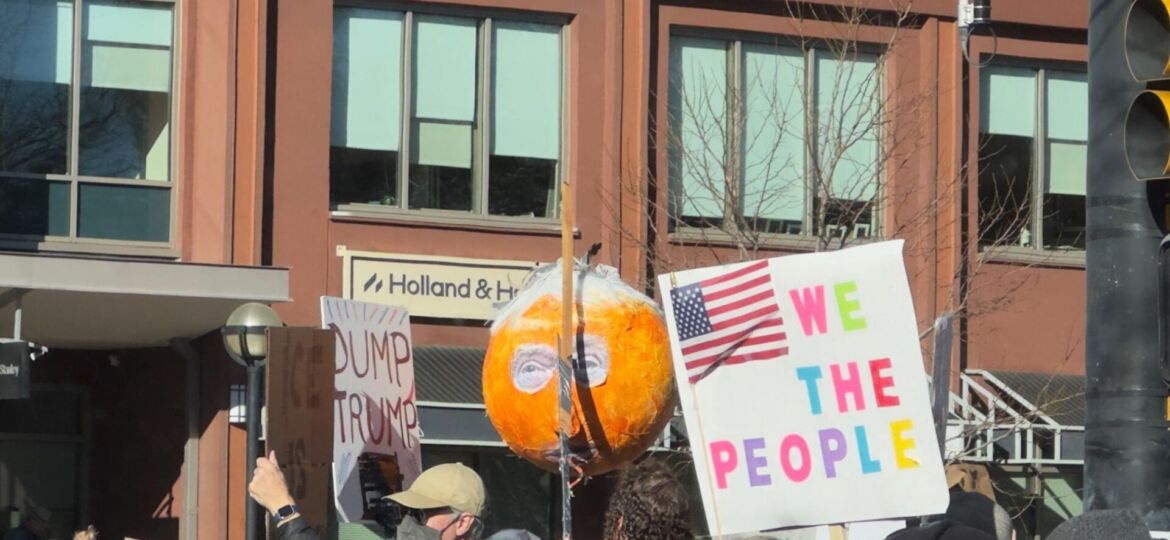
Colorado citizens protesting Immigration and Customs Enforcement (ICE) on Jan. 31, 2026, on Pearl Street in Boulder. (Photo by Valentine Motte)
Civil rights groups warn due process at stake in ICE-reporting amendment
Where do the boundaries between local law enforcement and federal immigration authorities lie? Colorado voters are being asked to consider the question with Amendment 81 on the Nov. 3 ballot.
Amendment 81 would change the Colorado constitution to require state and local police and prosecutors to notify the U.S. Department of Homeland Security (DHS) within 72 hours of the immigration status of a person charged with violent crimes, or someone with previous felony convictions whose immigration status is unlawful or unverified after a reasonable effort.
Under the proposed amendment, state police and prosecutors are obligated to notify the U.S. Department of Homeland Security (DHS) if an individual’s legal status cannot be verified or found. Since this is a citizen-initiated amendment, a 55% majority vote is needed for Amendment 81 to pass.
If passed, it would significantly change Colorado’s current judicial system by overriding state regulations and local sanctuary policies, like Boulder’s, that restrict the local police cooperation with federal authorities.
This national spotlight on federal immigration enforcement policies and deportations has increased during the second Trump administration.
Only one in three people arrested by Immigration and Customs Enforcement (ICE) nationally since January 2025 have a past criminal conviction, according to a recent study by CU Boulder labor economist Chloe East. And data from the Transactional Records Access Clearinghouse at Syracuse shows 70.6% of the current detainees have no criminal convictions as of July 11, 2026.
When Hanalei Anderson, a 20-year-old CU Boulder student and registered Colorado voter, was shown those statistics, she was blunt.
“Our entitlement is a reflection of our ignorance to other people’s suffering,” said Anderson. “To say that those who fight to an extent that most of us will never understand are not entitled to privileges under our constitution is hypocritical.”
Supporters of the proposed amendment believe that it will ensure and create essential public safety. Advance Colorado, the conservative advocacy group led by Michael Fields and Kristi Burton Brown, is driving the initiative.
The organization said it’s a selective proposed law, since it applies solely to cases with violent criminal charges or people with a record, and not low–level traffic or non violent violations.

Fields did not respond to requests for comment. The County Sheriffs of Colorado and the state Fraternal Order of Police declined comment.
I also walked around Boulder asking 42 people of different ages and ethnicities, and all either refused to speak about it or had no idea this measure was happening, what it was about, why it mattered and how it could affect the future of Colorado.
Multiple large civil liberties organizations, immigrant rights organizations and advocacy groups have all come together to fight passing this amendment.
ACLU Colorado policy representatives said notifying federal authorities before a trial jeopardizes basic constitutional rights, putting people at risk of potential racial profiling before their day in court.
Ariana Frosh, ACLU of Colorado policy counsel, added that it compromises foundational legal protections.
“When you are charged with a crime in Colorado, you are entitled to procedural protections to make sure the charges against you and what the state is accusing you of doing happened, those are things like a right to counsel, a jury of your peers,” Frosh said.
“What Amendment 81 does is prevent any of that process from happening. Because law enforcement would be required to report folks to ICE if they are not unable to determine if they are lawfully present in the United States within 72 hours of being charged, there’s no time for due process to occur, which is a substantial blow to constitutional rights.”
Community organizations believe mandatory reporting will break the trust and confidence between the immigrant community and law enforcement.
Rocky Mountain Equality, an advocacy group focused on equity and LBGTQ+ civil rights, is actively campaigning against this initiative.
Michael Duffy, the organization’s director of advocacy and engagement, also said the fear of deportation may prevent undocumented LGBTQ+ members from reporting hate crimes, safety concerns and domestic violence.
“Our communities overlap, there are a lot of LGBTQ+ folks who are immigrants, and a lot of immigrants who are LGBTQ+,” Duffy said. “Efforts like Amendment 81 erodes that trust that we’ve worked so hard to build and for good reason because it does jeopardize the safety and security of our community members.”
Legal experts have also pointed out that there are potential administrative issues in the initiative’s wording of asking officers to make a “reasonable effort,” though the text leaves “reasonable effort” undefined. On top of that, it is unclear which law enforcement agency would be legally required to notify DHS, since the district attorneys are the ones formally in charge of filing criminal charges.