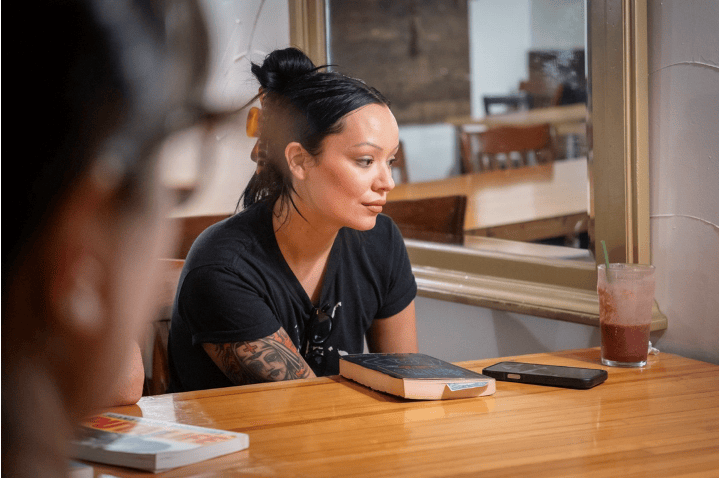
Devynn Dewey hosts an event in October in the Denver metro area with the Don’t Strip Our Rights organization, discussing literature perspectives on sex work rights and empowerment. (Photo by Ethel Yagudayeva)
'We're literally just your neighbors': Sex workers in Colorado push for decriminalizing their livelihood
Two years ago, Stella Marie celebrated her 46th birthday, surrounded by more than 80 friends in a sunlit backyard. She transformed her friend’s handmade stage into a showcase of the remarkably different people woven into her life — musicians, fire dancers, performers, even an edgy poem shared by her 82-year-old college professor.
Marie prepared more than just a variety show. She opened the evening with a vulnerable letter to a family member about herself to set some things straight. This was the coming-out her friends had been anticipating. Marie, whose real name is not being used for her protection, declared:
“I’m going back to being a sex worker.”
Intimacy services offer not only a livelihood for people like Marie, but also personal and professional fulfillment. But deeply engrained prejudices in society and the absence of legal protections create a hostile world in which Colorado’s sex workers must learn to fend for their own community together and their own safety by themselves.
That almost changed in Colorado in 2026. Democratic state Sen. Nick Hinrichsen of Pueblo introduced a bill to decriminalize prostitution, which is illegal across the United States with the exception of several counties in Nevada.
The push for decriminalization was what the women and femmes of Colorado have been striving for: to be considered equal.
Marie has been in the industry since she was 18 years old, and although she now has a more established and supportive community of sex workers, her world is still just as dangerous to pursue her passion in intimacy services. After a successful period of escorting, she was arrested for prostitution at age 28.
Prostitution was historically classified as a misdemeanor but the state downgraded it to as low as a petty offense in 2022, depending on specific jurisdiction and characteristics of the act. Petty offenses include petty theft or simple assault, carrying less severe criminal penalties.
Still, what may only be a second-degree misdemeanor became Marie’s lifetime fight for basic necessities. Marie was rejected from apartments and standard jobs were impossible to find. In her 30s, a graduate committee panel discussed her arrest records when she wanted to be a TA to pay for tuition.
She later ranked as a top candidate to become a firefighter, but interviews were cut short when her prostitution charge extinguished what was left of a possible career change.
“It really did disrupt my life, and it scared me, scared me real bad,” said Marie, recalling her prostitution charge. “I’m a white girl in America, I can’t even imagine what my Black and brown sisters have to go through.”
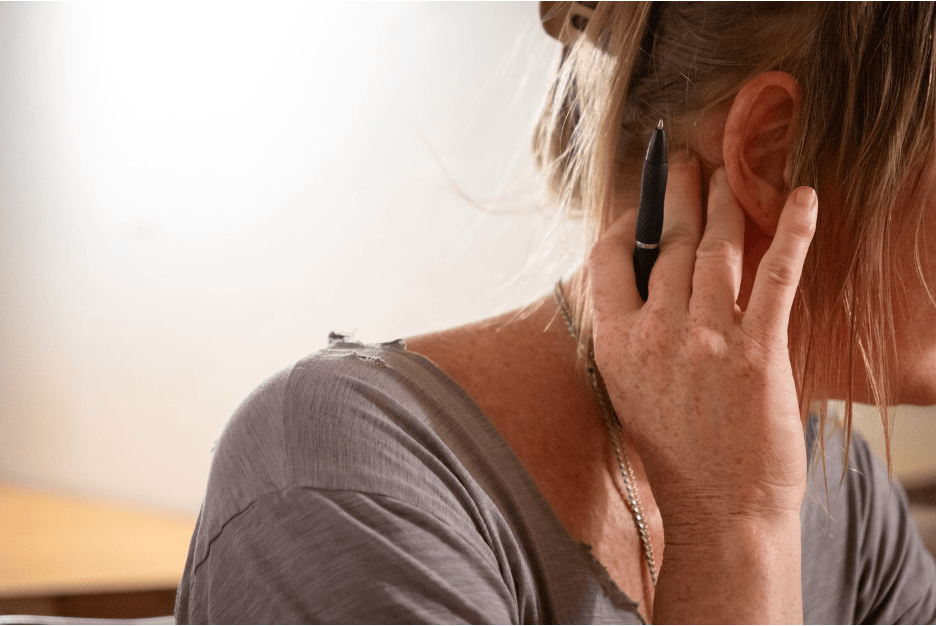
Marie attempted to search for stability in the realm of traditional jobs for 15 years but she eventually returned to sex work, tired of the struggle.
“Not everyone is open to intimacy with imperfect bodies or unconventional tastes, but I am,” Marie said that birthday evening. “Kinda like not everyone can work at an animal shelter on the euthanasia shifts, or volunteer at a horse rescue for 12 years, or pick up a maimed animal on the side of the road — but I can. It’s like the one thing that I really like about myself.”
At almost 50, Marie witnessed a milestone: Senate Bill 26-097.
Hinrichsen said a tip from a constituent who’s a sex worker led him to intensively research the topic, using New Zealand law as the most reliable precedent.
The bill, introduced Feb. 11, 2026, aimed to repeal offenses for prostitution, soliciting, patronizing a sex worker, keeping a place of prostitution and publicly displaying oneself for prostitution. But it would have kept felony-level charges for pimping and criminal intimidation or threats when arranging or offering to arrange a situation for prostitution. Most importantly, the bill did not eliminate laws against human trafficking.
“My gut reaction was, I don’t think that it’s a good use of government resources to police consensual sexual activities of adults. I don’t think that’s appropriate, and what actually is really wasteful when it’s actually enforced,” Hinrichsen said.
Lobbyist Devynn Dewey, the founder and policy advocate for Don’t Strip Our Rights, partnered with the bill’s sponsors to ensure it would guarantee the best possible outcome for the sex-worker community. A dancer for nine years, Dewey also has fought to prevent wage theft, provide security for entertainers and protect criminalized survivors of trafficking and domestic violence.
Joining Dewey was a good friend and community advocate, Becky Taha’Blu, who requested to use her stage name. Taha’Blu is the head organizer of the Denver Slut Walk, co-founder of the Rouge Support Network and member of the Lysistrata Mutual Care Collective & Fund.

In late January, Dewey received an email from a fellow activist with a draft of the bill, which was set to be filed in a week.
“Nobody told us until right then and there, which means we had, like, a month, which is impossible for any bill, let alone the most politically volatile subject in politics,” Dewey recalled. “So I’m reading this and I’m just like, ‘Oh, my God.’”
A meeting with Taha’Blu and other activists confirmed her concern: The draft wasn’t good enough.
Soon, Dewey, Taha’Blu and others were included in deliberations with the legislative sponsors. The activists fought to convince Colorado and the legislature of what was important to them.
“They’re not in the industry. They don’t experience the industry. They don’t know how big the community is. And frankly, sometimes they don’t care,” said Dewey. “I always say that lobbyists are kind of the strippers of the political world. You have to really push to get that yes from a legislator.”
The sex worker advocates had a short timeframe to address the flaws of the bill, but their community wanted to see decriminalization succeed.
“I personally did not support the legislation. I thought it was just a talking piece,” said Taha’Blu. “By decriminalizing sex work completely, they now built a loophole for requirements of licensing, and a federal charge of working without a license is even worse than a prostitution charge because prostitution charges are only state level.”
Colorado law requires anyone who wants to practice escorting to obtain an escort license, costing anywhere from $1,500 to $2,000. However, this license comes with a series of requirements, including background checks, fingerprints, submitting a list of clients and no explicit sexual contact between the escort and a client.
“If you get caught having sex with a client, you get multiple charges, not just a prostitution charge,” Taha’Blu said of the bill in its initial form.
Hinrichsen said he had a different approach in mind.
“Police have used the licensing bureau to check in on escorts to make sure that they’re not working as full-service sex providers,” Hinrichsen said. “But if full-service sex provision is no longer illegal, what’s there to check in on, and what’s the point of the licensing program?”
Avoiding interaction with police is one of the fundamental survival strategies of any sex worker.
Colorado has 171 prostitution arrests so far in 2026, according to the National Incident-Based Reporting System, affecting an almost equal number of white and non-white ethnicities.

Taha’Blu knows the risks of police involvement better than anyone. Between 2015 and 2017, she took on tantric healing for men with erectile dysfunction in her apartment, staying honest with her neighbors about her work. As rumors spread through a powerful subreddit hate platform, she became a victim of substantial doxxing — revealing her real name, social security number, addresses, license plate and car details, habits and information about her family.
According to Taha’Blu, what followed were two break-ins, stalking of both her and her mother, and multiple attempts of drugging and trafficking. Taha’Blu was then convicted of a DUI charge and spent two and a half years on house arrest.
The targeted harassment online continued, but group stalking has dwindled. The long-term effects also remain. Taha’Blu was effectively shunned by her peers, because she had become too hot of a target for law enforcement, and sex workers didn’t want to take the risk of associating.
Hours after the bill was introduced, the sex worker community was met with a relentless barrage of hostility and opposition.
“Twitter was blowing up with people talking about, ‘Look at what the Democrats just introduced. They don’t care about you,’” Dewey recalled. “They were saying things that we would consider slurs.”
Angry, religious conservative groups posted online about the destruction of society. County officials made public their opposition, fearing criminal activity. Hinrichsen received ominous threats and wild accusations through email and social media.
“I got a call once, a voicemail of, ‘You’re trying to legalize child sex trafficking. Watch your back, or you’ll endure the same pain that they have to deal with,’” he said. “There were also people who, I think, really felt that this was just an issue that made them morally superior.”
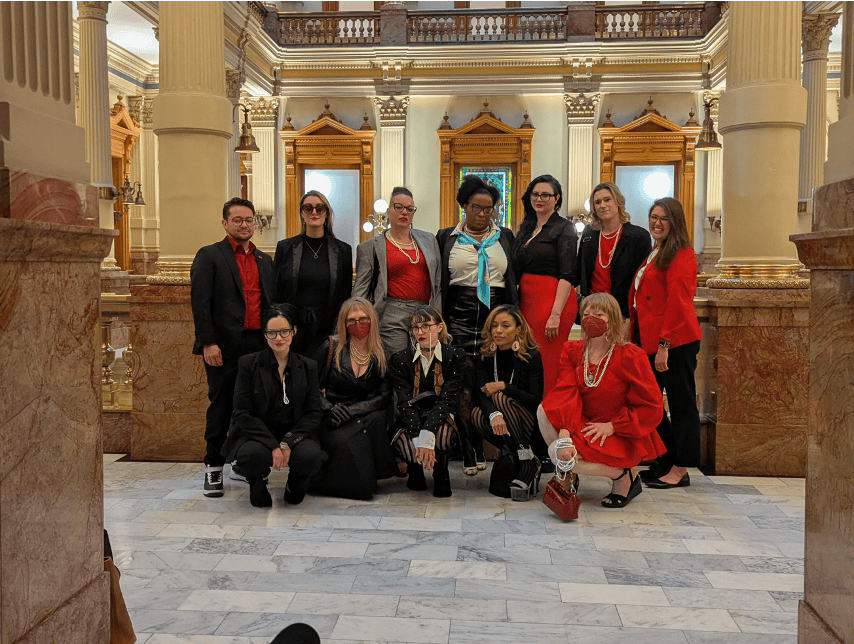
The sponsors and activists worked tirelessly to provide adequate research when the bill was assigned to the Senate Judiciary Committee, but getting a hearing — which would have kicked off a substantive public debate — proved harder than anticipated.
“My biggest frustration has been that the facts around the effects of our sex work policies were not well understood at all,” Hinrichsen said. “I had a couple people say to me, ‘I think you might be onto something here, but everybody in my district hates it, and I’m not gonna be able to say yes.’”
The stakes are high in a community that wants sex workers’ lives decriminalized, to prove their place in society and the lawbook. The frustration grows with every rejection, where their efforts are overlooked or undervalued.
“I wish I could share with my family all the work I put into building community to help marginalized people and this beautiful space for connection I created, and the way I think I’ve impacted people’s lives in a positive, meaningful way,” Marie said on her birthday evening. “In my heart of hearts, I can’t see what I’m doing wrong.”
Felicity has been in the industry for nine years, starting at age 18 through escort agencies. After a terrible first exposure to escort management, Felicity met the woman who she considered as a mother.
“She taught me everything she knew about the industry and how to screen (clients), and was really great,” said Felicity, who spoke under a pseudonym due to privacy concerns. However, after that woman unknowingly hired an undercover informant, Felicity’s greatest source of support was arrested for pimping and pandering.
Felicity had already become an independent escort at that point. Eventually, she got married, had three children and then realized the importance of independence in the life she wanted to live. She became sober, quit the escort business and divorced her husband to raise her kids on her own.
Since then, Felicity has continued her intimacy services, working only a couple days a week. She owns a separate apartment for work and has a flexible schedule to dedicate maximum attention to her kids.
“I spend around $2,000 a month on my kids’ athletics … we have a mortgage, and we have a really nice house in a really nice neighborhood. We go on vacation every year,” Felicity said. “It’s allowed us a level of financial freedom that I otherwise wouldn’t have had.”
Even as a single mother, sex work has provided a better life for her family. And she is trying to help her community by providing key support for Colorado’s sex workers, moderating two online support forums that provide industry advice, addressing urgent situations concerning someone’s safety and even helping people exit the industry.
Secrecy is the virtue valued the most, where even small things such as names on Starbucks cups and packages could be life-changing.
“The risks, if it were to get out, are pretty severe in terms of how it could affect my kids,” Felicity said. “I have 100% custody of my kids … so for me, it just makes sense to keep it hidden at this point.”
Dewey wants people to understand how incredibly important it is to humanize sex workers.
“We’re literally just your neighbors. We’re the people you see at the grocery store, we’re moms dropping people off at daycare, we’re in your classes, we’re in your yoga. We’re literally just normal people you know,” she said.
On March 11, the decriminalization bill was postponed indefinitely by the Senate committee. The bill had survived only a month.
“The vice chair of that committee laughed at us as we walked in,” Dewey said of that day. “The thickest air, so much tension, and just a very sobering feeling of, ‘Why does it feel like this? Why is our community on an island by themselves?’”
Although the sex-work community representatives and the sponsors expected the bill would be rejected, the defeat still felt crushing.
“I literally take my clothes off for a living, and yet I’ve never felt more naked and vulnerable than in the Capitol in that committee hearing,” said Dewey.

Dewey returned home exhausted. She had dropped one of her college classes to focus on the bill, but the only thing on her mind was sleep — and what would await her in the future.
That Sunday afternoon, Dewey went back to work after weeks off. She was stopped before she could clock in and was told her contract was inactive. She had effectively been fired, and after some snooping online, found she was blacklisted from the dancing community and all industry employers. Dewey lost her job after her public involvement with the decriminalization bill.
Sex worker and intimacy provider Grace Deville, who requested to use this name, witnessed the short lifespan of the decriminalization efforts and filmed a documentary about everyone involved.
“We need to capture this the best that we can and explain to people what seems so impossible to grasp, which is we’re not legalizing, we’re decriminalizing,” said Deville. “And we’re not being forced into doing this, this is a job we all want to do, or we’re happy to do.”
Felicity acknowledges that sometimes “The work isn’t always fulfilling … Of course, sometimes it’s gross or whatever.
“But there have been times when I’ve had a handful of disabled clients, a client whose wife just died, or a virgin who was terrified to have sex. There are definitely times when I felt like I’m doing the Lord’s work.”
The decriminalization bill was the start of what the community of sex workers hopes to be an honest and effective conversation with the people of Colorado: to provide the chance for themselves and future generations of intimacy providers to feel safe and appreciated in their world.
“People need to know how f—ing brilliant, creative, ambitious, industrious and with deeply deeply big old bleeding hearts the people in this work are,” Marie said.
“If they empathize with us, they will support us.”