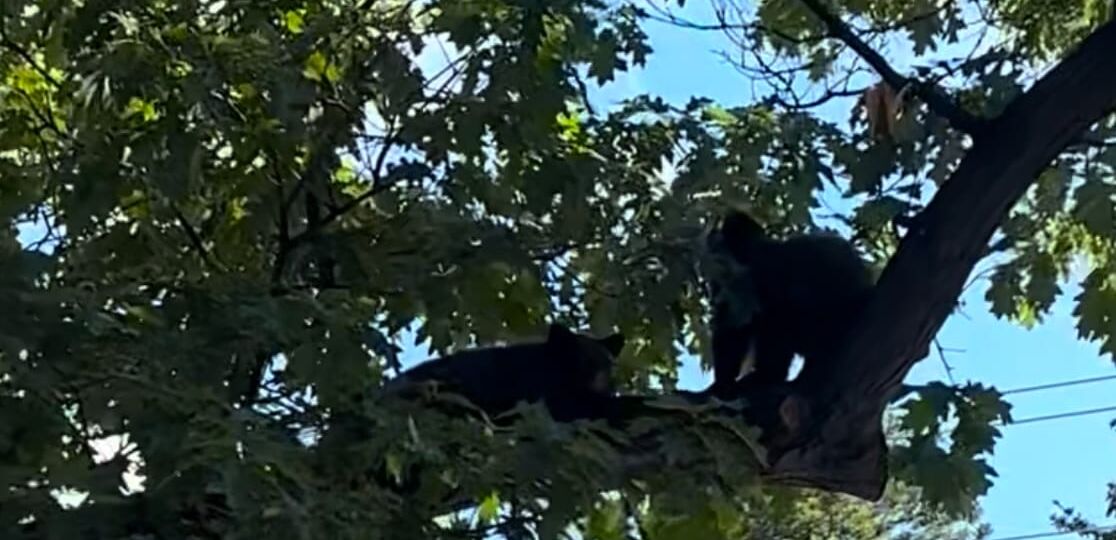
Two bear cubs hang out in a tree while their mother calls from a nearby tree on Sept. 8, 2026, in Boulder, Colorado. (Photo by Maggie Kelly)
Hungry bears head for The Hill as the number of Colorado sightings near a record
Hannah Howell saw two dark eyes reflecting in her headlights.
“I think that was a bear,” the CU Boulder senior remembers thinking as she turned her car around that July evening near Columbia Cemetery on Ninth Street.
She watched the bear sit and stare back before it rounded the corner into a nearby backyard, disappearing from Howell’s view.
Boulder is known for its mountain views and proximity to wildlife. But dry conditions across Colorado, reduced snowpack and a late freeze in May depleted bears’ natural food sources, forcing them to go into residential areas in search of alternative options. Boulder also happens to be particularly tasty due to legacy fruit trees.
From the start of 2026 to Aug. 31, Colorado Parks and Wildlife received 8,672 bear sightings and conflict reports — up 135% from the same time period in 2025. Colorado is on pace to break the record for the most bear reports since the tracking program began in 2019.
“We’ve seen a depletion and a scarcity of the things that bears should be eating in the wild,” CPW public information officer Kara VanHoose said. “They still need to eat, and they are coming into neighborhoods and suburban and urban areas looking for any sort of food source, and for them, that’s our trash.”

Trash cans are lined up for pickup at 28th Street and Arapahoe Avenue on Sept. 9, 2026. (Photo by Peighton Lemp)
Howell has been more aware of her surroundings since her encounter, knowing black bears are usually calm, but that caution is still necessary.
“My friend lives on Ninth and Arapahoe and sometimes I will drive over there at night and see a trash can knocked over and I will question, ‘Was that a bear?'” Howell said.
In late summer, bears enter hyperphagia, a state of extreme hunger as they build fat reserves for the upcoming winter.
The Hill is a predominantly student residential neighborhood that sits between campus and the Flatirons, containing two primary bear attractants: unsecured trash and unharvested fruit in yards.
When settlers arrived in the Boulder Valley more than a century ago, they planted fruit orchards. Today, these trees remain throughout the city, providing an accessible food source for bears.
“Once they know where they can get an easy meal, they’re going to keep coming back,” said Melanie Hill, the executive director at the nonprofit Community Fruit Rescue, which organizes fruit harvests, collects donations and redistributes the fruit to the local food banks or farms.
Bears do not naturally seek human interaction, according to VanHoose. However, when bears access trash or other unnatural food sources, they associate people with food and lose their fear of humans, increasing the likelihood of conflict.
According to Colorado Parks and Wildlife website, habituated bears are frequently euthanized due to their comfort around humans.
Human intervention often creates additional problems during seasons with food shortages, said Brenda Lee, founder and president of the Boulder Bear Coalition.
“Let nature do what it’s meant to do,” Lee said. “As painful as it is to not do that, it’s important we don’t because we would end up causing a bigger problem.”
Local law enforcement urges residents to take preemptive steps rather than waiting for an animal to appear on their porch.
“A little bit of proactivity is better than any reactivity, and I think just being aware and being safe,” said Jennie Whittle, an animal protection supervisor with the Boulder Police Department.
Bears frequently pass through Avery Grim’s back alley on the Hill, prompting her and her roommates to keep their trash inside the garage until collection day.
“My roommates and I ensure that our trash is always put away properly and shut to prevent them from getting into cans,” the CU Boulder senior said.
VanHoose and the parks wildlife department suggest doing what Grim does as one of the simple steps that people can take to prevent bear encounters as well as:
— Clean grills after every use.
— Lock house and car doors, especially at night.
— Take down bird feeders.
If you encounter a bear at close range, wildlife officials advise that you slowly back away, raise your arms to appear larger and make loud noises to deter the animal.