Why CU Boulder students should care about the RTD election
By William Flockton
Podcast TRT 6:17
TRANSCRIPT
William Flockton, Reporter: Do you take the bus to school? How about when you go to work, pick up groceries or go to see a concert? Students at the University of Colorado Boulder without a car may find themselves reliant on Boulder’s local transit system. Those local routes now see a chance of having their funding cut and their service ending.
Reporter: Welcome to the podcast. I’m William Flockton. On the show today, the upcoming election for the RTD Director of District O, and how CU Boulder students may be impacted.
Gracie Garcia, CU Boulder student: I use the bus like three times every single day. The Skip I take almost exclusively to work. I’ll take the 225 sometimes if the Skip isn’t available. I’ll take the Bound to the grocery store.
Reporter: That was just Gracie Garcia, a junior at CU Boulder studying political science and history. Until the spring 2026 semester, she was reliant on using RTD to get around Boulder.
Garcia: I didn’t have a car for a really long time, and then Uber is really expensive in Boulder, and the bus is free for students. And then B-Cycle, you know, Boulder, it has some harsh weather sometimes, especially in the winter, and the buses are heated.
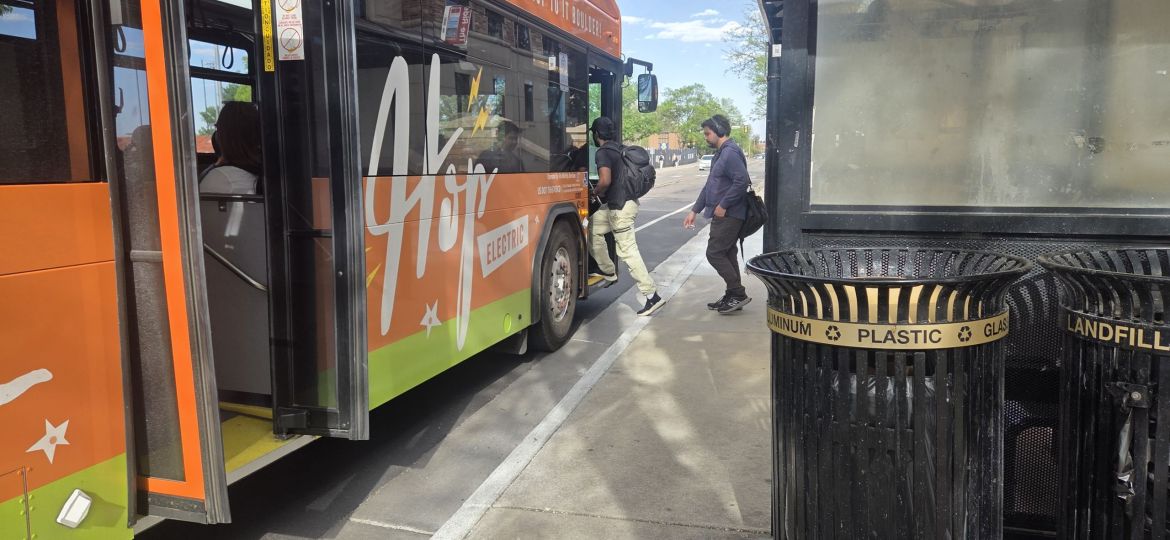
Reporter: CU Boulder students without cars find themselves reliant on the RTD bus system when traveling long distances or in bad weather. While these students might know their local bus routes—such as the Skip, the Hop and the Bound—they might not know how the upcoming November general election could change how they navigate through Boulder.
Reporter: According to Audrey DeBarros, the executive director at Commuting Solutions, a non-profit group that advocates for more accessible transportation, some people don’t even know who manages their public transit.
Audrey DeBarros, Candidate for RTD Board: I’d like to call it a hidden gem in a way. You know, people, from what I understand, don’t necessarily know the role of the RTD Board and that it’s an elected position.
Reporter: The Regional Transportation District is a public agency that provides public transit to several Colorado counties, including Boulder. The agency is run by the RTD Board of Directors, fifteen publicly elected officials who represent districts in RTD’s service area, each district being home to around 250,000 people. The board is responsible for approving RTD’s annual budget, creating policies for the agency, hiring management such as RTD’s CEO and listening to public feedback.
Reporter: This November, the position for the Director of District O on the RTD Board, who represents most of Boulder County, will be up on the general election ballot.
DeBarros: It’s just important to have a voice at the regional table so that we are making sure that the policies and funding align with the priority of our region and that we’re at the table to co-create what transit looks like in the Denver region. So, improving projects that potentially are directly in our region, so enhancing or making changes to service in our area.
Reporter: Lynn Guissinger has represented District O for the past eight years: a total of two terms, each lasting four years. However, as the RTD Board as a two-term limit, the position is open, and two Boulder residents have thrown their hat into the ring: DeBarros, and software engineer Jack Rosenthal.
Jack Rosenthal, Candidate for RTD Board: Honestly never thought I would run for anything in my life. Never considered myself as somebody who would want to do that. I am somebody who rides RTD everywhere, every day, that is just how I get around, and I depend on RTD myself. And, as anybody who depends on RTD would tell you, things have gotten a little worse from where they used to be, and I’ve been wanting to see some change.
Reporter: A main concern for CU Boulder students is RTD’s finances.
Rosenthal: RTD has a really tough financial future outlook. RTD’s cost of operating service, and this is actually nationwide, cost of operating service, just goes up and up every single year. It’s outpacing inflation. And so every single year it costs more and more to operate service. Especially right now, the cost of fuel has gone up too. Like, there’s all these things that are out of their control that has really driven up costs.
Reporter: Further strain is also placed on RTD’s finances from its age.
DeBarros: RTD has a system that is getting older. The system costs about $6 billion dollars, and 50% of the system is depreciated, meaning that it’s getting old. It’s 30 years old in some parts of the Denver metro area, and so the cost to maintain the system is getting more and more expensive.
Reporter: Which means RTD will have to make some hard decisions about what it can afford.
DeBarros: The region is coming together to look at a transit vision for the future, and they’re developing a five-year service plan as a part of that and then concurrently their budget is in a world of hurt right now.
Reporter: Rosenthal predicts that in the worst-case scenario, these cuts could fundamentally change how people are able to get around Boulder.
Rosenthal: There’s a $215 million dollar hole in RTD’s budget for 2027; and it looks like, based on our financial forecast, that we’re going to have a similar hole for the next few years down the road.
Rosenthal: I think if we don’t figure out a new permanent source of revenue, you know, by 2031-ish, sort of, it would be pretty major service cuts. I would say almost all local service would probably end up cut and that RTD would look like a more regional network.
Reporter: This means that local bus service that Boulder residents and CU students rely on like the Skip and Dash would be cut. While the Hop might remain, as it is co-funded by RTD, CU Boulder and the city of Boulder, the latter two might need to figure out how to make up for the lack of funds the bus system would lose if RTD could no longer fund it.
Reporter: However, DeBarros is quick to remind that RTD has yet to make a plan.
DeBarros: We don’t know. Those conversations haven’t started yet, but they will be coming.
DeBarros: Student voices matter because students are a main audience in the city of Boulder for how they want to get around locally and regionally.
Reporter: RTD has given Boulder students a way to access transportation without having to bring their car to campus or even have a car at all. However, with the agency’s finances, it’s uncertain if Boulder’s local routes will be placed on the chopping block.
Reporter: Thank you for listening, I’m William Flockton.