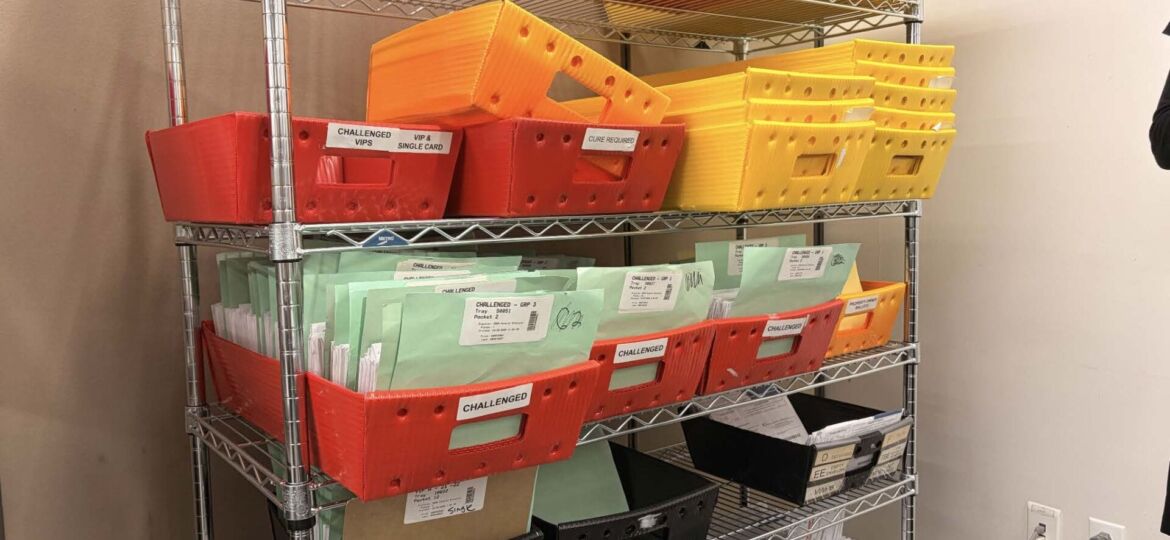
The ballots in red boxes have been challenged and are waiting to be cured at the Boulder County Ballot Processing Center just before Nov. 3, 2026. (Photo by Ainsley Coogan)
Ballot curing ends this week in Boulder County
The voting process doesn’t end after ballots are delivered. Sometimes, voter signatures need to be reverified before the vote is counted.
Ballot processing offices use a system called ballot curing to give the opportunity for voters to fix any discrepancies with signatures for up to eight days after the election — Nov. 12 for the just-passed midterm.
Ballots are flagged when signature verification workers cannot confirm that the signature matches signatures already on file for each voter, or when a voter does not sign their ballot. If a voter with a curable ballot is registered on BallotTrax, a free service for Colorado voters which sends ballot status updates to voters, they will be notified immediately.
Molly Halsey, a manager for Boulder County’s ballot processing center, said that each ballot gets looked at by a human judge. By the time a ballot is rejected, or flagged, at least three judges have seen the ballot.
“At the end of the election, they have until eight days after the election to cure,” she said. “If after that point they haven’t fixed their ballot, we have a bunch of ballots left over in those red trays. I send all of those to the district attorney.”
The curing process is simple. Voters are sent a form where they can mark if they personally signed and sent their ballot, as well as send in a photocopy of a photo ID. Once a ballot has been cured, it is accepted and counted.
If a ballot is not cured by the end of the eight-day period, or if the voter marked that they were not the person to sign and send their own ballot, it is sent to the district attorney. The district attorney then investigates if voter fraud impacted those ballots to have never been cured.
Most often, the DA is educating a person who improperly signed for another, like a parent signing for a student at college in another state. At the end of an election, anywhere from 800 to 2,000 names are sent to the DA to call.
“He’s probably not gonna arrest your mom for a felony for voter fraud, but he’s gonna have a conversation to say this is not allowed,” Halsey said.
Nationally, voter fraud is very rare. In the 2020 election, The Associated Press found only 475 potential cases of voter fraud out of 25 million votes cast in six swing states.
Molly Fitzpatrick, the clerk and recorder for Boulder County, explained that signature verification can disproportionately impact younger voters because there are not many signatures on file to be used in the verification process. Two months ago, the office mailed all voters under the age of 25 in Boulder County a letter requesting more signatures.
“We got about 800 responses to that letter, so we were pleased with that, and so hopefully that’ll bring the number down a little bit,” Fitzpatrick said.
Halsey said that young voters can also help mitigate the need for the curing process by providing a good signature when registering to vote. Additionally, responding to the cure notice provides another signature, which can help the signature verification process in the future.
“First time you vote, try to remember how you signed that time and do it as consistently as possible,” she said.
Corinne Steinbrenner, a voter from Erie, attended a Boulder County ballot processing center tour. She said she was encouraged by the security with the ballots.
“They’re counting continuously, they’re reconciling the numbers, they’re always having somebody else check to see if the accuracy of it, and I think that’s reassuring,” she said.