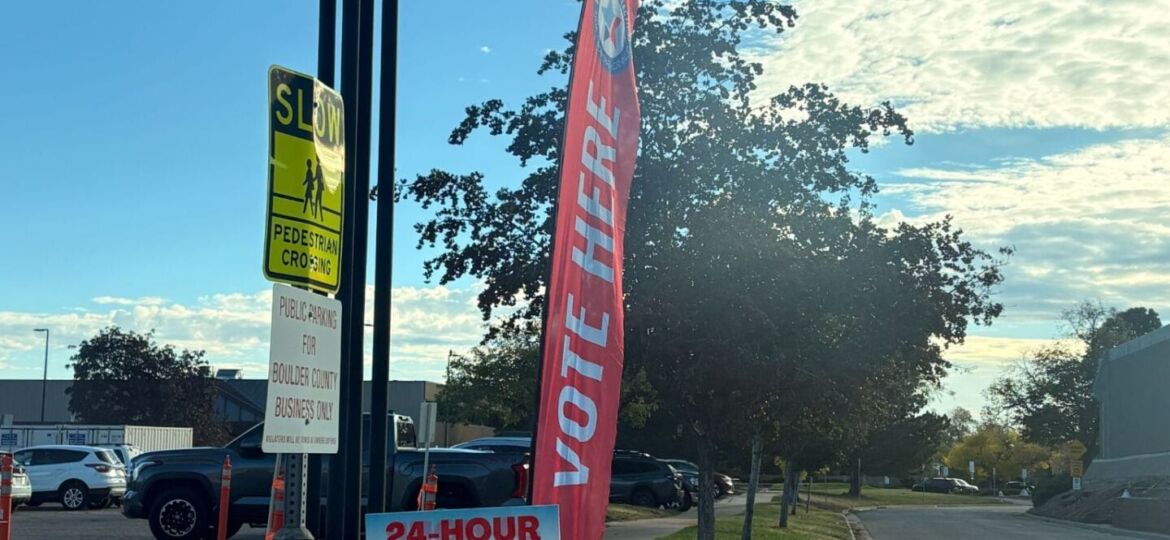
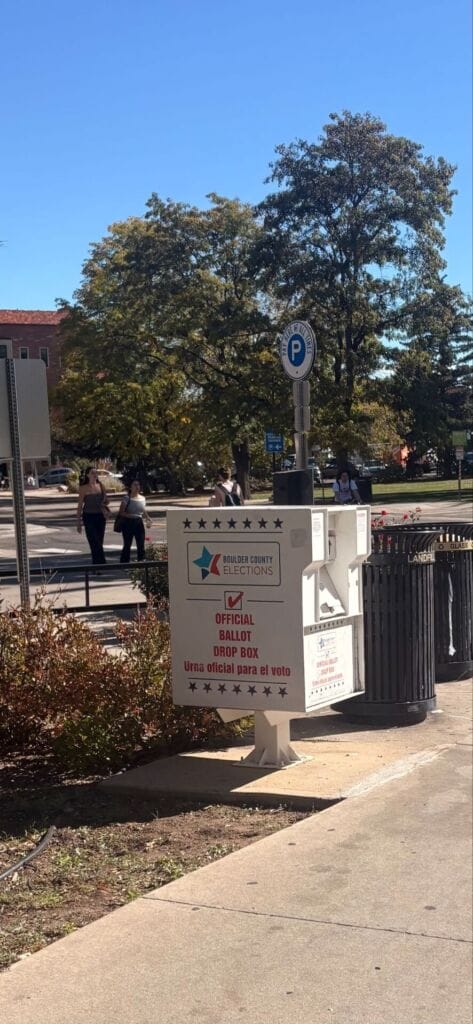
Signs point people to the voting center and drop box at the Boulder County Clerk and Recorder’s main office in Boulder. (Photo by Carly Malamut)
Government transparency emerges as key issue in Boulder city council race
In the upcoming Boulder City Council election, government transparency and accountability have become leading themes.
With 13 candidates running for five open seats, each has developed their own approach and goals to combat distrust in Boulder’s government, from establishing independent auditor committees to improving communication between council members and the community.
Tina Marquis, an incumbent running for her fourth consecutive term, believes that the biggest source of distrust in the Boulder community is fiscal sustainability, meaning the government’s ability to maintain its spending.
“One of the big changes I want to make is to create a capital infrastructure advisory panel that includes community members when we’re looking at our infrastructure priorities,” Marquis said.
She also suggested implementing an audit committee that would give the community external access to evaluate the council’s progress and decisions. While the council has an internal auditor, she acknowledges that the information isn’t accessible to the public.
“It’ll be a way for people to get a deeper understanding of how our programs are performing,” Marquis said.
Similarly, first-time candidate Scott Rendleman believes that an independent monitor will help the community understand the inner workings of the city government and evaluate its progress.
“The residents and the citizens of Boulder will be able to say there is evidence here that we’re doing things right, and then there’s also evidence that we need to improve, and we should follow that,” Rendleman said. “That would help residents know what we’re doing well and what needs improvement.”
In addition to implementing an auditor committee, various candidates find that accessible information is crucial to building community trust.
Jamillah Richmond, running for her first election, said making information readily available and accessible to the community is crucial to achieving government transparency and establishing trust. She notes that many decisions are made outside public view and believes meaningful community engagement is key to improving transparency.
“I want to model what I’m asking the city to do, and I want us to have our own talking sessions, our own design sessions as community members, and let that help inform the decisions that we make when I walk into those spaces (council chambers),” Richmond said.
Dave Martus, also a first-time candidate, is running on a platform that includes increasing trust in government and believes starting earlier is the best way to make residents feel more involved and heard in local government.
Quoting council member Matt Benjamin from the Oct. 1 city council meeting, Martus said “the dialogue has to happen earlier in the process.”
While the city council is responsible for improving its relationship with the Boulder community, University of Colorado Boulder student government representative-at-large Sophie Hoffmann believes the community is also responsible for bridging the gap between the government and the general public.
“I think that the people should really be trying to read through this stuff and inform themselves and reach out, so that everybody can make sure that their voice is heard,” Hoffmann said.
She also notes that community conversation is an increasingly difficult but important aspect of government responsibility.
“One of the biggest hurdles in that is finding a way to actually get information out to people,” Hoffmann said. “The people in these positions need to request input from their citizens, and then the citizens need to also be willing to put in a little bit of work to make their voices heard.
Richmond also emphasizes the importance of disagreement in conversation, highlighting that ignoring people because they disagree is problematic.
“It’s not actually how we are supposed to govern,” Richmond said. “I think there’s value in the diversity in how we think and how we (find solutions). So I would not shut out people I disagree with. I would welcome them in, and talk through it.”
Marquis maintains a similar approach.
“I very specifically meet with people who disagree with me, so that I can understand that perspective and make sure that I’m at least thinking about it when I’m thinking about how I’m going to vote on an issue,” Marquis said. “The best policy is made when you listen to people who think differently than you do.”
Affordability has also emerged as a key issue in the election, intersecting with concerns about government transparency.
Focusing on the $400 million bond recreation and safety bond that would “pay for the city’s backlog of unfunded building maintenance,” as described in the City of Boulder guide, Rendleman said it’s an example of the city getting ahead and not listening to its residents.
“City council needs to be the first step in listening to the residents,” Rendleman said.
Richmond noted community members and businesses are struggling to afford things, and that the council needs to create “opportunities for the people who are being adversely impacted by the decisions to be actively engaged and involved with what decision-making looks like.”
As the election approaches, Hoffmann emphasizes the importance of voting and educating yourself on the election.
“I think people should definitely do their research before voting, and not necessarily just listen to what the people around them are saying,” Hoffmann said. “… otherwise it feels like people are just voting based on what’s popular and what’s cool, whereas people should be voting based on what they themselves actually believe and what the candidate has demonstrated.”