A scarecrow perched besides the sign for Boulder County Water Resource Recovery Facility on Oct. 14, 2026, in Boulder, Colorado. (Photo by Maggie Kelly)
Data centers can save water and still leave environmental footprints
By Maggie Kelly
Municipal departments like Aurora Water and the Boulder County Community Planning and Permitting Department are working to protect communities from resource scarcity as data centers emerge along the Front Range. The rapid expansion has left residents uncertain about how facilities might affect them, raising concerns over water demand, noise pollution and surging utility rates.
Chase Poulin, an undergraduate student at the University of Colorado Boulder, who’s an avid skier, said the facilities have quickly become a frequent conversation topic because of the dry winter Colorado had last year.
“I am most concerned about how much water data centers use,” Poulin said.
To combat climate uncertainties, like data center water consumption, new land-use codes and regulations are being implemented across the state. Across the Front Range, where 66 data centers are already operating, according to the data center map, cities and counties are updating land-use regulations to prevent new developments from draining municipal water supplies and overloading the grid.
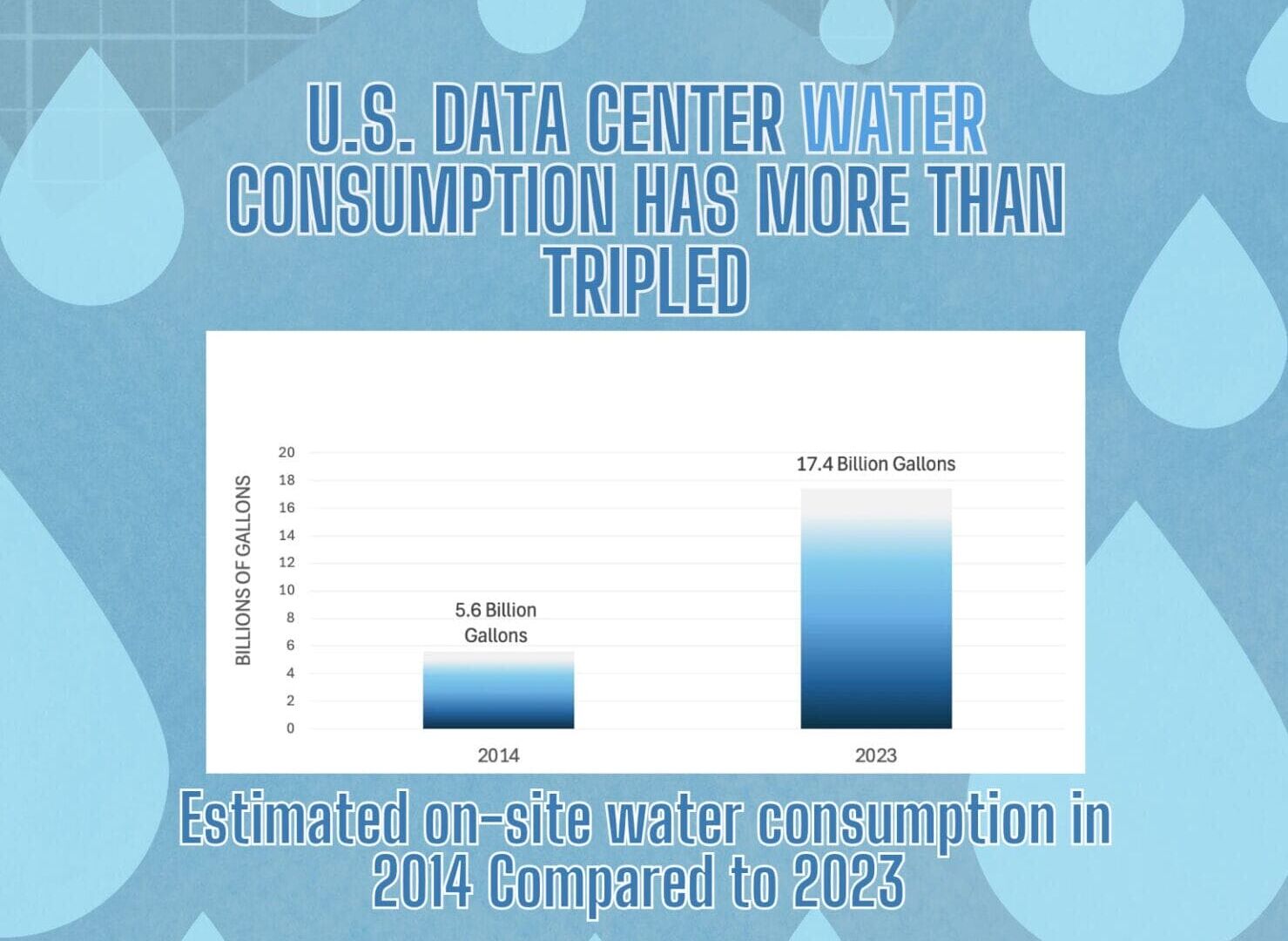
On Sept. 14, the city of Aurora passed an ordinance that bans evaporative cooling systems in new industrial or commercial developments, including data centers. Meanwhile, Boulder County enacted a six-month moratorium on new data center applications to draft land-use regulations specifically tailored to unincorporated areas outside of city limits.
Aurora has addressed water resource concerns through its cooling ban, but Boulder County’s proposed amendments expose other problems. Cutting water usage doesn’t eliminate the natural resource demand; it shifts it to electricity instead. Local officials were left to weigh the options between strained power grids and dwindling Western water supplies.
Evaporative cooling systems use minimal electricity, pulling heat from servers into water that then evaporates into the atmosphere to cool the facility.
“Evaporative cooling does use a lot of water, and it is fully consumed because it’s evaporated,” said Shonnie Cline, a deputy director of water internal and external relations.
Prohibiting these cooling systems in new developments will reduce on-site water consumption, protecting the city’s overall supply. Since evaporated water cannot be captured, treated or returned to the municipal system, Cline explained Aurora’s primary concern is not the volume of water used, but the volume permanently lost.
The ability to recycle water and keep it in the water supply is important in a dry region like the West. According to PBS, water is a dwindling resource in Colorado River Basin states where the river deposits snowmelt across the region. Last winter, according to the Colorado Virtual Library, the state faced its worst snowpack on record, reducing the amount of water deposited into the Colorado River and compounding regional water shortages.
The scarcity drive Aurora’s mandate requiring new developments to install closed-loop systems. In closed-loop systems, water circulates repeatedly, limiting the amount that is carried away from the facility. Pairing closed-loop cooling with dry cooling, which is using air to cool down water without evaporating it, will reduce water use because it recycles it, according to the Federal Energy Management Program.
However, reducing on-site water usage does not necessarily curtail a data center’s environmental impact. Closed-loop cooling systems may use less water, but that means the power to cool must be generated another way: through electricity. The closed-loop circulates liquid to absorb the heat, which is then dispersed into the air by high-powered electric fans.
Cooling system fans also drive power demand. The demand fluctuates based on outside temperatures and how the system’s designed. According to KSL, an NBC-affiliated news outlet based in Salt Lake City, Utah, its cool power demand is lower but surges when temperatures rise. These cooling systems are powered through electricity, which can be generated by natural gas and coal power plants that consume vast amounts of water.
Reducing on-site water use does not eliminate a data center’s broader need of resources. Chelsea Benjamin, a policy advisor for Western Resource Advocates, said an energy grid’s power source matters when evaluating cooling system effects.
“If electricity used to power a data center comes from fossil fuel-powered power plants, the water use will be shifted to the power plants instead of on-site water cooling at the facility,” Benjamin said.
Benjamin said citizens can ask for improved power usage effectiveness from data center developers to monitor their environmental impact. She also said transitioning toward renewable energy generation is a crucial way to reduce the water demand of these facilities. Using solar or wind power, electricity could be generated without using massive amounts of water for cooling.
Different from Aurora’s focus on direct water use, Boulder County is tackling the issue through land-use caps and electricity limits. Under its six-month moratorium on commercial facilities, county officials are overhauling land-use policies to align data center developments with local climate goals.
County planners drafted two amendments to the land-use codes for regulating data centers in unincorporated areas. Both proposals would prohibit facilities with an electrical demand exceeding 75 kilowatts — a threshold county planners equate to the daily power needs of roughly 2.5 households.
Neither of Boulder’s proposed data center regulations uses language that directly addresses water usage; instead, the focus is on size and energy. Ethan Abner, a planner with the Boulder County Community Planning & Permitting Department, said the measures are still early drafts subject to revision after public feedback. The county Planning Commission is scheduled to review the proposals at an Oct. 21 public hearing, which remain subject to change following public comment.
Abner said the threshold has been introduced to define the difference between a small server room and a data center. Planners selected the 75 kW limit because crossing the capacity threshold reclassifies a facility from a standard commercial server room to a regulated data center.
While the draft codes do not explicitly restrict water use — leaving developers technically free to use evaporative cooling — planners weighed overall resource strains during drafting. Abner said that if concerns were to arise, one of the drafted options would require a Limited Impact Special Use Review. This review would require officials to evaluate a facility proposal and hold a public hearing before approval.
“Then staff could put conditions in place that seek to mitigate those concerns,” Abner said.
Boulder County’s plan still addresses water concerns through a size limit, and if the one draft is adopted, it would allow for special review and public intervention before approval.
While Aurora chose to target water consumption directly through cooling system bans, Boulder County is proposing size and power thresholds to manage resource strain. With dozens of new facilities proposed across Colorado, other Front Range communities are watching Aurora and Boulder County to see whether land-use limits or water bans are more effective at keeping utilities from falling short.