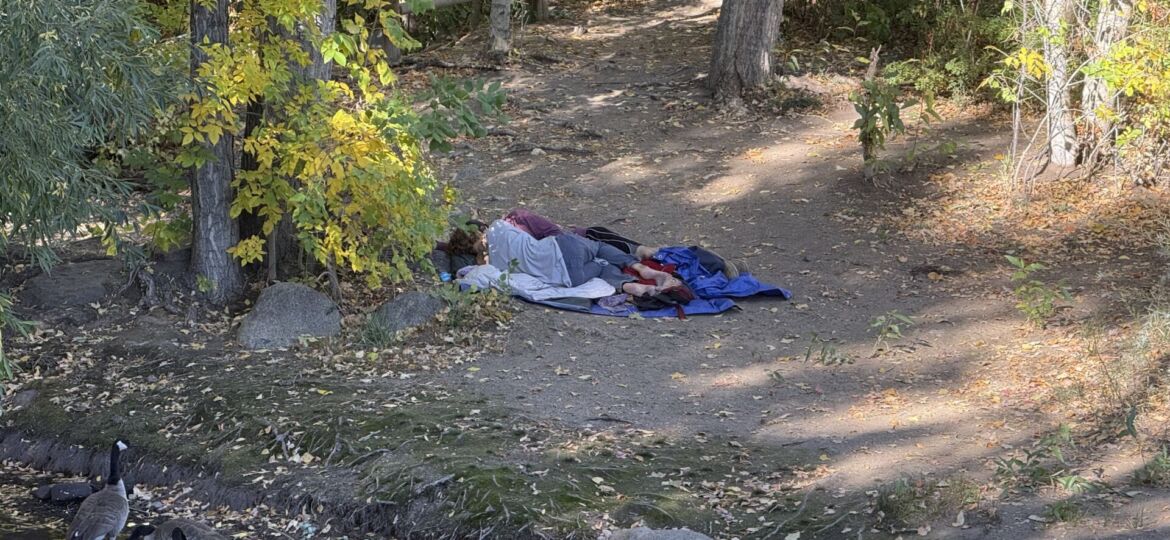
Two individuals experiencing homelessness sleep by Boulder Creek in the heat of the morning on Oct. 12, 2026. (Photo by Ellie Chase)
Extreme temperatures threaten people experiencing homelessness in Boulder
Victoria B. has been experiencing homelessness for over a decade. Colorado’s hottest summer ever recorded didn’t help.
Victoria B., who identified herself only by her first name and last initial, found herself walking more than two miles to the nearest store in this summer’s sweltering heat, trying to stay hydrated enough to continue.
Now, an unpredictable winter is on its way.
“I trust that God is not going to let me freeze to death this winter,” she said. “I don’t know how it’s going to work out.”
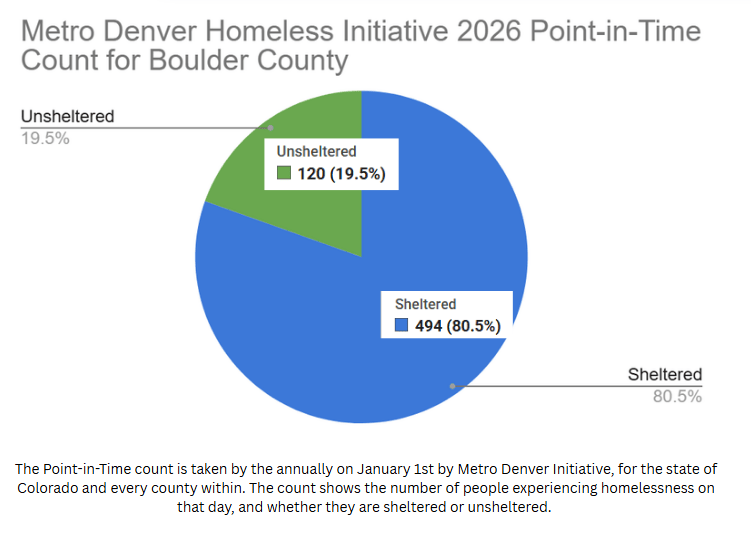
Victoria B. is one of 614 people estimated to be experiencing homelessness in Boulder County, according to the Metro Denver Homeless Initiative 2026 point-in-time count. In September alone, 58 individuals were admitted into the countywide homelessness service system, according to Boulder County data.
Record-breaking heat, declining air quality drought and declining snowpack are impacting all Colorado residents — but none more severely than those without shelter, according to Andy Schultheiss, the chief development and communications officer at All Roads shelter in Boulder.
“Bad weather can become a life-or-death crisis for them,” Schultheiss said.
All Roads is a housing-focused nonprofit seeking to end homelessness in Boulder. It is also the city’s primary emergency shelter. It has been a night-only shelter for 40 years, but in the last two years transitioned to all-day services due to demand in the summer heat.
And the shelter’s No. 1 priority when seeking donations isn’t food or warm clothing . It’s sunscreen, Schultheiss said.
“There’s a kind of nightmarish future in which homelessness has greatly increased because of climate change, and the effects on people who are already living homeless is much greater,” Schultheiss said.
While the summer’s heat has subsided, the looming threat of winter conditions and heavy snow remains.
Forecasters say this winter’s patterns could be shaped by a strong El Niño event, driven by unusually warm Pacific Ocean temperatures. While this anomaly is a natural phenomenon, scientists note that the intensity of this event likely stems from human-caused climate change.
The National Oceanic and Atmospheric Administration predicts a 90% chance of very strong weather during the northern hemisphere’s fall and winter, raising the likelihood of erratic winter weather and heavy precipitation across parts of Colorado.
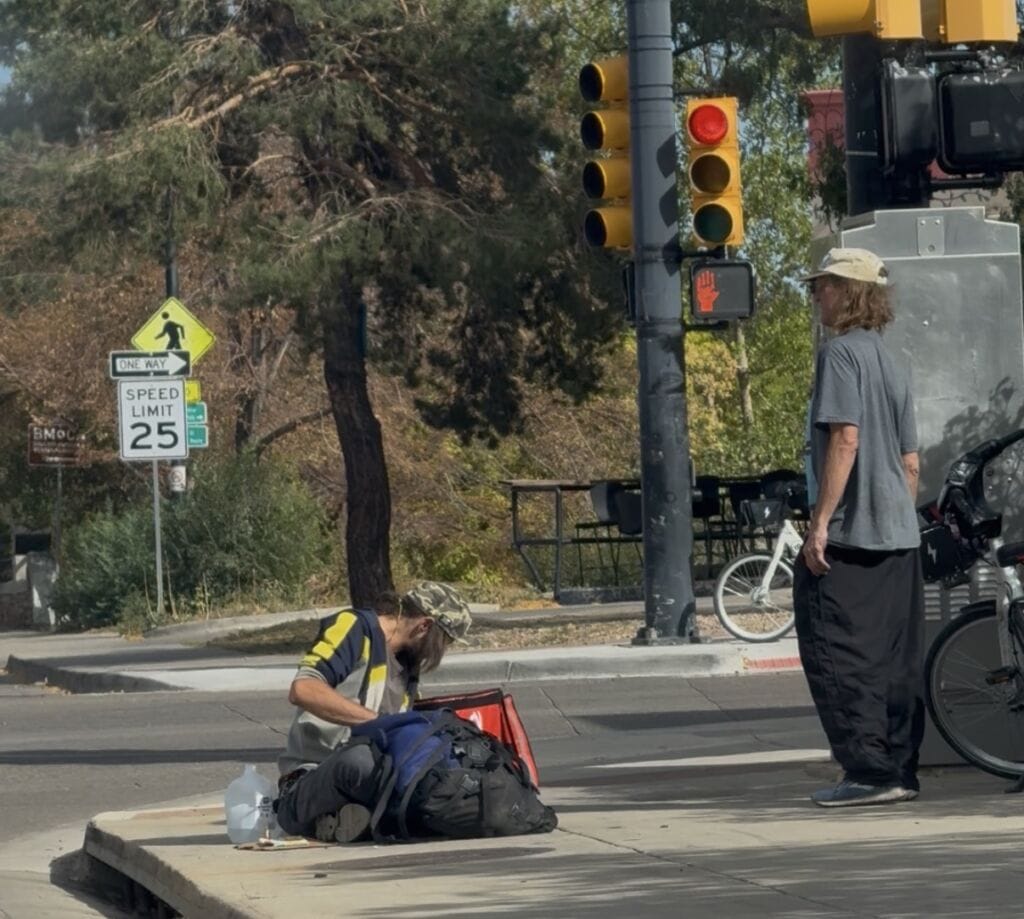
For people living outside in Boulder, that erratic forecast carries immediate physical consequences.
Adam Walker has spent multiple winters outdoors and has witnessed first-hand the challenges that unsheltered individuals face.
“Some people aren’t as prepared and don’t know how to best take care of themselves in extreme temperatures,” Walker said.
Walker works for Unity Table, a small organization that serves free hot meals five days a week at local churches for people in need.
Fifteen years ago, Walker made the decision to voluntarily live outdoors — an experience that has informed his understanding of the physical hardships that people experiencing homelessness face.
“I know a guy that lost some toes. But a big part of that is he wasn’t taking care of himself properly. It didn’t have to come to that,” Walker said.
Public health researchers describe these survival barriers as a lack of adaptive capacity — the resources, shelter, and support systems a group needs to adjust to extreme weather events. This concept, detailed in a study from the International Journal of Environmental Research and Public Health, is defined as “a community’s ability to adapt in response to a changing climate.”
As climate change accelerates, extreme temperature swings hit vulnerable groups hardest. The study notes that people experiencing homelessness face higher rates of chronic health conditions, leaving them “especially vulnerable to the effects of severe weather and increasing their risks of infections and disease.”
People living unsheltered face immediate exposure to extreme heat, cold, and severe storms with few structural resources to protect themselves.
The city of Boulder outlined goals in its 2025 Homelessness Strategy Update. One of these goals is to “create welcoming and safe public spaces” — a resource Victoria B. relied on this summer. Law enforcement has also developed a Homeless Outreach Team to help individuals experiencing homelessness engage with resources and normalize police presence in unsheltered communities.
Officer Keith Steinman, a member of the Homeless Outreach Team, said calls associated with heat-related illnesses increased this year.
“When you’re sleeping in a tent or just a sleeping bag, you have to find some shade and drink plenty of water,” Steinman said. “We’ve had heat-related incidents where people were just dehydrated and didn’t know what was happening because it’s the first time they’ve been dehydrated like that.”
Boulder’s police officers carry bottled water and granola bars during summer heat waves, and shift to hand warmers and winter boots to assist unsheltered individuals in extreme winter temperatures. They also provide transportation to shelters and health care providers, Steinman said.
While B. has used these temporary support systems in Boulder, securing permanent shelter remains her primary focus before temperatures drop.
“In some ways I feel supported. I moved up here and within two weeks, I’ve got five case managers, and I’m connected with LGBT resources specifically,” B. said. “I hope that by God’s good grace, I run into somebody who can get me into some kind of Section 8 housing before winter.”