
TikToker Nuno lists several peptides he considers “the best” for building an aesthetic physique in this screenshot from October 2026. (Screenshot by Savy Behr)
Gray market peptides promise quick results, but how much do we really know?
By Savy Behr
Peptide injections allegedly help you tan, lose weight, build muscle or recover quickly from workouts.
But the peptide space is unregulated, so what do we really know about the substances behind those claims?
What are peptides, and which are FDA-approved?
Peptides are short chains of amino acids that naturally occur in the body and play roles in processes ranging from metabolism to pain regulation. Lab-synthesized peptides can mimic or alter these biological processes when introduced into the body.
However, many of the specific peptides promoted online have not been approved by the U.S. Food and Drug Administration as drugs for human use.
Specific peptide-based medications, including certain GLP-1 drugs, are FDA-approved and have undergone clinical testing for their safety and effectiveness.
Others are referred to as “gray-market” peptides, which are not illegal to make or own but are also not subject to the quality controls of FDA-approved drugs. Gray-market is not an official FDA category; it’s a common descriptive term for substances in a legal gray area.
Some of the most popular gray-market peptides are retatrutide, ipamorelin, melanotan II and semax. People use them for several purposes, including weight loss, anti-aging efforts and cognitive enhancement. All four have safety concerns.
“You’re in the wild west with these compounds because you don’t know what you’re getting, and people are trusting the claims that are made online,” said Shireen Banerji, director of Denver Health’s Rocky Mountain Poison Control Center.
From social media trend to “gray market” product
Several public figures have advocated for the use of peptides.
On Joe Rogan’s podcast, “The Joe Rogan Experience,” U.S. Health and Human Services Secretary Robert F. Kennedy Jr. called himself a “big fan of peptides,” and argued for looser regulations.
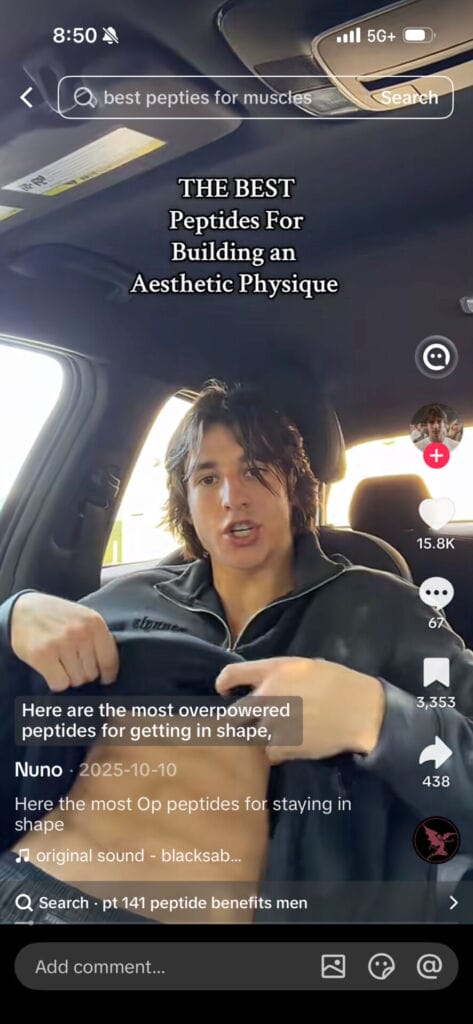
Influencers on platforms like TikTok and Instagram put out content showing muscular bodies, sharp jawlines, clear skin and tans with captions like “Peptides, that’s all babe,” or “These are the best peptides for an aesthetic physique.”
Where are peptides coming from? What are the risks?
Peptides aren’t difficult to find: People order them online from compounding pharmacies, which are specialized medical businesses that create custom prescription drugs with raw ingredients.
Those not approved to be produced by compounding pharmacies, such as melanotan II, can be found through online companies that sell research chemicals intended for laboratory use, not human consumption.
Most of the raw chemicals used to create peptides are sourced from China.
David Kroll, professor of pharmaceutical sciences at CU Anschutz, said Chinese suppliers give a certificate of analysis showing the substances are “about 98% pure.”
“That wouldn’t be good enough for the U.S. Food and Drug Administration because even a 2% contamination with something toxic could be quite damaging,” he said. “You’re relying on the supplier to give you truthful information about the purity.”
Poison-control calls point to growing exposure
There isn’t reliable data on the use of unregulated peptides. However, the Rocky Mountain Poison Control Center received two calls related to peptides in 2024. In 2026, they received 62.
“If that trend continues, that means that we are likely going to get more and more calls about these kinds of products,” Banerji said.
Google Trends also suggests a rapidly growing interest: Searches for “wolverine peptide,” referring to a popular peptide combination for muscle gain and recovery, rose from 16 in September 2025 to 100 this month.
“I think opportunistic retailers are trying to take advantage of this influencer wave, and we have a Secretary of Health and Human Services who is very permissive about unapproved drugs,” Kroll said.
Though neither the poison control center nor Google Trends specifies the ages of people making calls and searching for peptide-related terms, many of these influencers are college-aged and popular with young people.
“I haven’t had anything bad happen, no side effects or anything,” CU junior Avery Jackson said. “It’s like, if other people are using them and I’m not, I’m missing out on those benefits. They’re working for most people I know, it seems like.”
Research hasn’t caught up with demand
Banerji warns that establishing a drug’s safety and effectiveness takes years, despite how quickly peptides seem to be spreading online.
“I think it’s the adage that anything too good to be true probably is,” Banerji said.
This leaves a certain gap for consumers: Peptides may be a Google search away, but the risks and benefits remain largely unconfirmed.