

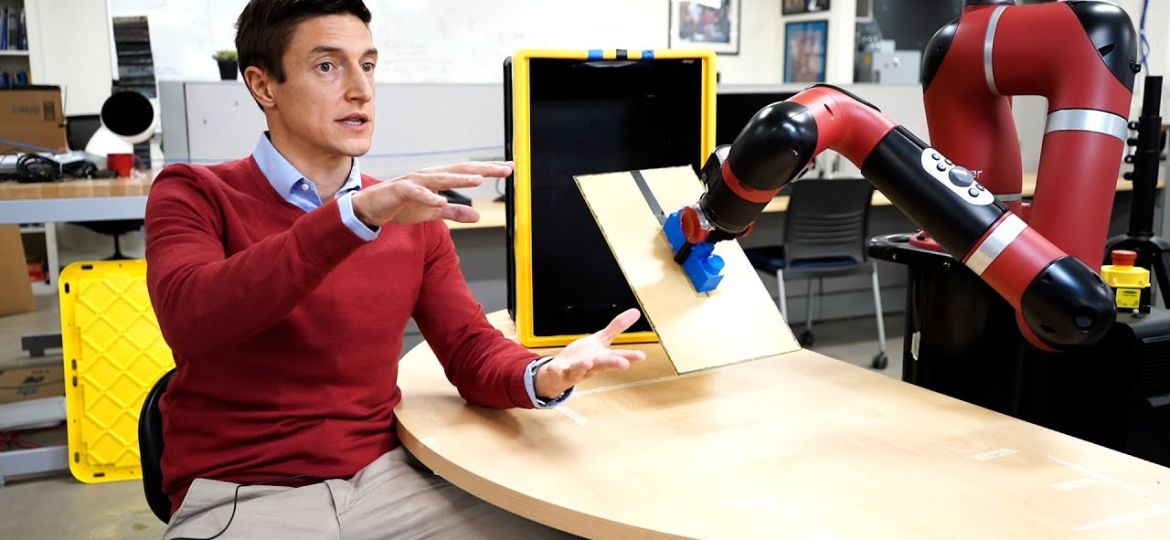
Alessandro Roncone and the Intersection of Humans and Higher Intelligence
By Teagan Bischoff
The robot didn’t spark or explode. It kept moving across the table and then suddenly crashed straight into the table as Alessandro Roncone watched. He had typed a simple command: move forward. The machine obeyed almost perfectly.
“And the first thing I did was to break its arm,” he said.
The wrist joint broke, a mistake that cost $50,000. For some researchers, that moment might have been a career nightmare.
“I am a strong believer on the philosophy of learning through mistakes,” he said.
As artificial intelligence rapidly moves from research labs into daily life, researchers like Roncone are shaping how humans will coexist with intelligent machines. As an assistant professor of robotics and computer science at the University of Colorado Boulder, he studies robots, artificial intelligence and human-robot interaction.
“It’s not about replacing human capabilities,” he said. “It’s more about augmenting them.”
That belief defines his work. While much of the tech world pursues autonomy, Roncone focuses on cooperation. His research centers around how robots interpret human movement and respond to uncertainty. In his view, intelligence alone isn’t enough. Machines must also understand the person beside them.
“We are extremely good at interacting socially with other people,” he said. “Robots are extremely bad interfacing with the technology that is similar to us.”
That disconnect creates tension. People instinctively expect intuition from anything humanlike. When machines fall short, even slightly, discomfort follows.
“There is this expectation gap in terms of what the public expects from these technologies,” he said. “People tend to expect that these systems are better than they are.”
Originally from Italy, Roncone grew up playing water polo and comes from an athletic background. He is now a father of three, balancing academic life with family while continuing to run regularly. His interest in that gap began during his doctoral work at the Italian Institute of Technology in Genoa, Italy, where he worked closely with the iCub humanoid robot, one of the most advanced humanoid systems. He later worked as a researcher at Yale University, studying human-robot cooperation. Those experiences still shape how he teaches and runs his lab.
“What we care about is big and bold ideas,” Roncone said. “My rule of thumb is that if there’s somebody you know, if there’s another five or six labs that are working on it, we probably shouldn’t, because it’s either too crowded or too easy.”
That emphasis on curiosity and risk-taking shapes who he brings into the lab as much as the research itself.
Caleb Escobedo, a doctoral researcher who has worked with Roncone since 2019, said he was accepted largely because of his enthusiasm despite having no robotics background.
“He really took a chance on me,” Escobedo said. “I had zero experience in robotics, or anything related to this before I came in.”
Escobedo said Roncone leads one of the largest labs at CU, drawing students from around the world and encouraging independence. Instead of micromanaging, he offers high-level guidance while students run daily experiments themselves. Even after two decades in robotics, Roncone remains realistic about the field’s pace.
“The technology has not reached that level of maturity that it becomes transformative,” he said.
Students say he often compares scientific progress to endurance training, fitting for someone who is a long-distance runner himself. Rather than building machines to function alone, he structures his lab around collaboration, both human and machine.
“So our research is divided in two groups. I have a very big lab and very happy about it, and our research is divided in embodied intelligence,” he said.
One group studies embodied intelligence, the idea that real understanding comes from having a body that can move and interact with the world.
“The best and only form of intelligence, true intelligence that we have is animal and human intelligence,” Roncone said.
The second focus is social intelligence, examining how machines communicate and respond to people. Together, those tracks guide the group’s broader goal of building robots that function naturally alongside humans.
Nataliya Nechyporenko, a doctoral student who joined the lab in 2021.
“Mistakes are not a big deal, because in research, there’s no correct solution,” she said. “It’s more likely than not that things won’t work out.”
While Roncone spends his days building intelligent systems, the lessons he draws from them are surprisingly human.
“We are humans, because we are grounded in our environment,” Roncone said.
Years later, the memory of the broken robot arm still lingers, not as a failure, but as a reminder. Progress is rarely linear, perfect or immediate. Sometimes, it starts with a crash and $50,000 lesson.
Edited by Nicholas Merl

This is the second article I have read by this author and both of them have been well written and researched thoroughly.