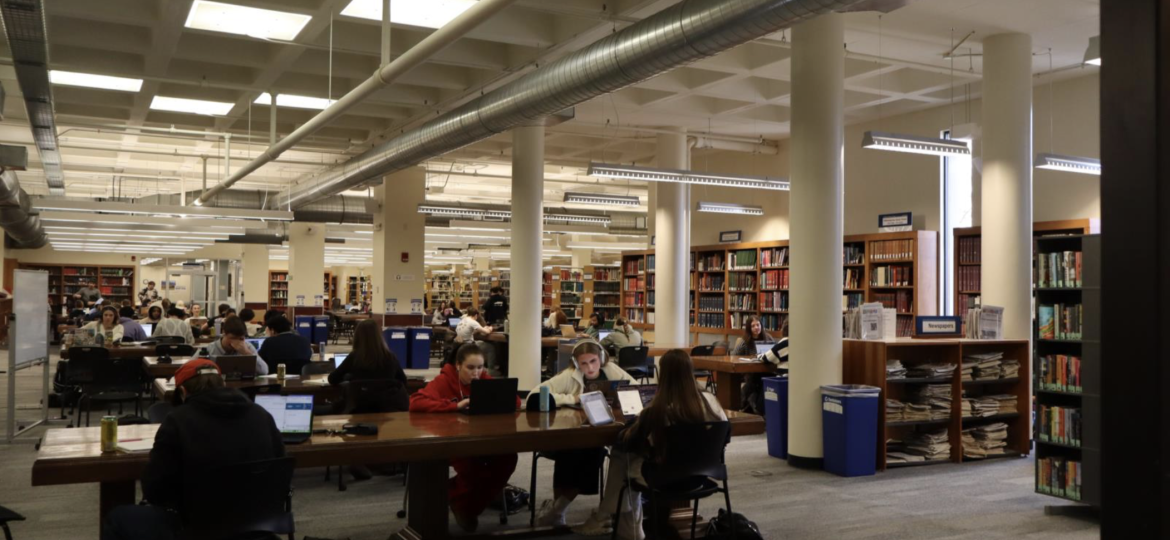
Caption: Students studying in CU Boulder’s Norlin Library on Jan. 28, 2026. (Photo by Aiyana Fragoso/The Bold)
Students unsure about new 'CU secure' Wi-Fi network
By Aiyana Fragoso
A new Wi-Fi network is in operation at the University of Colorado’s Boulder campus. But not everyone is excited about it. In order to get on the network, users have to download a security certificate, and students are not sure they can trust it.
“I didn’t want to download the certificate originally, and I heard rumors about the school’s intentions with our data,” said first-year student Claire Heron. “I’ve been using the guest network, which is more work. But I feel more secure on that one.”
Some students think that the university may be violating their privacy and tracking their AI usage.
“I’ve heard from multiple people that they now have access to your browser history, and are looking for use on ChatGPT and other AI platforms,” says second-year molecular, cellular, & developmental biology student Leila Alavi-Huskic.
Following widespread implementation of Media Access Control Address Randomization in 2024, the University of Colorado adopted a new Wi-Fi network called CU Secure. Most computers use a unique ID known as a Media Access Control address, or MAC address, to connect to the internet. This allows networks to track devices and send the right information to the right address. Recently, a growing number of tech companies have been adopting a practice called MAC Address Randomization, causing each device’s MAC address to randomize every 24 hours. While this helps protect users’ privacy, it makes it harder for networks to track and identify devices, leading to connectivity issues.
In 2024, Apple followed the trend and made MAC Address Randomization a default setting on its devices. Since UCB Wireless, the university’s previous network, was reliant on addresses remaining static, it was clear that the Office of Information Technology needed to update its practices. In order to overcome this challenge, OIT implemented a ‘certificate-based authentication system,” requiring students to download a form to authenticate for Wi-Fi access.
Orrie Gartner, associate vice chancellor of information technology, says the system was the best way for the university to resolve the issue.
“We had to identify a method to solve this problem,” Gartner says. “The certificate note is what determines whether or not you should be allowed on our network.”
Gartner explains that the certificate replaces the need for one MAC address, helping students connect to Wi-Fi faster and with less difficulty.
In fall 2025, the university introduced the new network to a select few buildings on campus, requiring students to download the certificate to access Wi-Fi. However, some students were afraid to trust the required download.
Eric Wustrow, an associate professor in the Electrical, Computer, & Electrical Engineering Department, investigated the rumors himself.
“One thing that I was concerned about was when they initially announced this and said, ‘we’re rolling out CU Secure and you have to have this certificate on your computer,'” Wustrow said. “Alarm bells in my mind go off and go, do you mean a root CA certificate? But certificates can also be used at this lower Wi-Fi level to authenticate that your computer is talking to the correct access point and that the access point knows that you are who you say you are.”
While some still are reluctant to switch to the new Wi-Fi, others are using the network. Some users report experiencing malfunctions, while others say it operates just fine.
“I really like that the new Wi-Fi works better in the Rec Center, from what I’ve noticed,” said CU freshman business major Noah Eisenberg.”During my lifts I can get better service than before. However, I have a TV in my room, and even though I registered it under CU Secure, I still can’t access it.”
The tech department has prioritized helping students with difficulties connecting to the network, according to Gartner.
“There are over 160,000 Wi-Fi devices. If you calculate how many students and staff and faculty, that’s, you’ll figure out that, wait, there’s more than one device per person,” Gartner said. “Our Gen Z student population, right? The most connected, most savvy wireless generation, perhaps, ever.”
Edited by Nicholas Merl