CU Boulder launches Safe App
By Piper George
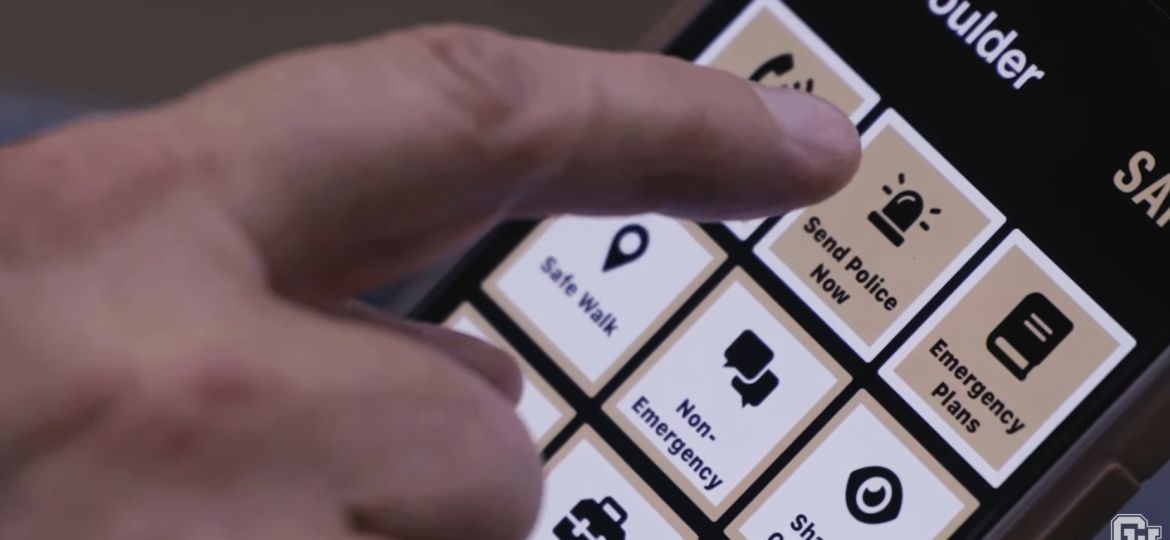
CU Boulder is putting safety at our fingertips. Now there’s one app that can do it all: call 911, find a night escort, get us to a mental health professional and more. The app is free for CU Boulder students, faculty and staff, and is now available for download on iOS and Android devices. Listen to the podcast to learn about the new phone app for accessing help on campus.
TRANSCRIPT:
Reporter: So far in the academic year, the University of Colorado Boulder has been rocked by a bomb threat and a shooting hoax. Both frightening instances resulted in concern, as emergency alerts were sent to students. In response, the university launched an app in October that provides alerts and safety resources all in one place—it’s called the CU Boulder Safe App.
Welcome to the podcast, and I’m Piper George.
The CU Boulder Safe App was developed by AppArmor, which creates custom mobile safety applications for universities, private companies, police departments and hospitals. Jack Briggs is the Assistant Vice Chancellor for Public Safety Operations at CU Boulder and worked on the app’s development.
Jack Briggs: “The CU Safe app is designed to be a tool for our students, faculty, administrators, the affiliates of the university, to enhance the safety aspects of their day. Whether that’s communication, maybe tools, being available to get alerts so that they know things that they may need to do if there was a situation that warranted that.”
Reporter: The CU Boulder Safe App introduces a range of features helpful to students. However, awareness of the new development is apparently limited. John Loehr is a senior at CU Boulder, and he says he has never heard of it.
John Loehr: “I’m sure you asked 95%, 99% of the kids, everyone have no idea what that is. I didn’t even know, this is the first time I’m hearing of it.”
Reporter: The app’s tracking system reported about 1,500 downloads since its launch last month. However, this is expected.
Jack Briggs: “Just from my experience at previous institutions, it’s going to take us a little bit of time to get that momentum wheel going, but once we do, it ends up accelerating, actually.”
Reporter: The new app differs from the current RAVE notifications, which send students emails and texts about emergencies and safety threats.
Kate Robson is a junior at CU Boulder and says the RAVE alerts are inconsistent.
Kate Robson: “I’ve noticed…like, I will get a text, like, before one of my friends, or, like, the other way around, like, they’ll get a text, like, minutes before I get one, and they’re like, oh my god, there’s a bomb threat, and I’m like, I wouldn’t even know about that if you weren’t sitting right next to me.”
Reporter: These time differences can be traced to a batch process used by the RAVE system. Here’s Jack Briggs again.
Jack Briggs: “With the RAVE system, when we push out an alert, it does it in batches. So two people could be standing next to each other, and they may not get the alerts at the… excuse me, at the exact same time, because of the way it’s batched. That’s not the case with the app. The app is going to send them all out at the same time. And that’s a big, big improvement and a big feature.”
Reporter: Although the app will allow students to receive alerts at the same time, the lack of information in alerts has caused concerns.
John Loehr: “Obviously, like, they text you random stuff, like, they don’t really tell you what’s going on that much. It’s very vague and very broad, so I don’t think it’s that good.”
Reporter: Jack Briggs offers an explanation.
Reporter: Aside from emergency alerts, the app introduces features that could promote safety in situations of violent crimes. According to CU’s 2024 Clery Report, on-campus rapes increased by 167% between 2023 and 2024—a dramatic jump from 36 to 96 rapes. The app includes buttons that can be quickly pressed in serious emergencies, like a button for “call 911” and “send police now” — features that could improve timely responses to dangerous situations.
Jack Briggs: “So, one of the features of the app is, very similar to the blue light, if you need to let somebody know that you would like some support or help, all you have to do is press the button, and it’s geolocated so that we can come to you.”
Reporter: However, the app’s geolocation only works on campus and the areas
between Willville and East Campus, leaving places such as The Hill in the dark.
Kate Robson: “I would say on campus, I feel pretty safe. I would say maybe on
the hill, walking there at night, I generally feel more unsafe, just because there’s more people around, you can’t really be on alert as much.”
Reporter Transition: Students and faculty need to activate the app with their identikey. Once logged in, students have tools like emergency plans, health and wellness services, safe walk and so much more at their fingertips.
Jack Briggs: “The app has this… has this almost… interactive… ability that… that just a website doesn’t have, right? And so when you have this app in your hand, you’re… you’re interacting with your own safety.”
Reporter: As the university continues to navigate concerns about safety and security, the CU Boulder Safe App marks a step in the right direction. Thanks for listening.