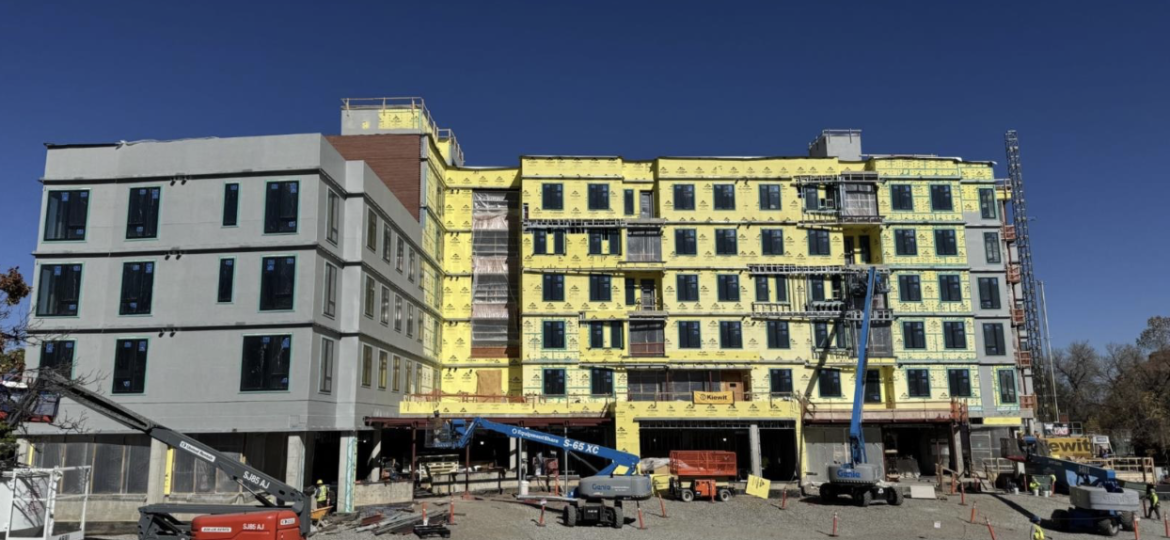
Caption: Residence One, CU Boulder’s newest housing facility, is scheduled to house students for the 2026 fall semester. View from Athens Street. (Matt Spivack/The Bold).
CU housing construction met with criticism
By Matthew Spivak
It’s Saturday morning and University of Colorado Boulder student Jacob Hansen wakes up to the sound of deafening jackhammers and loud machinery sending ear-bleeding noise through his neighborhood. Hansen lives just blocks away from CU’s newest construction project, Residence One. His weekend mornings used to consist of sleeping until noon and relaxing in his apartment.
“I’m not a morning person naturally,” Hansen said. “With the construction, I’ve been waking up at 8 am. I definitely hear it.”
Over the past decade, CU Boulder’s student population has exploded, forcing the school to build more housing. In November 2023, CU’s Board of Regents approved the plan to construct Residence One, a new dorm.
The development is slated to house 332 upperclassmen on 19th and Athens Street and is scheduled to be finished by August 2026. The building will feature a variety of different room types, along with amenities similar to those at Williams Village, including a UPS store, a cafe and a grab-and-go cafeteria.
It is the first housing expansion to CU’s campus since the addition of Williams Village East in 2019, which houses up to 705 students. Since then, Boulder’s student population has grown by roughly 4,000 people.
“I think it’s a greater problem of Boulder getting greedy and accepting more students than it should,” Hansen said. “When you over enroll students, it turns out they still need a bed to sleep in.”
The construction of Residence One is part of the CU’s Housing Master Plan, finalized in 2020, which aims “to guide the housing and resident support service needs of the University for the next 10 years.” The plan identified increased student population, a monopolized housing market in Boulder and a need for modernization of campus housing as key challenges.
CU designed the dorm specifically for upperclassmen to combat the issues of finding affordable housing in Boulder.
“Research shows that living on campus correlates directly to student success and retention,” CU Spokesperson Nicole Mueksch said. “CU Boulder is making a concerted effort to create more housing options for our non-first-year students, helping reduce the number of students who have to seek housing off campus or who have to commute from outside Boulder.”
However, many locals remain skeptical. Aside from noise pollution, the construction process brings other challenges for nearby residents.
The sidewalk on the east side of 19th Street is closed, forcing residents to walk around the site to reach their homes. Parking spots have also been closed around the site, including a majority of 19th Street and part of Athens Street and Arapahoe Ave.
“My apartment complex has private parking,” Hansen said. “But nobody checks it, and I know other people park there. It’s become a bit of a free for all.”
Nearby residents are not the only ones impacted by the loss of parking. The construction workers building the dorm are also getting the short end of the stick.
On a Wednesday morning, Luke Knifong and his fellow crew members arrive at work nearly an hour before their shift starts. Not because they want to, but because they have to. With no parking spots available in the area, the workers park five blocks away and take shuttles to the job site. Only about ten people fit on each shuttle, leaving Knifong standing in the hot Colorado sun for upwards of half an hour, waiting for the next one.
“I have a dog. Some people have kids, so it sucks,” Knifong said. “You spend more time at work than you’re getting paid for. It doesn’t pay the bills but takes time away from your family and your loved ones.”
The process repeats at the end of the workday, with workers waiting after their shift to get back to their cars. Despite this dynamic, Knifong doesn’t let it affect his attitude.
“I take pride in my work,” Knifong said. “Everything I do, I treat it as if I was going to live there. Knowing you, or whoever the next college kid is, might have a cool place because of what I built, that kind of gives me a sense of happiness and gratitude.”
Despite concerns by both local residents and construction workers, the project continues unimpeded. And with the recent rapid growth of the Boulder student community, it doesn’t seem like Residence One will be the last of its kind.
Edited by Nick Merl