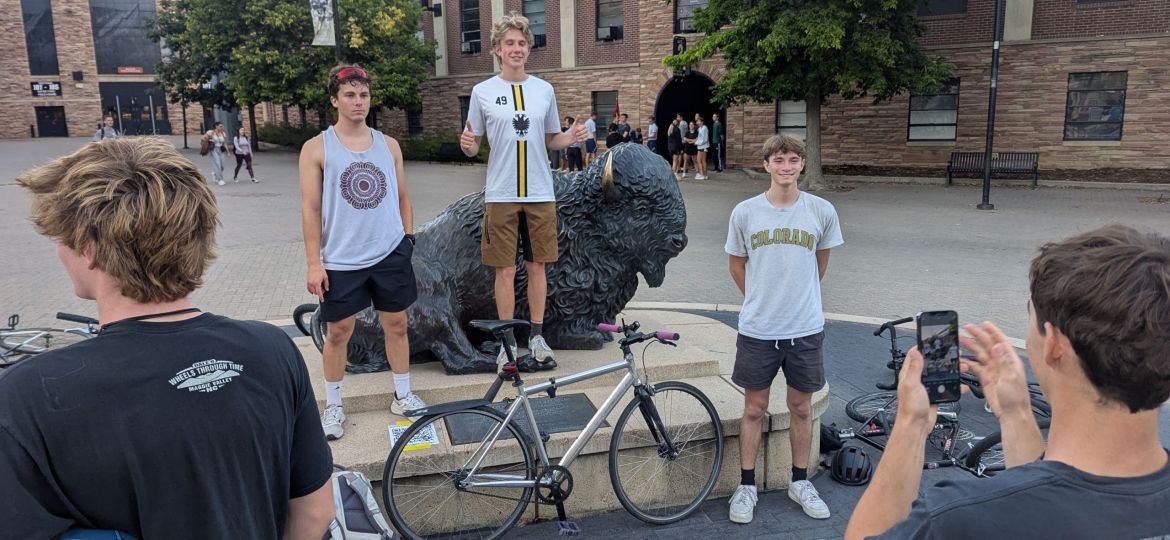
Caption: The top three finishers of a recent Alleycat bike race around Boulder. Photo by McCarley Root.
Meet the organizer behind Boulder’s underground bicycle races
By McCarley Root
An underground bicycle racing tradition once forgotten in Boulder is pedaling back to life. Oscar Lechner, a University of Colorado fifth-year student, is using his passion for cycling and creative design to revive unsanctioned Alleycat races.
“We’re just a bunch of rowdy people getting together and biking around fast,” Lechner said.
An Alleycat race is an informal, checkpoint-based event where riders navigate across a city on fixed-gear bicycles to complete a set of tasks. The goal of the races is to find the most unpredictable route to each checkpoint, which may require darting through alleys and traffic like a cat.
According to the Boulder Alleycat website, “It’s not just about being the fastest; it’s about being the smartest and the most in tune with the city’s rhythm.”
While Alleycat races first gained traction in major cities like Toronto and San Francisco in the late 1980s, they did not emerge in Boulder until 2008. Official races dissolved nearly ten years later, but in the fall of 2023, Lechner and his co-creator Doug Snow decided to bring the Alleycats back.
“It started out just all word-of-mouth, all paper, like all of my friends were at the checkpoints,” Lechner said. “But then eventually, I realized that if I wanted to do this more often, it had to be a little more formal.”
This led Lechner, a Creative Technology and Design major, to build a custom timing and data system for the races. Using QR codes, participants log their progress at each checkpoint, with times recorded and displayed on a website leaderboard.
“I fully designed, engineered and built an online web-based tool that tracks timing data,” Lechner said. “I love seeing people’s times and people’s routes. It helps the community come together and have fun.”
Alleycat races are not officially sanctioned, which raises questions about legality and safety. According to the Boulder County traffic regulations, cyclists cannot impede normal traffic flow. There are also speed limits for bicycles on bike paths, crosswalks and streets. Some community members have safety concerns.
“I would hate if a cyclist caught a bystander off-guard during a race and an accident occurred,” said Nick Zaleski, a local business owner.
The danger is part of the thrill. Racers share the road with vehicles and pedestrians and can cover far distances in a short time period — sometimes traversing eight miles in a 30-minute race. This advanced cycling network is why Lechner says Boulder is a natural fit for Alleycat racing.
“If you’re not riding a bike around as your main source of transport, especially as a Boulder resident, you’re doing it wrong,” Lechner said. “The cycling infrastructure in Boulder is super sophisticated, and you can get anywhere faster than a car.”
So far, the races have attracted a small but dedicated following of about 30 riders. Kaeden Batz, a senior majoring in biochemistry, raced for the first time after hearing about the Alleycats through a friend.
“I usually just ride my bike to class, but coming to this race was a lot of fun,” Batz said. “It’s cool to see the community, and I’ll definitely be coming back.”
Prize money is awarded to the top finishers using cash collected from the $5 entry fees. Batz secured second place in the race, earning him $18. But according to Lechner, prize money is not the only benefit.
“The Alleycat is about bringing the city’s capabilities to light, building a small community, having prizes, having fun and riding bikes,” Lechner said. “I just love that.”
The next race will take place in the spring. Visit the Boulder Alleycat Instagram page for more information.
Edited by Keeley Haynes