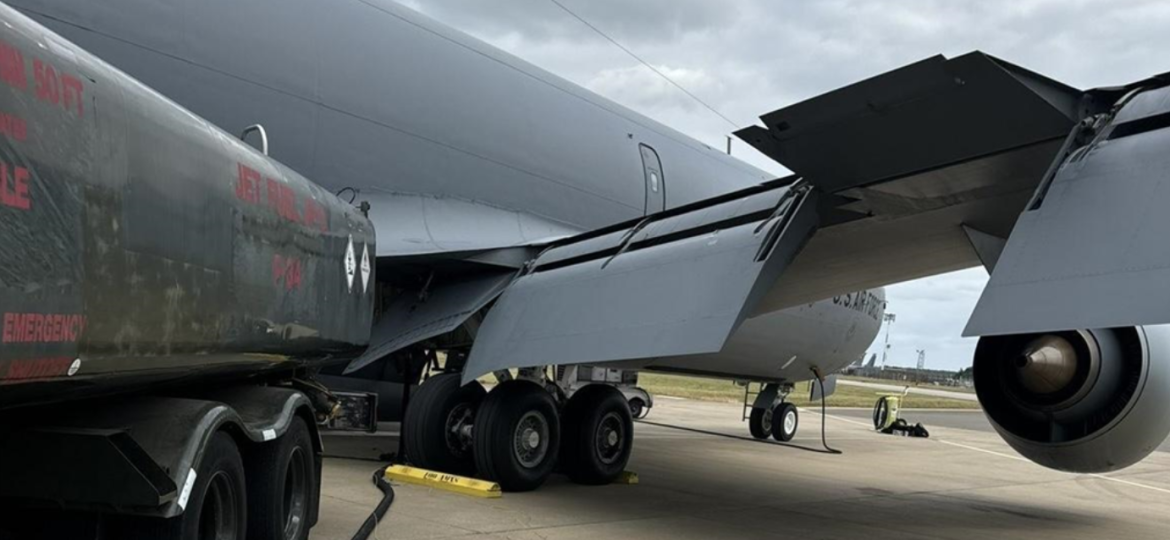
Airmen fuel a Boeing KC-135 Stratotanker (Photo by Jonah Masch).
Wheels Up: A path from the Air Force to college
By Leo Rivera
Sitting in a classroom, Sidney Herrera watches the clock tick down on his senior year. He would have to make a decision that would alter the rest of his life. His choice landed him 4,000 miles from home.
Born to immigrants in Los Angeles, 20-year-old Herrera learned about life’s hardships from an early age. As a Mexican-American, he witnessed his parents’ efforts to provide for their family, which sparked something within him.
“Growing up, nothing ever felt stable,” Herrera said. “We moved around a lot because my parents never really felt secure. We didn’t have a permanent home, and that kind of uncertainty stuck with me.”
Herrera is a long way from the comfort of home now. After enlisting in the Air Force after high school, he signed a six-year contract and was stationed in England. Family was the ultimate motivator for him. When considering his options post-grad, he thought first of his parents.
“I saw joining the Air Force as a way to give something back to them,” he said. “I thought maybe I could help them feel safer here and even help them with their citizenship. After a lot of time and effort, I was able to get my dad his citizenship, and now I’m still working on getting my mom’s.”
Herrera made it through the rigors of basic training. His job is working in fuels, also known as POL (Petroleum, Oils and Lubricants). The tasks are broken into different parts of treating fuel, transporting it and loading it into the aircraft. He must monitor the conditions of the various gases and liquids and regulate their levels accordingly.
While working on fuels in the Air Force, Herrera met Jonah Masch from Colorado. The two became friends. Masch acknowledges the dangers of their job.
“Fuel, obviously, is highly flammable and explosive, fumes that cause cancer and other serious health issues,” Masch said. “Driving a truck with all that in there when one spark can create an entire bomb. Liquid oxygen is combustible when it comes into contact with fuel, while it is -297°F and can freeze your skin to the touch.”
Essentially, it is their job to fuel aircraft for various purposes and ensure the safety of the fuel in all of its stages. The unique position can create a sense of pride among the men.
“Without us, planes don’t fly,” Herrera said. “Then there’s facilities, which handle the fuel storage side. They operate pump systems that store fuel in large tanks and push it through pipelines to different fueling points called pits located out on the flight line.”
It’s a difficult job overseas, like most in the military, that poses a risk of injury or death. A small mistake or miscalculation can lead to a catastrophic outcome. While being away from family, airmen look to their coworkers for strength.
“Being so far away, you have to find some kind of connection that can be helpful to keep your mind occupied from those thoughts of homesickness,” Masch said. “Sid is a great worker and not afraid to do work. He’s always been a great person and a good friend.”
Herrera has decided to stay in the Air Force for now but college remains an option.
At the University of Colorado, the Office of Veterans Affairs helps enlisted folks like Herrera. Tomas Chacon is a student who works in the office and understands the complexity of those decisions. Initially, he tried some college classes after high school, but ultimately, he enlisted in the Air Force.
“I wanted to be independent quickly, and I think that is shared amongst a lot of people who joined out of high school,” Chacon said. “The sense of I can go be independent quickly and still be in a good place.”
Choosing military first, Chacon was able to earn benefits that could help cover the cost of school after he got out. Once he finished his term, he returned to Colorado to attend the university and build on the skills he learned in the military.
“I feel like I’m learning so much from getting to be in classes with people of basically the next generation after mine and right there with them,” Chacon said. “So it’s a really valuable thing to hear some of those different perspectives, but also I value what I’m doing here.”
Being older than a typical college student, Chacon has experiences that he brings to the university and a willingness to learn, highlighting the melting pot of ideas that strengthen the learning environment.
Although there can be concerns about time away from school, there are still ways for veterans to find a community on campus. The Office of Veterans Affairs is a place where these individuals can connect and get advice from others who’ve taken the nontraditional path to a college education.
Edited by Rue Murray