
AI in the classroom: tool or temptation?
By Mercer Murton
As colleges nationwide grasp how to handle artificial intelligence in the classroom, students and faculty at the University of Colorado Boulder are exploring its limits.
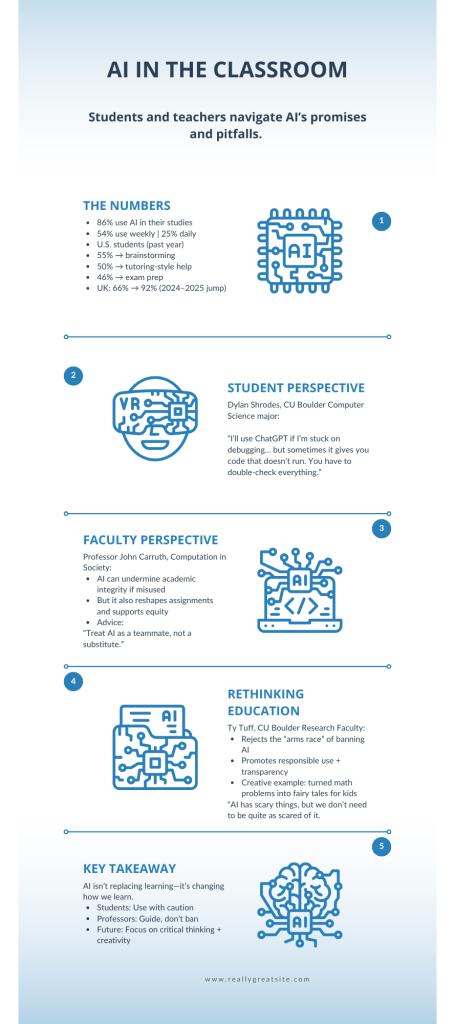
The use of AI among students has surged in the past year. According to Campbell University, 86% of students around the world use AI in their studies, with nearly one in four using it daily. In the U.S., 85% of college students reported using generative AI in the past year, mostly for brainstorming, tutoring and exam preparation.
At CU Boulder, students like Dylan Shrodes, a third-year computer science major, find AI helpful for problem solving but use it with caution.
“I’ll use ChatGPT if I’m stuck on debugging, just to point me in the right direction,” he said. “But sometimes it gives you code that doesn’t actually run. You have to double-check everything.”
The tension between speed and accuracy is widely considered. Students report that AI can replace hours of manual review, but not without risk, particularly when students rely on it without verification.
Faculty are beginning to rethink how to structure courses in response. Christopher Carruth, an assistant teaching professor in Information Science at CU Boulder, balances opportunity with oversight.
“It really depends on the learning objectives,” he said. “AI can undermine academic integrity if it’s used to bypass learning, but it also opens doors for innovation—reshaping assignments, supporting equity and helping students develop new skills.”
Carruth integrates AI directly into the classroom, challenging students to think about their education from a different perspective. His course asks students to reflect on their academic goals and then revisit them with AI.
“My advice is simple: treat AI as a teammate, not a substitute,” he said. “You can’t outsource critical thinking and human connection.”
CU faculty are not alone in adapting to this new reality. According to AP News, a Duke University pilot study gives undergraduates free access to ChatGPT-4o and a custom ‘DukeGPT’ to evaluate AI’s academic impact, emphasizing student responsibility over restriction.
Back at CU Boulder, research faculty member Ty Tuff is navigating this shift. At the Environmental Data Science Innovation and Impact Lab, Tuff works with other instructors who also see AI as a powerful learning tool.
“In the classroom, some people get stuck in a defensive arms race—students use it secretly, professors try to catch them. It wastes time and doesn’t go very far,” Tuff said. “You don’t ban it, you teach students how to use it responsibly and show their work.”
Tuff says the key is changing the tone of the conversation, focusing less on fear and more on creative possibilities.
“I think this can just be a customizable tool that opens up new doors that have never been open before,” he said.
Edited by Lily Young-Stallings