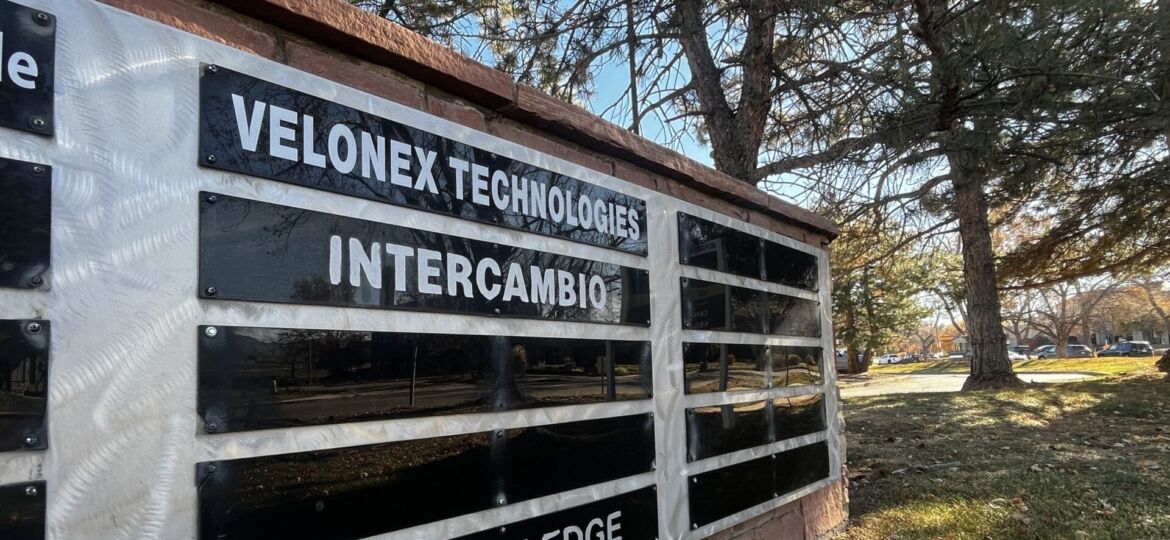
A sign directs volunteer teachers, staff and students to Intercambio in Boulder, Colo., on Nov. 16, 2026. (Photo by Joshua Loehr)
Intercambio bets big on going national
A year and a half ago, John Lopez sent a memo he never wanted to write.
Addressed to every student, staff member and volunteer at Intercambio Uniting Communities, the memo explained what to do if U.S. Immigration and Customs Enforcement agents showed up at a learning center.
“That’s never something you want to do because it scares people,” said Lopez, the nonprofit’s CEO. “(But) it was the right thing to do.”
For 26 years, the Boulder County nonprofit has connected adult immigrants with volunteer teachers to help them learn English. An organization built on helping immigrants find belonging, Intercambio is now pursuing national expansion as federal budget cuts effect organizations which buy its curriculum and fear is keeping their students home.
Lee Shainis and Shawn Camden founded Intercambio in 2000. Since then, it has taught an estimated 17,080 students and enrolled 1,080 students in the 2026 fiscal year, according to it’s latest impact report. These students come primarily from Mexico, Venezuela and Colombia. Group classes for students cost $100 for a nine-week term, and one-on-one online classes cost $50 a month, according to the National Literacy Directory.
The organization currently has 20 full-time employees, with four of them being former students, according to Lopez.
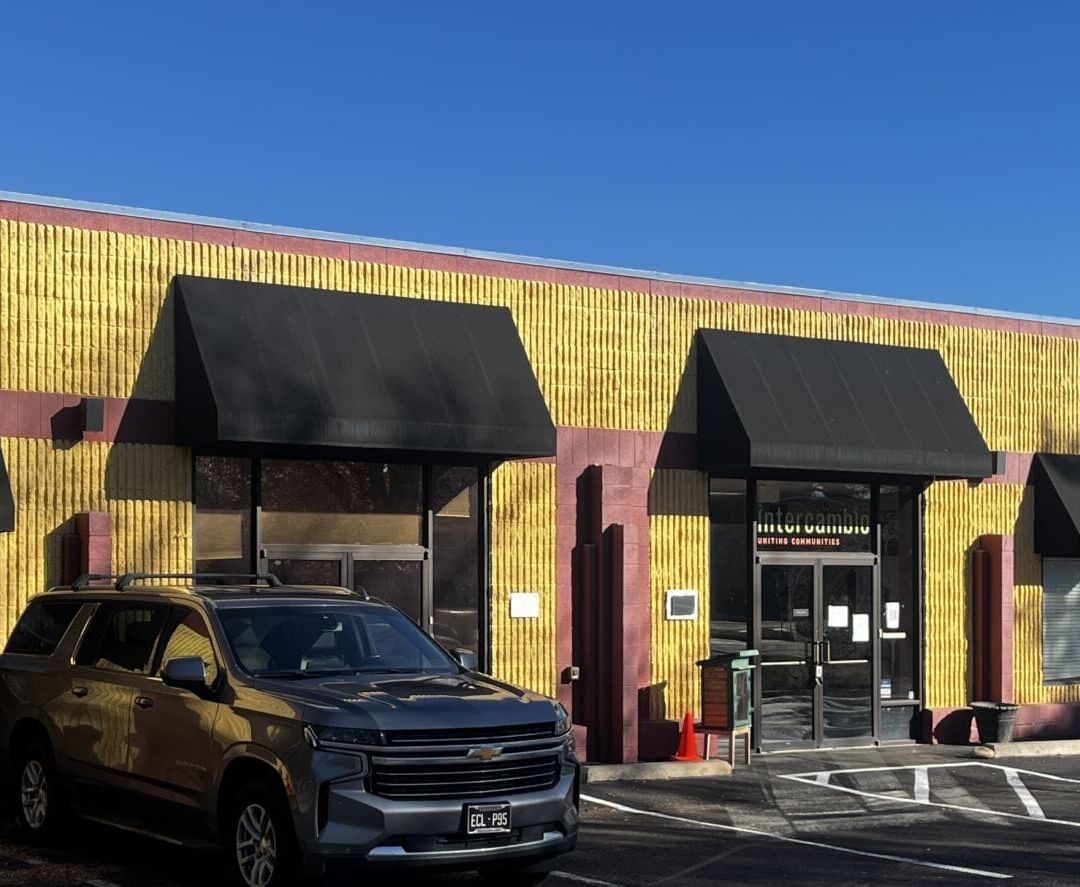
Lopez stated that the in-person classes at their Boulder and Longmont locations are “the foundation of the organization” and won’t change as the organization explores online courses for greater, national reach. The goal is to build on that base by offering learners and volunteers across the country the opportunity to experience what we Intercambio is already doing in Boulder and Longmont through an online curriculum.
Part of that reach already exists. According to Lopez, around 745 organizations nationwide, including libraries, churches and ESL programs, already buy Intercambio’s curriculum, called “Confidence and Connections.”
Leanne Chacon, Intercambio’s director of curriculum and training, helped write it and said it was designed for volunteers not certified teachers. Each two-hour lesson covers grammar, pronunciation and authentic conversation.
But the learning goes both ways.
Intercambio teaches volunteers “cultural humility.” Chacon outlined a scenario she hears concerns about often. Picture a volunteer teacher brand new to the Intercambio community. If a student walks in 30 minutes late, and proceeds to greet every classmate one by one, that teacher may feel disrespected.
Just as often as she hears this concern, Chacon reminds teachers that in some cultures 30 minutes late “is fine” and that skipping the greetings would be disrespectful.
Retirees make up most of Intercambio’s volunteer teachers, Lopez said, and the organization will keep recruiting them, but it is also reaching toward a younger pool: college students who need teaching hours for education degrees. About 60 college students from several large online universities now volunteer as teachers through the online teaching program.
Jennifer Marinalarena, Intercambio’s marketing director, believes growth can’t come at the cost of the “Intercambio touch,” which she describes as “personalized care for people and understanding them as a person.”
Doing that online is the challenge. “We can’t necessarily have one-on-one interactions with everybody if we’re trying to grow the program as much as we would like to,” Chacon said.
However, the future isn’t free.
“Making money really isn’t the goal,” Lopez said. “And though it is not the goal, it is the pathway to pursuing the mission.”
In 2024, Intercambio brought in about $2 million, according to its federal tax filing. Roughly $1.17 million came from donations and grants, about $661,000 from curriculum sales and about $143,000 from student registration fees. Government grants made up about 6.5% of that revenue.
Libraries and programs that buy Intercambio’s curriculum are less insulated from federal cuts. In March 2025, President Donald Trump signed an executive order calling for the elimination of the Institute of Museum and Library Services, the main federal agency that funds libraries.
That July, the U.S. Education Department temporarily withheld about $6.8 billion from states, including money for adult literacy and English-language instruction, before releasing it weeks later. For now, those programs are funded through Dec. 11 under a stopgap spending bill, but the White House’s 2027 budget again proposes cuts to the Institute of Museum and Library Services.
“There have been a lot of budget cuts at the federal level,” Lopez said, and the organizations that buy Intercambio’s materials “have less with which to purchase materials and services.”
That hits Intercambio’s largest source of earned income. Curriculum sales made up about 82% of its program revenue in 2024.
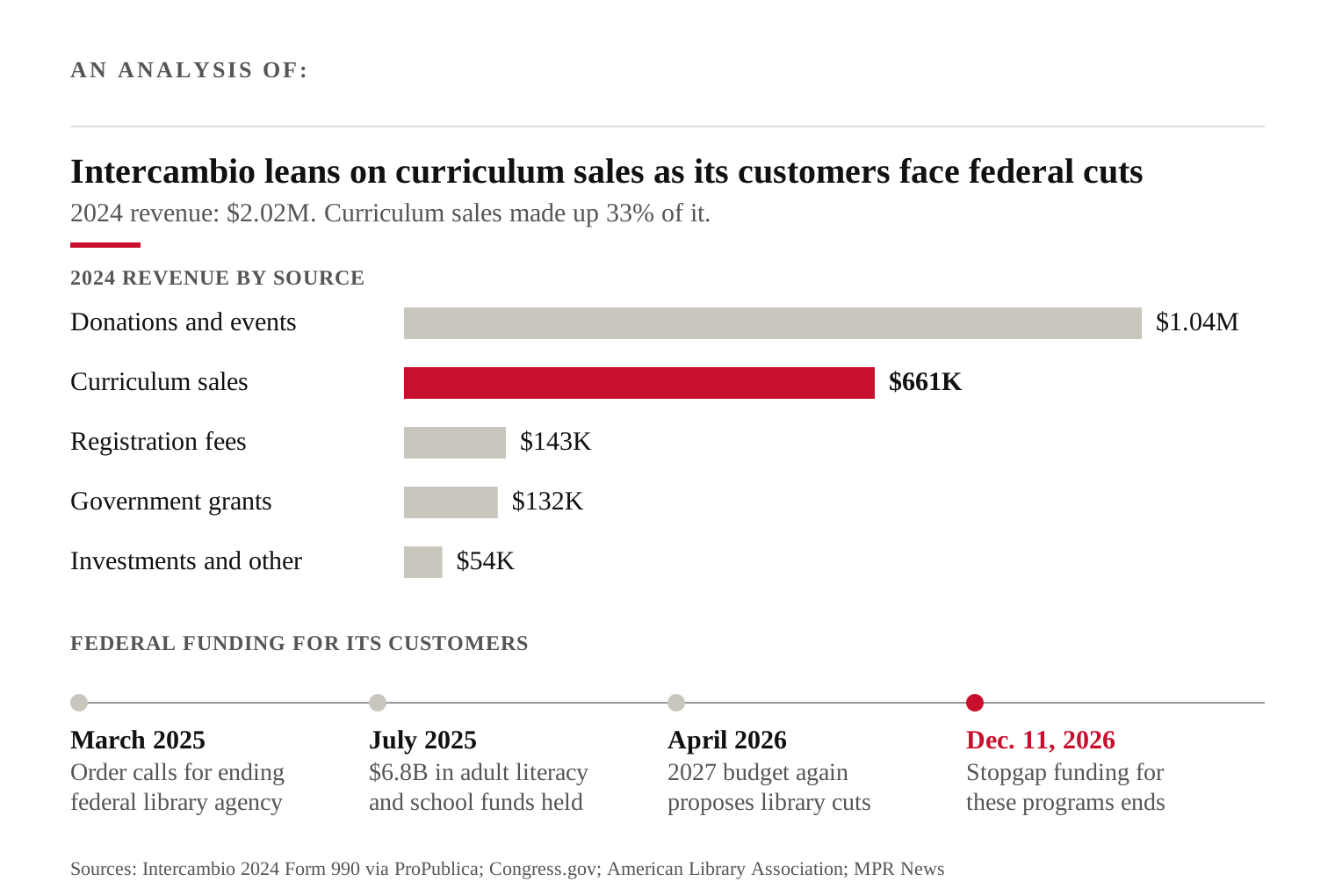 Graphic by Josh Loehr
The pressure isn’t only financial. With an increased immigration enforcement presence, Lopez said, many immigrants are less willing to come to class “for fear that something might happen.”
Facing an uncertain future, Intercambio is moving forward by focusing on building trust. Staff call students to remind them to register, and each term ends with a graduation ceremony that students’ families attend. Once students are in class, Lopez said, “they’re laughing and lighthearted and feel pretty comfortable.”
Marinalarena said trust depends on following through.
“If we say the class is free, it better be free,” she said.
Intercambio also never shares a student’s story without permission.
That trust is built slowly. At outreach events, she has watched the same woman circle her table two or three times before she “finally comes over and starts asking questions.”
Lopez, who immigrated from Belize, said the work is personal.
“I’ve watched my whole family figure out how to go about life in the U.S., me included,” he said, adding that it can be “pretty difficult.”
For Lopez, the point of the expansion is the same as the point of a single classroom. He returns to Belize every two or three months, and is often treated there as an American outsider, even though he is Belizean.
“I’m constantly aware of what that feels like to be the person on the outside coming in,” he said.
Some students now stay outside altogether. With an increased immigration enforcement presence, Lopez said, some students are staying home and out of the community “they might be targeted or soemthing negative might happen.”
Still Lopez wants to bring people in, to use Intercambio as a sledgehammer to whatever barriers keep people from feeling they belong. “As long as we keep doing that work,” he said, “I’ll be happy.”
This story used Anthropic’s Claude LLM to analyze Intercambio’s tax filings and U.S. federal expenditures.