
Colorado Proposition 132 could bring harsher fentanyl penalties and higher prison costs
In 2020, Julie Wright’s daughter took what she thought was a single OxyContin pill. It turned out to be fentanyl.
Maddie, like so many others during the pandemic, struggled with anxiety. Her mother says she began self-medicating with alcohol and Xanax.
In a rehabilitation facility, Maddie met the person who would eventually give her the pill that took her life.
“I’m sure she thought at the time, okay, you know, I am stressed. I’ll take this, you know, one pill. She would have been still left with a substance issue. It wouldn’t have been even enough for an overdose. But she didn’t recover or wake up at all,” Julie Wright said.

At age 23, Maddie Wright became one of about 5,200 Coloradans who have died of a fentanyl-related overdose since 2020.
Julie Wright, the founder of the Maddie Wright Foundation, believes that Proposition 132 on the Nov. 3 statewide ballot will prevent future overdoses by getting people to treatment through the criminal justice system.
The measure is controversial, however, with critics saying it will lead to more overdoses and a large increase in Colorado’s prison population. Without any source of funding attached, many Coloradans are also concerned about the cost to taxpayers.
Both sides want to save lives but disagree on how.
Initiated by conservative group Advance Colorado, Proposition 132 would make possession of any amount of fentanyl a felony with a mandatory minimum sentence of eight to 32 years for distribution. It would also remove options to reduce sentences under certain possession and distribution laws, including the option to reduce a sentence if a person is caught possessing it while helping someone else get medical attention.
There is a provision for treatment: Successful completion of court-ordered treatment can result in the conviction being vacated.
Currently, possession of one gram or less of fentanyl is considered a Level 1 misdemeanor, while anything over a gram is a Level 4 felony.
“A very heavy penalty is going to deter a lot of people from taking the risk,” Wright said.
In 2025, the Colorado Center for Public Health and Environmental Data attributed 980 deaths to fentanyl. Synthetic opioids accounted for 5,213 emergency department visits between 2022 and 2025.
Colorado has seen a decline in overdose deaths — by 13.9% between October 2024 and October 2025, according to the state. But that wasn’t the case in Boulder County, where fentanyl overdose deaths rose from 24 in 2024 to 35 in 2026.
This may be because of changes in the illicit drug supply, differences in access to treatment and naloxone or ordinary year-to-year fluctuations in relatively small numbers.
Despite the uncertainty surrounding overdose trends, Wright believes tougher prosecution of fentanyl distributors is necessary.
She considers the person she says intentionally gave Maddie a fatal dose of fentanyl to be a predator who ultimately avoided incarceration due to a combination of procedural errors and judicial decisions.
“I’ve attended different cases for other affected parents and was appalled at how many times people are being arrested for clear trafficking, not possession, trafficking, and let go with zero bail,” Wright said.
The proposition also makes no distinction between distributing fentanyl for profit and sharing it without an exchange of money.
However, there is debate over whether harsher penalties would have the intended effect of preventing fentanyl distribution.
Katherine LeMasters, a social epidemiology researcher at CU Anschutz, says the distinction between drug distributors and drug users is not always clear. People often sell illicit substances to support their own drug use, she said.
Critics also worry that increased incarceration could have unintended consequences for overdose deaths.
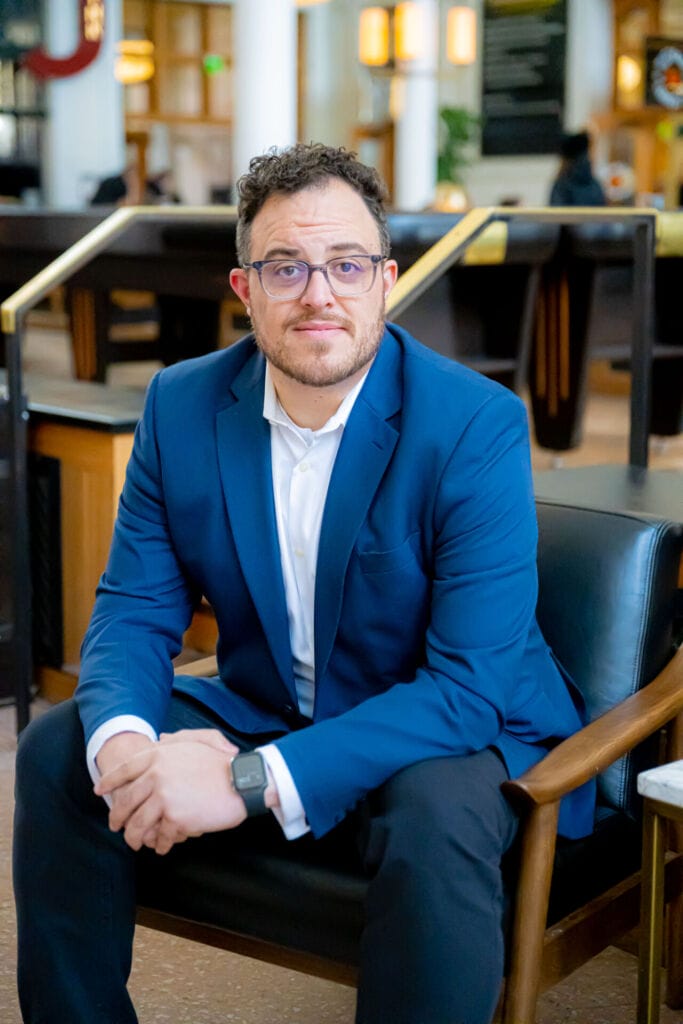
“People leaving the Department of Corrections have an almost 200% higher chance of overdosing in the first 30 days than someone who is just struggling in community,” said Kyle Giddings, deputy director of Colorado Justice Reform Coalition.
Giddings is a formerly incarcerated person and Campaign Chair for Vote No on 132. He’s also 12 years sober and said his addiction led to his incarceration.
“Being incarcerated didn’t help me. Access to drugs inside of jails and inside of prisons exists. It’s actually a huge issue,” Giddings said.
LeMasters says the risks of incarceration extend beyond drugs.
“We know that carceral facilities are traumatic environments themselves. And so even when we are offering those medications, we’re also exposing them to other sorts of harms. It’s really the perfect storm for people to reengage,” LeMasters said.
Beyond the risks of incarcerating people with active opioid addiction, putting that many people in prison would be costly.
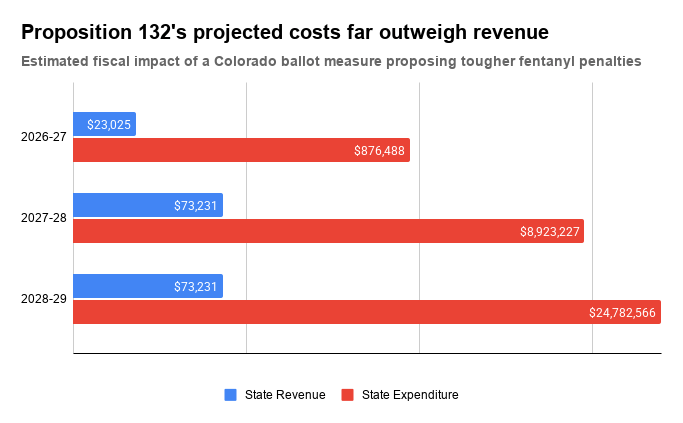
According to an analysis by Colorado’s Legislative Council Staff, Proposition 132 is expected to put an additional 1,024 people in prison by fiscal year 2030-31, relative to what the prison population otherwise would have been.
It would also cost an additional $141.6 million in prison and parole operating costs over five years.
The state estimates that building enough new prison beds to accommodate the entire projected increase could cost as much as $422.5 million, based on an estimated construction cost of $412,500 per bed.
Proposition 132 does not establish a dedicated revenue source to cover its implementation costs, so the state would pay most of the projected additional expenditures through its general fund, which supports major public services.
“We might just need to get the ballot, get this over the line, and then they will find and allocate the funding,” Wright said.
“(People arrested for possession) are facing the opportunity for drug rehab,” she said.
However, Amy Lieberman, the deputy director of the Harm Reduction Legal Project, doesn’t think the treatment provision is enough.
“There isn’t enough treatment available for the people who want treatment at this point, let alone people that are not interested in treatment,” Lieberman said.
“So even if I thought this was a good idea, there’s no way to support mandatory treatment,” she said.
Other states have already implemented tougher fentanyl penalties, offering some insight into how such laws might work in Colorado.
The clearest test case is Florida, which added fentanyl-specific trafficking offenses in 2017 with mandatory minimums of three years for four to fewer than 14 grams, 15 years for 14 to fewer than 28 grams, and 25 years for 28 grams or more.

While Florida’s rates have been consistent with the national trend in declining overdoses, the state did see a surge between 2017 and 2019 because of changes in Florida’s illicit drug supply.
According to LeMasters, it’s difficult to reliably determine if stricter prosecution laws have been effective, considering the short amount of time Florida’s laws have been in effect as well as several other variables contributing to changing overdose rates.
In 2022, the Colorado legislature passed the Fentanyl Accountability and Prevention Act, which had tougher criminal penalties and harm reduction measures, like expanding access to naloxone and fentanyl test strips and funding community programs aimed at preventing overdoses and reducing drug-related harm.
“No, I probably won’t change anything if that gets passed. I’ll still do (cocaine and ketamine) at concerts and stuff. It’s still already illegal,” an anonymous CU junior said.
“I feel like people will be scared to trust those people that test stuff at concerts or events because if they find fentanyl, we wouldn’t know what would happen,” an anonymous CU sophomore said.
These students requested anonymity due to recreational and illegal use of cocaine, ketamine and opioid pills.
Proposition 132 would also remove the clause of Colorado’s Good Samaritan law, under which a person distributing fentanyl may receive a reduced sentence if they are caught because they sought emergency services to help someone else in an overdose.
“I was in a situation where I was with a friend who was overdosing, who I got help for, and Prop 132 rewrites the laws to where the legal immunity I had because I got that person help would be gone,” Giddings said.
For many Coloradans, the debate is deeply personal.
Wright believes the ballot measure would have saved her daughter’s life, even if she had been incarcerated for fentanyl possession.
Giddings isn’t so sure: “It would be hard to imagine how my life would be if Prop 132 had passed, especially around possession charges and stuff. I can’t imagine a path forward. My mind wanders to really dark places.”