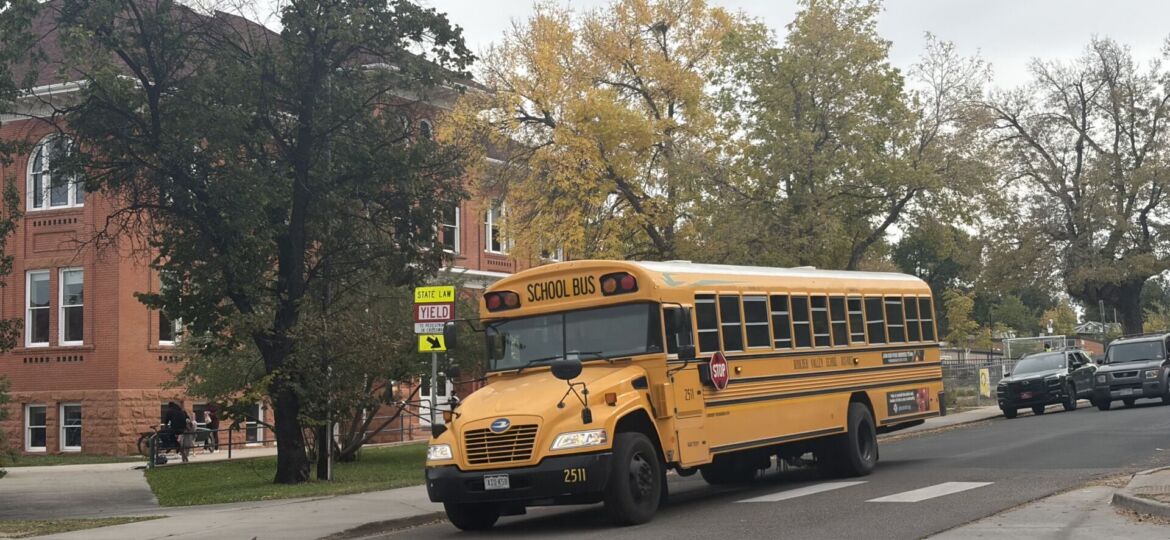
A Boulder Valley School District bus leaves University Hill Elementary School in Boulder, Colorado, on Oct. 22, 2026. (Photo by Bronte Moore)
Colorado boosts K–12 funding amid budget challenges
The May bill allocated $10.18 billion to public schools for the 2026–27 school year, an increase aimed to help protect core K-12 education funding and spare school districts from budget cuts.
Due to rising operating costs and inflation, critics argue that the tax increase won’t make enough impact.
“The state share has increased by $214 million, so the local property tax share went down $21 million,” state Sen. Chris Kolker said. “Total funding still went up by $194 million; but is it enough? No.”
Local taxes contribute to school funding, but districts may need additional revenue to cover expenses beyond what state and local funding provides, which this law doesn’t address.
The law aims to help schools by implementing a new funding structure. The new formula will gradually shift how school districts receive funding while limiting abrupt financial disruptions.
“One of the kind of misnomers here is that we have a new formula. We will not have a new formula until 2031,” said Justin Silverstein, executive director of the Colorado School Finance Project, an organization that collects data on K-12 public school funding.
Districts facing an enrollment shortage could face difficult budget decisions, including closing some of their operations. One of those districts is Boulder Valley School District, which is preparing to close four of its schools in the 2027–2028 school year.
The previous formula primarily calculated funding based on student enrollment, district size, cost of living and additional funding for at-risk students and English language learners.
The new formula adds specialized funding for special education and adjusts how districts receive money based on student needs, local costs and geographic location.
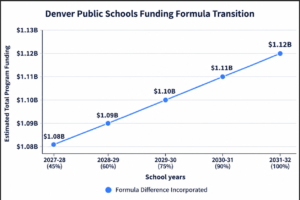
According to the law, 30% of the difference between the old and new funding formula will be incorporated into districts funding calculations for the 2026-27 school year.
That percentage will then increase to 45% in 2027-28, 60% in 2028-29, 75% in 2029-30 and 90% in 2030-31, before the new formula fully replaces the old one in the 2031-32 school year.
While the formula accounts for enrollment dropping by shifting to a three-year enrollment averaging model from a five-year model, at the same time it decreases the financial soft landing, leaving some schools desperate for more funding.
The bill still benefits larger districts, Denver Public Schools in particular.
“The new formula overall benefits us when all things are held equal, when you start to take into other factors,” said Katie Hechavarria, the executive director of finance for Denver Public Schools. “Even under the old formula, we would have less money.”
To sufficiently meet the needs of public schools Colorado needs to spend $3 billion to $4 billion more, Silverstein said.
While the bill does increase overall funding, the additional investment may not be enough to address the broader needs of operational cost.
“K-12 used to be the number one expenditure from the budget. And now we’re less than 30% of our budget. We used to be over 40, and I believe higher,” Kolker said.
Some Colorado residents feel that the funding is unjustified, facing a potential $1.2 billion to $1.5 billion shortfall, a gap driven by rising health care costs and strict constitutional spending limits risking the stakes of other programs.
Some argue that the spending will not have enough impact because student performance is dropping along with student enrollment.
“This bill requires no accountability and gives no rationale, yet taxpayers are asked to fund a large increase in spending. Legislators need to do their homework,” said Kim Monson, president of the Colorado Union of Taxpayers.
Supporters say increasing funding is necessary to address rising school operating costs.
“If you believe in equity, I think this new school finance act model does a better job of equitable distribution of trying to get more funds for the students with the highest needs,” Hechavarria said.
Colorado underspends the national per pupil average of $17,619 by around a thousand dollars.
There’s also the legislature-led solution of Proposition NN, which passed in November 2026. It intends to address some of these longstanding challenges by allowing the state to increase K–12 education funding.
Despite slow investment in public education, Colorado ranks highly compared to other states.
“We should be prioritizing K-12 budget before other areas of government,” Kolker said. “That should be our first priority.”