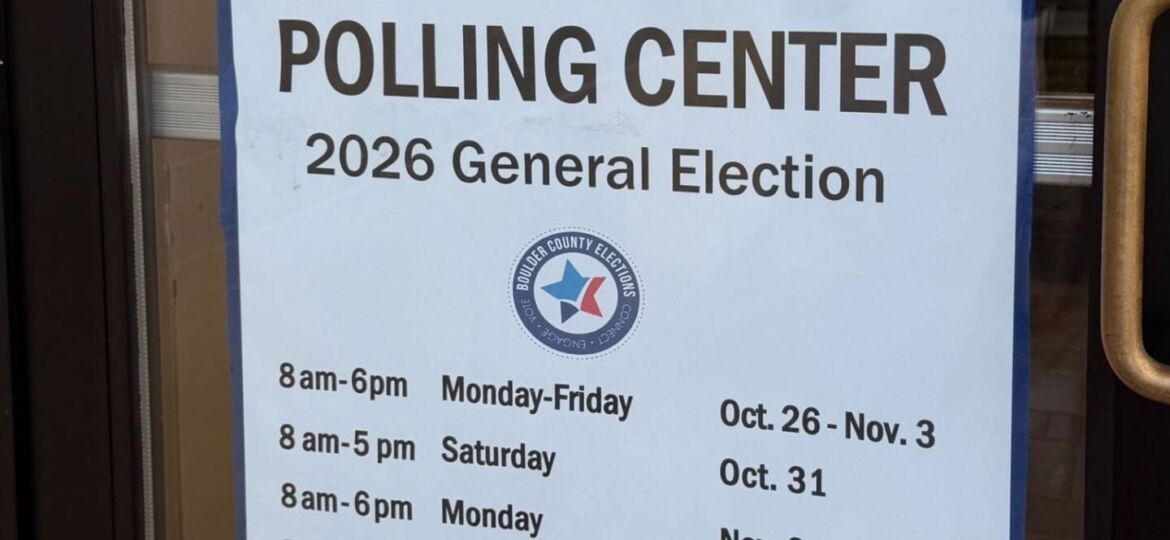
Voting information is posted on the door of CU Boulder’s University Memorial Center in October 2026. (Photo by Meg Avery)
With Proposition NN, voters will decide if K-12 public education is one of the state's most pressing financial issues
By Meg Avery
Colorado voters are headed to the polls this November, and on the ballot is funding for public K-12 education.
Proposition NN would raise the state tax revenue limit under TABOR, allowing the state to increase education funding by up to 2% each year indefinitely. About $241.5 million would go toward K-12 education in fiscal year 2026-27 and $234 million in fiscal year 2027-28, according to the state’s Blue Book ballot analysis.
The Taxpayer’s Bill of Rights allows the state to collect tax revenue up to a certain limit, determined by inflation and population growth. The excess is then returned to the taxpayer. If Prop NN passes, the limit will increase, resulting in less money that might come back to you.
The measure was referred by the legislature, and the bill was sponsored by state Sens. Jeff Bridges and Cathy Kipp, who are both Democrats. Kipp said the ballot measure is trying to address teacher pay, class sizes and the overall quality of education.
However, certain taxpayers see the excess revenue in taxes as money they are entitled to receive back.
“We’re currently facing a $1.6 billion deficit. So we’re in a really bad place,” said Kipp. “But if people want to not have kids get adequate education, they can certainly vote against it.”
TABOR was an amendment to the state constitution that voters passed in 1992 as a means of consenting to where their money is going. To change the amendment’s structure, it must first be approved by Colorado citizens.
If Proposition NN passes, the state will be required to publish an annual public, independent audit of how the revenue was spent.
Still, many Coloradans question the level of discretion that TABOR allows state officials to have when spending their tax money.
Jon Caldara is a main opponent of the measure and the president of the Independence Institute, a think tank focused on free markets and individual liberties. He said is concerned about democracy in a system where taxpayers do not control how their money is spent.
“Only a third of what the state spends do they spend out of the general fund that has direct representation. Two-thirds of all your tax money is being spent by people you can’t elect, you can’t appoint,” Caldara said.
Yet, Liz Waddick, the vice president of the Colorado Education Association, is looking forward to the transparency the measure contains.
“I couldn’t really ask for a better proposition that has clear guidelines, a clear audit annually. I’m excited to be able to have those conversations with school districts and look at the transparency of where they spend that money,” Waddick said.
Before her position as vice president, Waddick was a Spanish teacher at Summit High School in Breckenridge, and believes in the importance of improving K-12 public education.
“I’m serious about teaching language. It’s my life’s work,” she said.
According to the U.S. Census Bureau, the national average spent per pupil in fiscal year 2024 was $17,619. In comparison, the Colorado General Assembly allocated a base of $8,496.38 per pupil in fiscal year 2024-25.
Caldara would not attribute the large discrepancy between state and national per-pupil spending to a lack of revenue.
“They just gave another $3 million to give people electric bicycles, but we don’t have money for education,” he said. “You know, you just keep going down the line, and you realize if they say there’s not money for education, it’s because they don’t make it a priority.”
Caldara, who has been involved with TABOR issues since the original amendment was approved, calls TABOR a skeleton of what it once was.
Bennie Pollack, a junior at CU Boulder from Denver, believes it is necessary to direct excess TABOR revenue toward K-12 education, even if it affects her family’s taxpayer refunds.
“It is important to have good K-12 education in order to go to a university,” Pollack said, tying the measure’s relevancy to her life as a college student.
Junior Reese Trobaugh, a CU student from Superior, also backs the measure.
“I plan to vote yes on Proposition NN because I believe investing in children’s health and education is an investment in Colorado’s future,” Trobaugh said.
Kipp argues that TABOR has imposed significant constraints on what the state government can do, and says that improving the quality of education will have a positive impact that extends beyond just K-12 students and their teachers.
“You’ll probably be able to see that in the success of people in our state and the success of businesses in our state. I mean, education is one of those things that raises all boats,” Kipp said.
But Kipp is not the only one who believes that Proposition NN will have significant effects in the future.
“If you vote yes on NN, you’ll never be asked for your refund money again. It’ll be gone forever and ever and ever,” said Caldara. “And that’s a long time.”