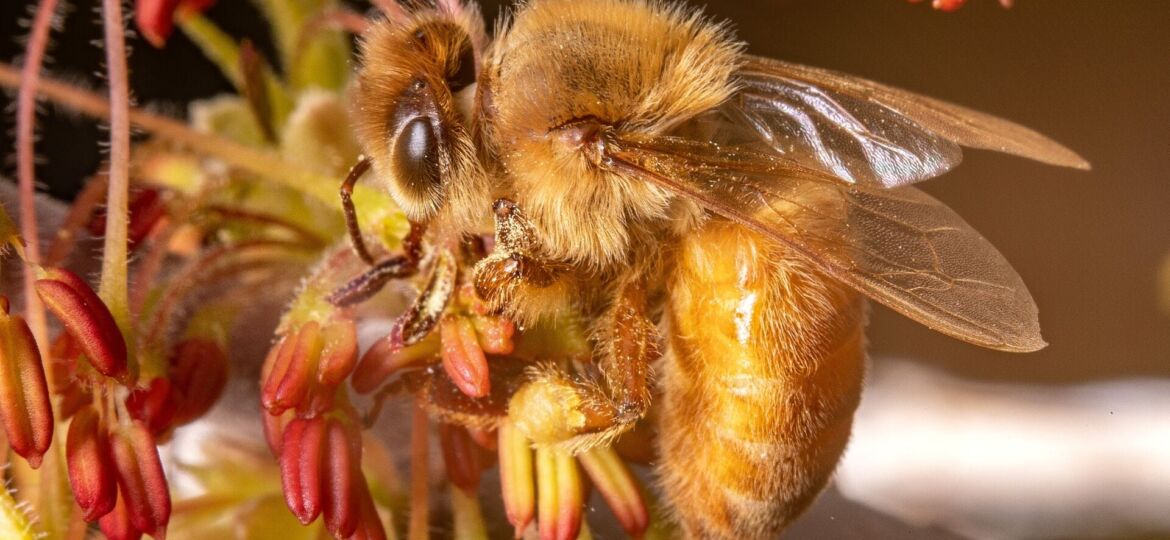
A bee visits a flower to pollinate on May. 9, 2020. Pollinators help many plants reproduce. (Photo courtesy of Justin Hein)
From gardens to labs, Boulder is mobilizing to protect pollinators
From walking around the University of Colorado Boulder’s campus to hiking in the Rocky Mountains, pollinators feed the ecosystems people encounter every day. Despite the crucial work they do, pollinator and insect communities in Colorado have been declining for the past 35 years — with some species dropping by nearly half over that time.
The city of Boulder is doing its part to reverse the damage that infrastructure and other factors have made on natural pollinator habitats.
Pollinators are animals that move pollen between flowers, allowing many plants to reproduce and support ecosystems in which plant-eating animals rely on. Common examples of pollinators include bees, butterflies, moths, birds and even bats.
Pollinators are essential for Colorado’s overall ecosystem and agricultural stability, and many plants rely on them to reproduce.
“Scientifically, many plants flower to attract pollinators so they will bring their pollen … So, if we don’t have pollinators, then we don’t have food,” said Justin Hein, a doctoral candidate and pollinator researcher at CU Boulder.
Additionally, livestock and wild animal communities depend on the vegetation pollinators produce, while amphibians and birds feed directly on the insects themselves.
“It’s really important that we recognize how much habitat we are taking away, how much food we are taking away, not just from bees, but from butterflies, moths, basically every insect any time we build anything,” Hein said. “What we should be prioritizing is helping pollinators and the easiest way to help pollinators is to plant things and to learn more.”
He explained that planting even five seeds yields flowers for generations of pollinators, noting that every plant makes a difference. To protect native bees through winter, he also encourages residents to build simple hives by drilling holes in wood and lining them with plant material.
Boulder is organizing a series of larger programs at the university and city levels to study and protect these pollinators. And Gov. Jared Polis signed an executive order on Sept. 16 that requires state agencies to protect pollinators, building on research and programs Boulder has run for decades.
Research programs, planting gardens and pesticide reduction are all products of a community that cares about protecting invertebrates.
“If we see pollinators decline to the point where there are not enough to pollinate the crops we eat, there is nothing to replace them,” Hein said. “There is no good solution other than to protect the pollinators we already have.”
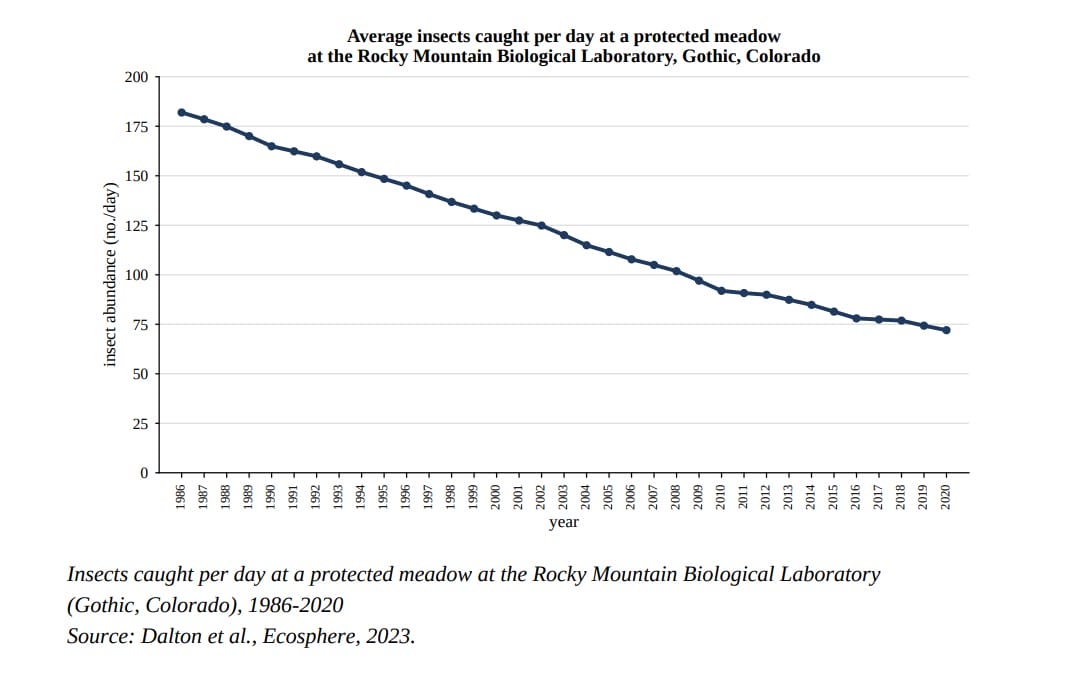
One of the first long-term studies conducted on generational pollinator rates was started by Michael Soulé at the Rocky Mountain Biological Laboratory in 1984. Analyzing long-term data through 2020 revealed a 61.5% decline in insect abundance and a 47% decline in insect biomass, contributing to what ecologists have called the “insect apocalypse.”
According to the ecologist community, climate change, pesticides and habitat loss are the three main causes of pollinator decline.
“It’s a combination of drivers, the big one being habitat loss and fragmentation. So when we convert their habitats we tend to lose them, not surprisingly,” said Julian Resasco, a professor of ecology and evolutionary biology at CU Boulder.
Resasco studies plant-pollinator interactions in the long-term. His team has focused on collecting data on pollinator adaptation for more than a decade.
He discusses how pollinators are often classified as “generalist species,” which remain active across varied settings, unlike “rare species” that require very specific environments.
“Most plant species rely on pollinators for pollination so they can reproduce and make fruit and seeds,” Resasco said. “Native, unmanaged pollinators provide services to pollinate many of our crops, and they do these services for free for us. We take them for granted.”
Researchers with Boulder Mountain Research, a CU program conducting long-term ecological research in the Rocky Mountains, frequently study pollinators in their natural habitats.
Much of this work takes place in Elk Field — an undeveloped, pesticide-free site near Nederland, where Resasco runs a long-term pollinator population study.
Through his research, and that of others, the CU Boulder Museum of Natural History has collected and documented 1,006 bee species as of 2023.
Adrian Carper, senior ecologist and pollinator conservation program manager for Colorado Parks and Wildlife, says that many generalist species are overlooked. He emphasizes that this makes them no less important — they are just as crucial for maintaining biodiversity.
Insect pollinators are cold-blooded creatures, relying on their environment to regulate themselves. Therefore, they are especially susceptible to global warming and struggle to adjust to rising temperatures. Climate change also affects water sources, damages floral ecosystems and alters when plants flower, decreasing nectar production. This eliminates pollinators’ food sources and changes when they are able to forage.
“In response to climate, bumblebees have shifted over 250 meters higher in elevation while the plants they depend on can’t move but instead now flower a month and a half earlier on average,” Carper said.
He explained how the western bumblebee, a mid-elevation species, has declined 70% from its known historic range in only the past two decades. These changes are directly connected to climate change and neonicotinoids, a type of pesticide.
In a 2025 pollinator study, NatureServe published findings demonstrating that 22.6% of pollinators native to North America are at an elevated rate of extinction. They evaluated around 1,600 species and found bees are currently the most at-risk, with 34.7% at risk of extinction.
The area with the most at-risk species was in the Southwest U.S. This was linked to climate-related stressors such as extreme heat and rising infrastructure.
“Pollinators are the canaries in the coal mines. They are having a hard time right now, so the whole food chain that depends on them is having a hard time,” Carper said.
Carper, as well as other pollinator advocates, are petitioning for around 20% of native bumblebees to receive federal protection.
Carper also spoke about how these initiatives only focus on the species they know about; there are plenty of species that need help that conservation teams are unaware of. While butterflies and bees are the most studied pollinators, beetles, flies and mosquitoes are largely understudied.
Before 2024, invertebrates and rare plants did not qualify for wildlife status. However, the People Pollinators Network secured this status to expedite conservation efforts. The Boulder chapter was instrumental in this effort and provided much of the research that was used in the legislation.
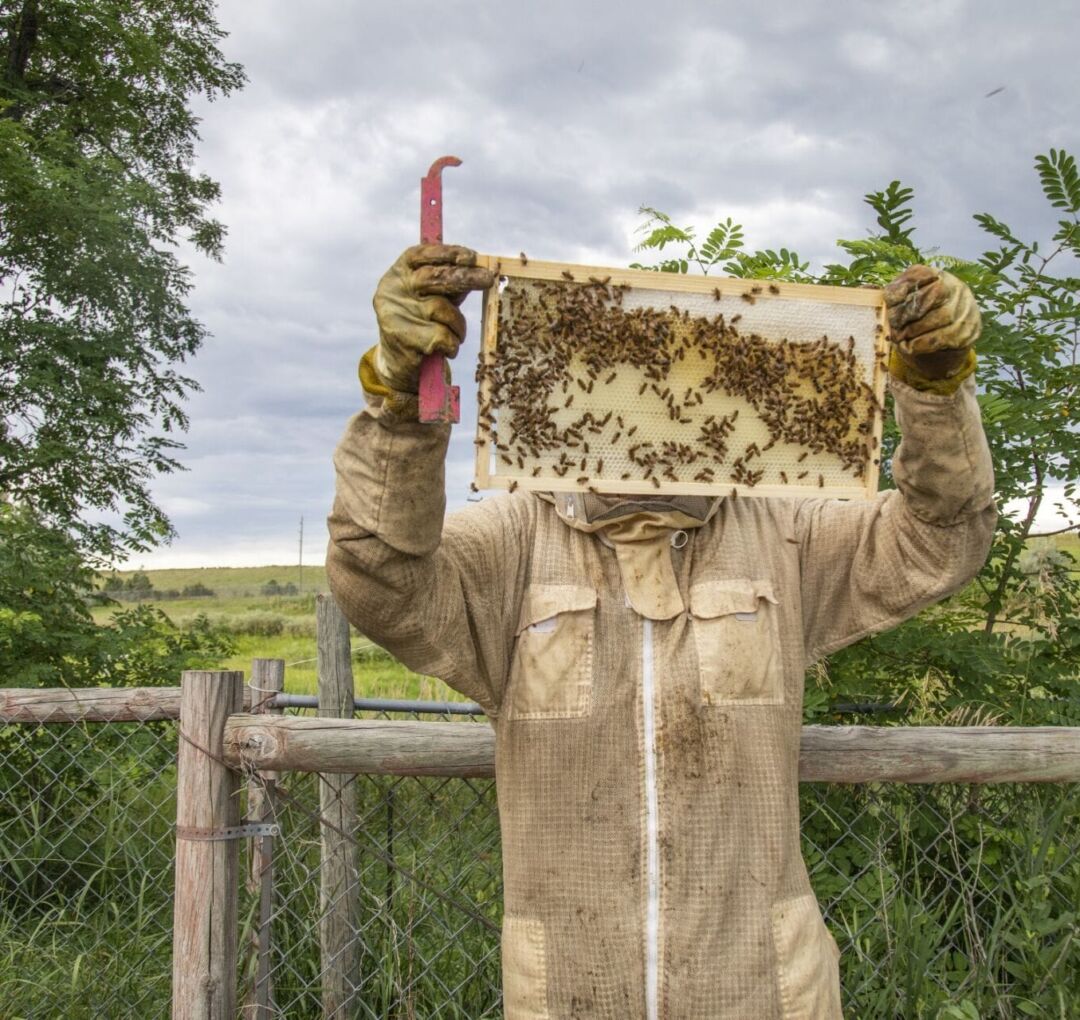
The city of Boulder also announced a bee-biomonitoring initiative in August 2026. The study observes honeybee and native bee patterns to inspect the pollen and nectar they gather.
These noninvasive measures offer insight into microplastics levels in the environment, air and soil pollution, plant diversity, invasive species takeovers, pesticide toxin levels, and changes in seasonal bloom timing.
Scientists track these factors by analyzing the DNA of the pollen samples brought back from hives and nests. Because bees forage so consistently, scientists gain hundreds of data points a day.
This program hopes to identify which areas need help in biodiversity and which plants are the most advantageous to this effort. It also points to areas with higher pesticide usage so that researchers can develop solutions that reduce exposure to harmful chemicals for pollinators, animals and humans alike.
Additionally, Boulder city’s work contributed to Polis’ executive order signed on Sept. 16 that requires state agencies to take coordinated action to protect and support Colorado’s pollinators.
The order will mandate the creation of a long-term conservation plan, an agreement to reduce harmful pesticides, the protection of existing pollinator habitats, and the creation of new pollinator habitats. Despite initial opposition to pesticide reductions, farmers are now partnering with researchers to find solutions that protect both their crops and native pollinators.
Rella Abernathy, a senior ecologist and applied ecological programs coordinator for the city of Boulder, contributed to this effort.
When discussing the many programs Boulder instituted this year, Abernathy noted that the strength of the conservation community is their collaboration.
“What’s exciting about what is happening in the state is that we’re seeing the fruits of many, many years of work behind the scenes and work that individual organizations and universities are doing on their own,” she said.
Abernathy explained how Boulder hosted the first Colorado Pollinator Summit, an event that assembles renowned ecologists, urban planners, nonprofits, and government officials to share their research and work together to protect pollinators and their habitats. She hopes that people are seeing the hard work the pollinator community is doing now so that future generations will be inspired to take up the mantle.
“We want people to take action, and you have to have hope to take action. And the things you know you can do are actually the things that are going to put us on a better trajectory than we already are,” Abernathy said.