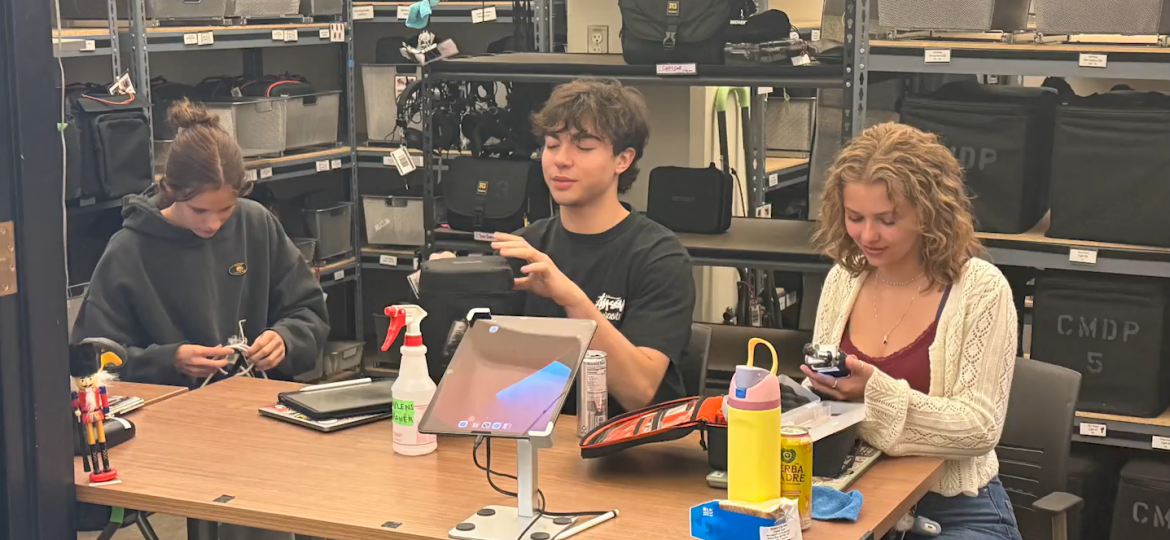
Podcast: Working in college: A balancing act
By Avery Clifton
Podcast TRT 5:04
TRANSCRIPT
Avery Clifton, Reporter: Serenity Sisneros, a sophomore media production major at the University of Colorado Boulder, is no stranger to a busy schedule. On top of taking 18 credit hours and participating in clubs, she also works four part-time jobs.
Serenity Sisneros, Working Student: Yeah, I think that my drive to succeed in my academics is not a top priority when you have to make a stable income.
Clifton: Welcome to the podcast. I’m Avery Clifton and today we’re talking about balancing work and school. Sisneros works around 35 hours a week as a waitress, a student employee and a freelance video editor.
Sisneros: I take the free minutes that I have and they’re no longer free minutes. Like, everything I do becomes working in some capacity, like.
Reporter: She says working to pay for her school tuition, car and living expenses has made academics take the back seat.
Sisneros: So, a lot of the time it is really stressful, and I can’t always focus because it’s, it’s trying to decide whether or not you need to make an extra 100 bucks this week or you need to finish this essay.
Reporter: A 2024 survey of more than 50,000 college students by Tellis Strategies, which researches secondary education, found that working more than 20 hours a week is linked to lower academic performance.
Regina Bateson, CU political science professor: So it’s not uncommon that, you know, when I try to talk to students or ask them, why can’t you spend more time on assignments? You know, why are you missing so many things? People citing conflicts with work is pretty common.
Reporter: That was CU political science professor Regina Bateson, who has seen students struggle to balance work and school. When she worked at the University of Ottawa, she had a student who was failing her class because the student had to work while the class met.
Bateson: And I was just like, oh, catch 22 right? You’re spending so much time working that you’re not being a student, but if you don’t work, you can’t be a student. And I mean, honestly, we never found a good solution for her and my perception is that some of the students here are backed into a similar situation.
Reporter: Sisneros says her grades have slipped from getting A’s in high school now that she has more commitments in college.
Sisneros: I’m like a B average, maybe, like, there’s C+ every once in a while, in there. I’m not proud of it, but it’s the way it is, you know.
Reporter: Sisneros says that she weighs her priorities day by day, even if that means submitting assignments late or not at all.
Sisneros: Everything is different because you have added pressures, and you can’t put 110% of yourself into every single thing you do, because then there will be none of you left.
Reporter: Savannah Weatherington is a therapist in Boulder who supports working college students. She says attending school and working long hours have become more common among her clients.
Savannah Weatherington, Boulder therapist: Because, if you’re working jobs as well as if you’re in a full time student position, and you’re not able to meet those specific expectations that you place on yourself, then it leads into even, like a depleted or even like some depressive symptoms too.
Reporter: Weatherington says that working students often need to prioritize slowing down and focusing on one task at a time.
Weatherington: Yeah, there’s a difference between pushing yourself and then depleting yourself, you know.
Reporter: According to Weatherington, making to-do lists can be helpful for working students and give them a sense of accomplishment.
Weatherington: Your brain activates a new reward system and it’s like, oh, cool. I feel better about this, right?
Reporter: Sisneros says she combines her tasks with things she enjoys like exercising and spending time outside.
Sisneros: I don’t get a lot of time to, like, go to the gym or to exercise a lot or whatever. And so it’s like, oh, yeah, I have to go to the drugstore and pick up, you know, something or other. I’m gonna walk to the drugstore and make myself feel better about it, like.
Reporter: Sisneros also drives an hour from her house in Fort Lupton to CU campus during the week. She says the drive has become built-in time for herself.
Sisneros: It is kind of nice because I’m like, That’s my hour. I just, like, kind of zone out and listen to music, or I listen to a podcast or listen to a book, or, you know, I’ll call my mom.
Reporter: Working long hours in college can be tiring, but Sisneros says working enjoyable jobs makes it easier.
Sisneros: If you find a job that you like, stick with that job, because it’s hard to find those and when you find it, it’s worth keeping.
Reporter: A 2019 study found that students who worked during college had higher earnings after graduation compared to those who did not. Sisneros says that while working four jobs is stressful, it’s also rewarding.
Sisneros: There’s a sense of gratification and being like, Yeah, I did all that on my own, you know, I want to come out of college and be like, you know, I did go to college, and I did pay for it.
Reporter: According to Sisneros, combining tasks and pleasures can make a heavy workload feel a little bit lighter. Thank you for listening, I’m Avery Clifton.