Stratøs: Art with no boundaries
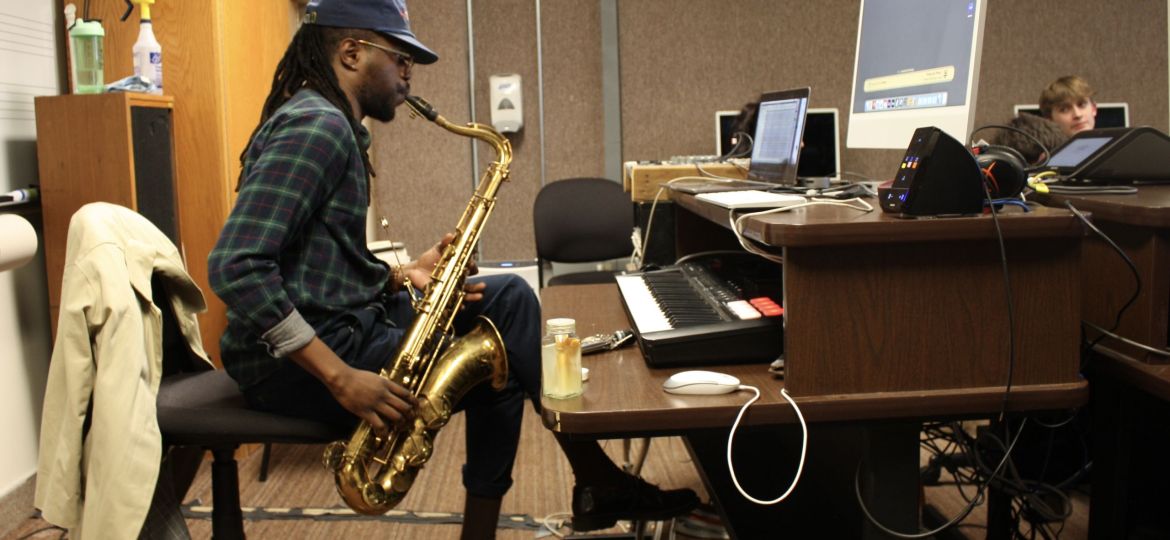
Caption: Musician and University of Colorado Boulder professor, Stratøs, playing the saxophone in a music technology class on Feb. 17, 2026 (Avery Clifton/The Bold)
By Avery Clifton
The audience sits in hushed anticipation. Stratøs steps out on the shiny wood floors of the music hall, acknowledging them with only a nod. After taking his place at center stage, his sleek, curved instrument in hand, the room floods with his signature electronic saxophone sound. His rings reflect the bright lights as his fingers move smoothly and quickly over the instrument.
“It’s become an integral part of my sound,” Stratøs said.
As a saxophonist, composer, producer, photographer and cinematographer, Stratøs pushes the boundaries of what it means to be an artist and musician. In addition to performing, Stratøs teaches students to find their artistic voice as a composition professor at the University of Colorado Boulder.
“When you dedicate yourself to artwork, there’s more than enough time for several disciplines,” Stratøs said.
The musician’s artistry began in Michigan when he went by Eddie Codrington, and he started playing the saxophone in high school, along with the flute and clarinet. He said that the saxophone was the only instrument he played seriously.
Stratøs attended West Michigan University for his undergraduate and master’s degrees, both in jazz studies. He independently studied music composition, audio engineering, photography and cinematography.
He developed his stage name shortly before releasing his first album.
“The idea behind that was to kind of make, like, a singular identity that would be synonymous with visual arts and music, to try to make things less confusing,” said Stratøs.
In 2021, he released his first album “Planets” which was self-written, composed and produced. The album has one song for each planet in the solar system. He said the theme allowed him to use multiple composition styles on one album while still being marketable.
After moving to Los Angeles in 2022, he worked across disciplines with a variety of artists. Stratøs wrote music with the likes of Charlie Burg, including “Lancaster Nights” featured in the 2023 romantic comedy “Anyone But You.”
His current project, “Challenger Deep” is inspired by his late grandfather, a fisherman in Barbados. The album details a fictional story where his grandfather descends to the lowest point in the ocean.
“There’s like, cities and cities of people and their stories who have yet to be told down there,” Stratøs said.
The project will include a photobook of his relatives in Barbados and short films about the production. The musician sees it as dissolving the typical boundaries of his artform, and said that he likes his albums to invite other forms of storytelling.
“I would describe myself as kind of like a world building type composer,” he said.
While he produces integrated art projects, Stratøs still finds the pressure to work in one discipline discouraging, as specializing in one art form is more marketable.
“It’s just that we live in a society now where it’s easier to market something if it’s specialized, if we can brand it,” he said.
At the same time, Stratøs says that despite its challenges, being a multidisciplinary artist also has its benefits. He says it helps him professionally and creatively.
“My, sort of like database of connections and network is a little bit wider because it includes photographers and visual artists,” he said.
One of those connections being Adam Hersh, who has played the keyboard for Stratøs in the past. Hersh said that Stratøs focused on giving his collaborating musicians creative freedom, and that he was a relaxed and open leader on the stage.
“I think he really trusts the musicians to create something with him,” Hersh said.
Creative freedom is also important to Stratøs as an instructor. He hopes to give students the tools to express themselves.
“I’m very interested in helping people, you know, in their time on this earth as artists, make the artistic statement that is the most them,” said Stratøs.
CU musicology professor Jermey Smith recalls observing Stratøs in an individual student session, moving between a shiny black piano and a wooden desk with audio software displayed on a computer. He says that Stratøs encouraged the student to experiment with the music and emboldened her personal expression.
“Stratøs accepted that things might start very small and then he showed you how rich it could be,” Smith said.
Stratøs’ goal is for students to define themselves as musicians where in the everchanging music industry, artistry must be their focus.
According to Stratøs, some students want to focus on how to get music deals, but he says entering art making from that perspective sets you up to fail. In the everchanging music industry, artistry is important to hold on to.
“If you got to figure stuff out, you still have this thing that no one can take away from,” Stratøs said.