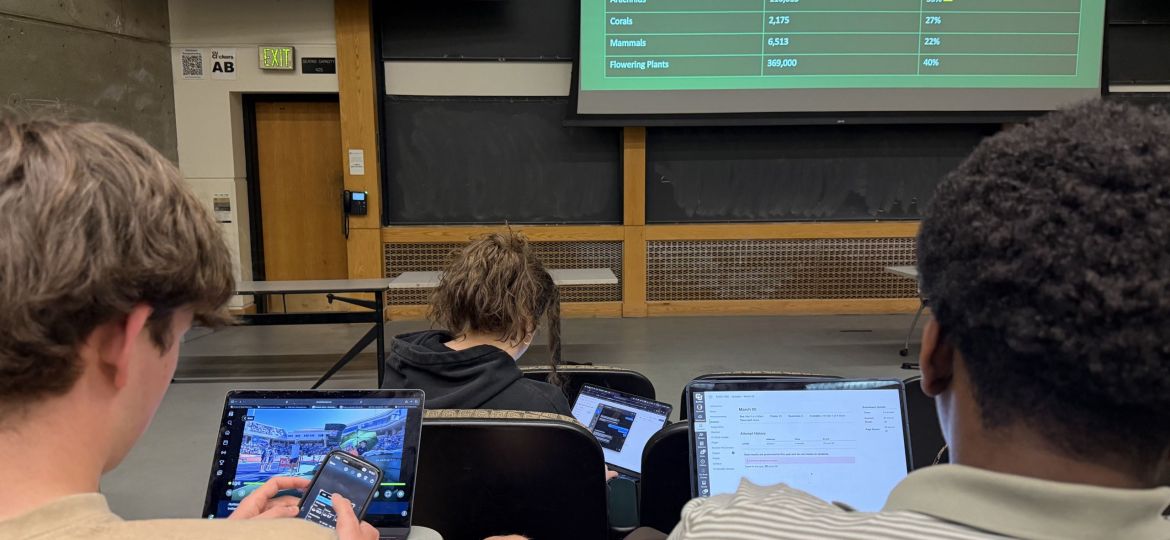
Caption: Students distracted on their phones and laptops during an environmental studies class lecture on March 5, 2026. (Photo by Madison Shaw/The Bold)
Digital Distractions: Social media and the rise of student procrastination
By Teagan Bischoff
Disorganized browser tabs. Phones hidden behind laptop screens. Insistent notifications. This is what procrastination looks like for college students. Information overload, not laziness.
Research shows that internet use, especially social media, is directly linked to procrastination. A 2025 study published in Frontiers in Psychology found that social media addiction significantly predicted academic procrastination and was strongly correlated with lower self-control and fear of missing out.
Psychologists say the behavior is more complex than simple distraction.
“The accepted scientific definition of procrastination is voluntarily delaying action on a goal despite expecting to be worse off for that delay,” says Daniel Gustavson, a research professor at the Institute of Behavioral Genetics at the University of Colorado Boulder.
Studies from the Psychological Bulletin say that about 75% of college students consider themselves to be procrastinators while 80% to 95% of college students actually procrastinate.
From a cognitive perspective, Gustavson says procrastination centers on two major processes: self-regulation and reward valuation.
Seeing a message from a friend can be an irresistible temptation compared to an assignment due in several days. Psychologists call this “delayed discounting,” the tendency to favor immediate gratification over future rewards. A good grade at the end of the semester feels distant. Scrolling Instagram delivers a dopamine hit instantly.
Social media platforms are designed to pull you in.
“When people are endlessly scrolling, they’re not necessarily doing it voluntarily anymore,” Gustavson says. “It’s rewiring your brain to force it to be a habit and to suck you in and just soak up all your time. And then you just have less time to do other things.”
CU business major Dominic Cardenas says the challenge is that schoolwork and social life happen on the same devices.
“I like to log into my Instagram and Snapchat from the browser, just so that I don’t have to pick up my phone and get distracted by it,” he said. “Before I know it, the pen is down and I’m sitting on my laptop scrolling.”
The shift to digital learning has intensified this challenge. According to Toby Hopp, CU associate professor of advertising, public relations and media design, digital platforms overwhelm us all with content.
“Every time we use the internet, we’re exposed to a diverse array of information inflows,” Hopp says. “Some of those may be meaningful, but many of them are not.”
Hopp describes modern digital spaces as “cluttered information environments,” where advertisements, links and notifications compete simultaneously for our attention. Instead of multitasking, he says we are actually switching between tasks, a process that makes it harder to engage deeply with information.
“You can’t do two things at once,” Hopp says. “Your brain isn’t necessarily set up to do that.”
The design of digital platforms plays a role in the competition for our attention. Notifications, algorithms and ads are built to keep us scrolling.
“The business model is based on you remaining in the platform environment for as long as possible,” Hopp says. “Your attention is being allocated to that platform and for an extended period of time, allows those platforms to serve you more ads.”
That system, often called the attention economy, means students are navigating digital spaces specifically designed to capture their focus.
“Everything you do is embedded with this sort of attempt to capture, quantify and sell your attention,” Hopp says.
Despite the challenges, Gustavson says there are strategies to reduce procrastination and help us focus. He suggests turning off notifications and removing distractions from the work environment.
“There’s two options to get you out of that situation,” Gustavson says. “One is to develop really hardcore self-control and stop yourself from doing that.”
The other is not to have it in your environment at all.