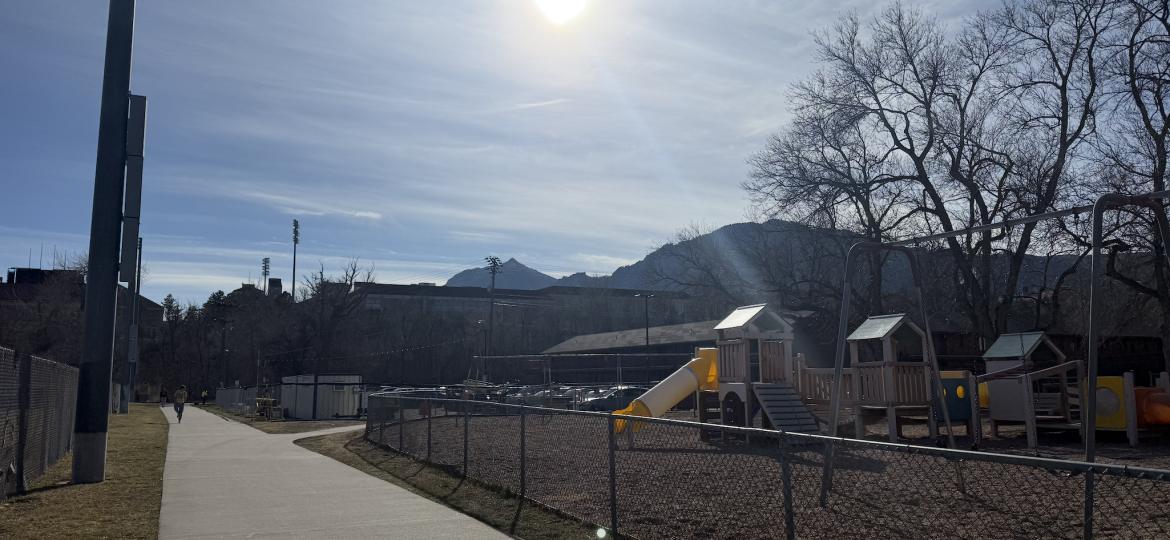
Caption: Boulder Creek Path near University of Colorado Boulder’s campus, Jan. 22. (Photo by Teagan Bischoff/The Bold)
Colorado’s warm winter puts water security in question
By Teagan Bischoff
Colorado has been experiencing one of its warmest and driest winters in decades, with record low snowfall. For local farmers, the unseasonable conditions have sparked fears of water scarcity for the coming summer and a possible drought.
Snowpack functions as a natural reservoir, storing water during winter and releasing it gradually as temperatures warm. That water supplies municipalities, farms, wildlife, recreation and storage reservoirs across Colorado.
“Anytime we get that fresh powder, that’s something to celebrate for skiers, it’s also something to celebrate for Colorado’s water,” said Keith Musselman, an assistant professor in geography at the University of Colorado Boulder.
This winter, snow has been unusually scarce. According to the Colorado Water Conservation Board, snowpack levels in the Boulder Creek Basin were 44% lower than the 40-year average as of January. Farmers and food advocates fear that the abnormal weather patterns could seriously threaten local agriculture.
According to the Colorado Water Conservation Board eight of Colorado’s warmest years on record have occurred since 2012, and temperatures this winter were more than 10 degrees above average across sections of central and northwest Colorado. Those warming trends cause the snow to melt earlier in the year.
“Any time that we shift when that water melts, shift it earlier in the year, it means that we’re more likely to dry out earlier and more intensely in the summer,” Musselman said.
For water managers, this is troubling. When water supply cannot meet demand, not all users receive the water they need.
Colorado has long had a ‘first come, first serve’ approach to water distribution, according to the Colorado Water Conservation Board. As supplies tighten, farmers are cut out of the loop.
“We basically have a bucket that isn’t very full, and we have a lot of users who are and who want to behave like it’s still really full, and that’s not gonna happen,” said Ellen Burnes, an assistant professor of Finance at CU Boulder.
Outdoor irrigation accounts for 50% of municipal water use in Colorado, making it a primary target for reductions during shortages. Farmers, however, often struggle when water supply is reduced. They rely on limited water rights and may receive little or no irrigation in severe shortages, according to the Colorado Water Conservation Board.
Sarah Salsich, a volunteer with the Flatirons Farmers Coalition and a Colorado resident since 1968, said farmers are actively discussing weather-related concerns as warmer winters become more common. She pointed to soil regeneration as a critical strategy.
“Healthy soil makes healthy plants makes healthy food makes healthy people,” Salsich said, adding that food security depends on collective action as farmers face mounting pressure.
Despite the concerning trends, climate experts on the Colorado Water Conservation Board note that winter is not over. April is historically the snowiest month in Boulder County. But there is significant ground to make up, with 145% of normal snow accumulation needed for the return to average conditions, a deficit with heavy implications for Colorado’s water system.
“We rely on that system, and we’ve built our entire water industry around it,” Musselman said.
Edited by Nicholas Merl