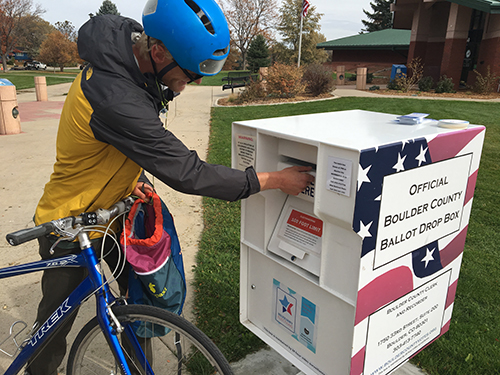
Election Day is Nov. 4. Here's everything you need to know.
Hey, CU Students: We got you covered for this fall’s local elections! Want to know about the candidates and issues on your ballot? Here’s our 2025 Voter’s Guide produced by students in the Covering Political Campaigns class and fact checked by our editing staff. Knowledge is power. Read on!
Below you will find out about statewide ballot measures such as the Healthy School Meals for All program as well as county-level ballot measures regarding mental health and open space. Read the bios for the four Boulder City Council seats and learn about permanently extending a sales tax in Boulder. There are also details about races for some Front Range school boards and the potential to overturn Denver’s recent flavored tobacco ban.
Register to vote at Vote.org.
Statewide Ballot Measures
Proposition LL: Retain and Spend State Revenue Exceeding the Estimate for Proposition FF
This ballot measure asks Colorado voters to allow the state to keep $12.4 million in tax revenue from Proposition FF, which created the Healthy School Meals for All Program. It also asks voters whether to keep the lower tax deduction limits that voters approved in 2022 for those earning $300,000 or more for this program, as well as ensuring the state will spend at least $1 million on parts of the Healthy School Meals for All Program if Proposition MM doesn’t pass in this election.
The measure was put on the ballot through a legislative referral process, with Democratic state Rep. Lorena Garcia and Democratic state Sen. Dafna Michaelson Jenet sponsoring HB-25-1274. The bill passed both chambers and was signed by Gov. Jared Polis in June to be referred to the ballot.
Supporters say that the measure would provide continued funding for the Healthy Meals for All Program so that public school children across the state will be fed during a time of uncertainty.
Opponents of the measure argue that not all families need free meals, and that tax retention is unnecessary and would be too much of a burden on Coloradans.
By Alex Organa
Proposition MM: increase State Taxes for School Meals and Food Assistance Programs
Voters across Colorado will decide if they approve lowering the state income tax deduction limits for taxpayers earning $300,000 or more to generate an additional $95 million annually for the Healthy School Meals for All program.
The bill was introduced in the Colorado Senate, passed by the Senate and the House, and signed by Gov. Jared Polis all in August. It was primarily sponsored by Democratic state Rep. Lorena Garcia and Sen. Dafna Michaelson Jenet.
The tax deduction limits for the $300,000-or-more earners would move from $12,000 to $1,000 for single filers and from $16,000 to $2,000 for joint filers.
Proposition MM has gained significant support from many advocacy groups dealing with education and hunger prevention, including Hunger Free Colorado, whose director testified in support of the bill to the Senate Health and Human Services Committee. There is no reported opposition to this measure at this time, aside from social media groups who generally oppose tax deduction limits.
Both Proposition LL and MM need simple majority support to pass.
By Sam Hokkanen
Boulder County Ballot Measures
Boulder County Ballot Issue 1A: Open Space Sales and Use Tax Extension
Voters will decide whether they want to permanently extend a 0.15% countywide sales and use tax that helps the county purchase, maintain and manage open space lands that are used for parks, hiking, resource management and agriculture — and also protect the views of the foothills and flatirons.
This sales and use tax was approved by county voters in 2010 and is currently set to expire in 2030. It is one of four that Boulder County collects for open spaces. The county commission put this measure on the ballot.
The Boulder Reporting Lab detailed before the commission’s Aug. 12 meeting some pushback by farmers about the language in the measure, which they said was too vague and didn’t take into account maintaining or preserving the more than 26,000 acres of farmland that falls under the county’s nearly 109,000 acres of open space.
The council had revised the ballot issue to make it a 10-year extension instead of the indefinite extension that county staff favored, but later changed it back to make the tax permanent, should it pass. Commissioners Ashley Stolzmann and Marta Loachamin voted in favor of the change for permanence; Commissioner Claire Levy was against it.
Boulder County Ballot Issue 1B: Mental and Behavioral Health Sales and Use Tax
Boulder County voters will decide whether to approve a new three-year 0.15% sales and use tax that would be used for mental health crisis services, suicide prevention efforts and substance use prevention and treatment. Officials estimate it would collect at least $15 million.
The ballot issue identifies five categories of funding: crisis response and intervention for things like a mobile crisis clinic and walk-in clinics; outpatient and residential care treatment facilities; recovery services like case management and sober-living communities; navigators to help connect people to resources; and prevention efforts in schools and nonprofits to help people who might be at risk of mental health or substance use disorders.
Boulder Mayor Aaron Brockett and County Commissioner Claire Levy said in an op-ed published in the Boulder Reporting Lab that there is demonstrated need for stronger mental health services in the county, especially for Latino, LGBTQ+ and unhoused residents. State Sen. Judy Amabile has refused to endorse the proposal saying it is too broad.
The county commission revised the initial resolution from five years to three years, and unanimously approved the updated ballot issue in August. If approved in November, the tax would start immediately and run through Dec. 31, 2028.
City of Boulder Ballot Measures
Permanent Extension of the Community, Culture, Safety and Resilience Tax, Ordinance 8710
This ballot measure seeks to permanently extend the community, culture, resilience and safety sales and use tax. This bill will not raise additional taxes, but instead perpetually extend the 0.3% tax, which is set to expire in December 2036.
If approved, the money would go toward “essential general fund city services,” such as road and sidewalk upkeep, snow and ice removal, parks and playground maintenance and fire and police station renovations, among other things. The measure also would put 10% of the money collected by the sales and use tax into a grant pool for nonprofits in the Boulder community.
The city council put the ordinance on the ballot after two readings, and Mayor Aaron Brockett signed it. Annie Scott is Boulder’s representative for the Community, Culture, Resilience and Safety tax.
The Downtown Boulder Partnership, which is made up of Boulder public figures and business owners, is in favor of it, with an endorsement on its website. As of this article’s publication, there is so far no registered opposition on this bill.
By Tatum Jordan
Increasing Debt Capacity, Ordinance 8711
Voters are being asked whether to increase the city’s debt to a combined maximum of $350 million in principal and interest for building or renovating things like the East Boulder Community Center, Civic Area construction and a fire station.
The city council, with the approval of Mayor Aaron Brockett, put this measure on the ballot.
Supporters say it would give the city more debt-financing flexibility for projects that contribute to the health, safety and welfare of Boulder residents. Those who oppose the measure say the city has taken on too much debt and needs to pay that off first.
This measure, if approved, would only take effect if related ballot measure Ordinance 8710 also passes. Ordinance 8710 asks voters to permanently extend a 0.3% sales and use tax, which would be used to pay the debt from Ordinance 8711.
By Grace Moore
Boulder City Council Candidates
The 2025 Boulder City Council election is the first election in the city’s transition to an even-year cycle, with terms for newly inaugurated members lasting three years instead of four. Four of nine incumbents with terms ending this year are seeking re-election with seven challengers. Incumbents are listed first below, followed by the rest of the field in alphabetical order. You can watch their candidate videos on the city’s website at this link.
Matt Benjamin
Matt Benjamin, 43, is seeking re-election, having first joined the Boulder City Council in 2021. He is a professional photographer and an astronomer. Before joining the council, Benjamin served as the education manager of Fiske Planetarium and committee chair for the Our Mayor Our Choice ballot measure in 2020, which allowed Boulder residents to directly vote for the mayor for the first time. Each incumbent seeking re-election has endorsed Benjamin. The Boulder Progressives organization said Benjamin has championed policies that provide safer transportation, raised minimum wage and improved access to affordable housing. Boulder City Council Candidate Rob Smoke criticized Benjamin and other councilmembers in a video, saying they are “promoting antisemitism tropes” and denying motions to divest from Israel. In response to a question about the city council’s lack of a stance on Israel’s war on Gaza, Benjamin said in an interview that creating a city resolution would only create divisiveness in a community so physically disconnected from the conflict.
By Ben Chapman
Lauren Folkerts
Mayor Pro Tem Lauren Folkerts, 38, is seeking re-election. Folkerts, an architect, says should she win again, she wants to further combat Boulder’s housing crisis and inequality, while continuing to address the climate emergency. The Boulder chapter of the Democratic Socialists of America backs Folkerts, describing her as “a champion for working people,” and notes her significant role in helping Boulder become the nation’s first city to adopt the embodied carbon building code. Opponents criticize Folkerts for what they call her “tolerance for illegal encampments.”
By Ella Stivison-Moran
Nicole Speer
Nicole Speer, 48, is seeking re-election to the Boulder City Council, where she’s served since 2021. She wants to make Boulder a more equitable and progressive city that fosters growth for a diverse and sustainable future. Supporters say Speer is values-driven with a progressive approach to housing and equity issues. Opponents say that she favors progressive and equity-focused programs rather than addressing pressing issues through compromise.
By Carly Chamlin
Mark Wallach
Mark Wallach, 72, is seeking a third term on the Boulder City Council. Wallach is running on a platform centered on building affordable housing, investing in public safety and improving environmental infrastructure and renovation. Supporters, including former councilmember Bob Yates, describe Wallach as a practical problem solver whose wisdom is needed. As of this publication, there is no formal opposition registered to his campaign.
By Vanessa Shell
Rachel Rose Isaacson
Rachel Rose Isaacson, 28, is hoping to replace one of the incumbent city council members. She is the director of regeneration at Woven Web, a nonprofit focused on community resilience, and is a barista at South Side Walnut Café. Isaacson is running on a platform of housing affordability, renter protections, climate resiliency, equity and stronger community engagement in city decision-making. Supporters say she brings lived experience as a young renter, and will advocate for policies that address affordability, equity and climate challenges. Opponents argue her platform may be too idealistic and raise concerns about her support for transportation projects like the Iris Avenue redesign.
By Aidan DeMuro
Rob Kaplan
Rob Kaplan, 60, is seeking a seat on the Boulder City Council. Kaplan is a retired fire captain who served 18 years with Boulder Rural Fire Rescue and now sits on the city’s Parks and Recreation Advisory Board. He is running on a platform that emphasizes wildfire preparedness, housing for middle-income families, improvements to transportation and infrastructure, and revitalizing downtown Boulder. His supporters, including PLAN Boulder County and Open Boulder, say Kaplan offers pragmatic, responsible leadership and would strengthen community safety and housing opportunities. Some people argue that Kaplan’s cautious stance on the city’s Core Arterial Network could slow progress on needed transportation and safety upgrades.
By Grace Katz
Montserrat Palacios
Montserrat Palacios, 30, is making her first run for political office and says she’ll bring a young voice to Boulder City Council. Palacios has worked in the fine arts industry since graduating from the Catholic University of America in Washington, D.C., and is currently an auction house manager. Her website shows she’s focused on five policy issues: affordable housing for middle-income families; sustainable and safe transportation; fully funding police and first responders; connecting unhoused residents with support systems and services; and strengthening and supporting Boulder’s arts and culture communities. She does not appear to have any public opposition to her campaign, which the Boulder Daily Camera reported is not taking endorsements or donations.
Jennifer Robins
Jennifer “Jenny” Robins, 48, is once again in the running for Boulder City Council, presenting herself as a candidate of “good governance.” Robins has built her civic profile as chair of the City of Boulder Parks and Recreation Advisory Board, a board member of the Play Boulder Foundation, and co-chair of the Boulder Chamber’s Community Affairs Council. Her campaign centers on housing affordability, youth programming, wildfire resiliency, and preserving Boulder’s identity while making sure basic services are delivered consistently and fairly. Supporters describe her as a steady, respectful voice who brings thoughtfulness to local debates. University of Colorado Regent Elliott Hood praised Robins as the type of leader Boulder needs, emphasizing her ability to approach tough issues with balance. However, critics may point to her decision to call the police during a heated public forum in Aug. 2025 as a sign of how she manages conflict, as well as raise concerns about her alignment with pro-development and establishment planning positions, and her association with a more conservative-leaning slate of candidates.
By Alexia Bailey
Max Lord
Max Lord, 32, is looking to unseat one of the four incumbents on the Boulder City Council. Lord is the owner of Hammer and Driver, a home improvement and construction business in Boulder. He would like to bring more pragmatic oversight to city projects involving infrastructure, public safety and housing, saying that Boulder should balance ambition with affordability and incorporate more community voices. Supporters say that he has experience with city zoning, permits and infrastructure, and is thoughtful about how construction and city planning should be streamlined. His critics say that he’s overly cautious when it comes to infrastructure projects, pointing to his opposition to the contentious Iris Avenue redesign.
By Logan Zeiler
Rob Smoke
Rob Smoke, 69, has lived in Boulder for 39 years and previously ran for council. His main campaign issue is Israel’s war in Gaza, telling the Boulder Reporting Lab that it is “the moral issue of the day.” He criticizes Boulder’s government over not divesting in companies that are linked to Israel. Smoke is advocating for fellow candidate Aaron Stone.
Aaron Stone
Aaron Stone, 49, is a computer engineer seeking his first political office. His campaign website says that the reason he entered the race was Israel’s war in Gaza, and Boulder’s lack of response to offering up a ceasefire resolution or divesting in companies who are linked to Israel. Stone’s platform also includes setting up a sanctioned encampment for the unhoused, requiring developers to build more affordable housing units, and bike path safety. Stone said in his candidate video on the city’s website that he doesn’t believe “I am a fringe candidate, as the papers have been reporting.” Stone is advocating for fellow candidate Rob Smoke.
Boulder Valley School District Board of Education, District E
Only one of three seats up for grabs in the Boulder Valley School District Board of Education election is contested: District E, which is the largest district geographically. Neither candidate currently serves on the board.
Jeffrey Low Anderson
Jeffrey Lowe Anderson, 62, is a data assimilation scientist at the National Center of Atmospheric Research and an adjunct professor at his alma mater, the University of Utah. Anderson has 24 years of experience within BVSD’s District E, most recently serving as co-chair of the BVSD Long Range Advisor Committee. Anderson aims to improve state test scores, increase enrollment, expand budgets, address artificial intelligence concerns and create a safe learning environment for students.
Deann Bucher
Deann Bucher, 61, is a former educator and recipient of “The Best Should Teach Award” from the University of Colorado Boulder. Bucher’s child is a graduate of BVSD schools. Her website says she led the development of the BVSD’s social studies curriculum. Bucher previously ran for a BVSD board seat, but didn’t win. Her goals if elected are to support educators, sustain and strengthen high academic standards, promote inclusive and equitable learning environments and ensure support for students and families.
By Logan Brinker and Tanvi Sabharwal
St. Vrain Valley Schools Board of Education, Districts B and D
Two district seats are contested in the St. Vrain Valley School Board’s 2025 election, breaking a trend of uncontested elections in years past. District D is a race between John Ahrens and Meosha Babbs. And District B, which covers parts of Longmont, Erie, Mead, Firestone and Frederick in the south-central part of the district, is a race between Hadley Solomon and Peggy Kelly, neither of whom currently serves on the board.
Hadley Solomon
Hadley Solomon, 54, is a technology, climate and sustainability industry consultant. She has four children who have all attended St. Vrain Valley Schools. Solomon served two years as president of parent advisory boards and of the Grassroots St. Vrain Board. She is also a two-time alumna of the St. Vrain Leadership Program. In letters to the editor of The Left Hand Valley Courier, many supporters said Solomon is a problem solver and intelligent leader. In her letter of interest posted on the district’s website, she said the board’s most critical responsibility is to create a strong partnership with the new superintendent, providing support and strategic guidance. If elected, her goal is to build the district’s success by being a constructive and effective partner from the start.
Peggy Kelly
Peggy Kelly, 76, is a retired registered nurse. She has eight grandchildren who are enrolled in or have graduated from St. Vrain Valley Schools. Kelly has taught science, English and Old Testament survey in public and private schools, and was a school nurse for the Boulder Valley School District. A petition on the New Creation Church website shows the church’s efforts to support Kelly and get her name on the ballot. In her letter of interest on the district’s website, she said schools exist to partner with families educating children of all backgrounds and abilities. If elected, her goal is to bring a fresh perspective, high-achieving programs and understand the needs of families.
By Maddie Fisher
Denver Referendum 310: Flavored Tobacco Ban
Denver voters will decide whether they want to keep or overturn a 2024 city council-imposed ban on the sale of flavored tobacco products. Voting “yes” keeps the ban in place, while voting “no” indicates you want to overturn the ban.
Sponsored by council members Serena Gonzales-Gutierrez, Shontel Lewis and Darrell Watson, Ordinance 24-1765 passed by 11-1 vote, and Mayor Mike Johnston signed it in mid-December. In early 2025, more than 17,000 Denver residents who are against the flavored tobacco ban circulated a petition for a veto referendum, which got enough signatures to be placed on the ballot.
Supporters of voting “yes” say a ban on flavored tobacco products protects public health, arguing that flavors are a gateway for younger generations to use other tobacco products. Yes for Denver Kids says on their website that “kid-friendly products” like “watermelon ice vapes … and very berry nicotine pouches” are “how Big Tobacco addicts lifelong customers.” A coalition of professional national and state medical groups also are in favor of a yes vote.
Those in favor of a “no” vote say the ban negatively interferes with local tobacco and vape-shop businesses and may cause them to close. CitizenPower!, which was behind the petition, says on its website that keeping the ban could cost “$13 million per year in lost revenue,” and adding to Denver’s already-large budget deficit. Opponents of the ban also say that it may not attain its goal of minimizing tobacco use among younger people. Nicotine companies, who make the flavored tobacco products, are also asking voters to choose “no.”
By Stella Ashfield-Salter and Eva Woodruff-Stern
Denver Public Schools Board of Education, at-large seat
Denver Public Schools has four seats on its Board of Education up for election in Districts 2, 3 and 4, and an at-large seat. The at-large seat is wide open, due to incumbent Scott Esserman running in District 3. At-large candidates must gain the approval of voters across the city as opposed to the district races, which voters elect within that district. There are two candidates for the at-large seat; the third dropped out about a month before Election Day.
Amy Klein Molk, 41, is a former entrepreneur of education-focused companies such as Pooka Box and Beanstalk Inc. She has firsthand experience in the Denver Public School system as a SPED paraprofessional, working with the district’s most vulnerable children. She is a mom of two children in the district’s schools.
“My number one priority is to make sure that we have a system that is equitable,” she said in an interview.
Alex Magaña, 56, has spent the last 25 years in education, and is a Denver Public School principal at Grant Beacon and Kepner Beacon middle schools. If elected, he would be forced to resign his current job because of conflict-of-interest rules. Both of his children graduated from district schools.
Magaña, who spoke in an interview with Chalkbeat Colorado, said he is concerned with issues about safe and welcoming environments, preparing students to succeed academically and emotionally, and leading by listening to the students and educators.
By Owen Houtakker
Jefferson County School District Board of Education
The Jefferson County School District is the second-largest district in the state of Colorado. Three seats are up for grabs in Wards 1, 2 and 5. No public opinion appears to be available for the candidates listed below.
Ward 1
Denine Echevarria, 41, was previously a teacher and currently serves as a nonprofit operations coordinator. She is running on the issues of school safety, supporting staff, working with families, community engagement and financial responsibility.
Michael Yocum, 26, founded the tech company Yocum Tech. He wants to help students who tend to fall through the cracks find alternate ways of success through things like Warren Tech, a school within Jeffco that teaches skills like cosmetology or mechanics while students also attend regular high school.
Ward 2
Peter Gibbins, 35, previously worked as a lawyer and with labor unions. He believes schools and communities are in a crisis, and his campaign is grounded in transparency, accountability and the belief that public education is the cornerstone of a just society.
Samuel Myrant, 69, has volunteered in schools for four decades. His campaign addresses making alternative careers known to students, teaching civics to students and doing what he can to get families involved in the community.
Ward 5
Tina Moeinan, 36, has almost a decade of experience in government and has built a career in public service. Her campaign is built on strengthening institutions, empowering students and supporting teachers.
Mary Parker, 78, is an incumbent on the school board. She is a court-appointed special advocate for neglected and abused children and owns an human resources consulting business with her husband. Parker advocates policies that put students first.
Gloria Teresa Rascon, 52, works in foster care in Douglas, Arapahoe and Jefferson counties. Her policy platform was not available to the public.
By Eve O’Neill