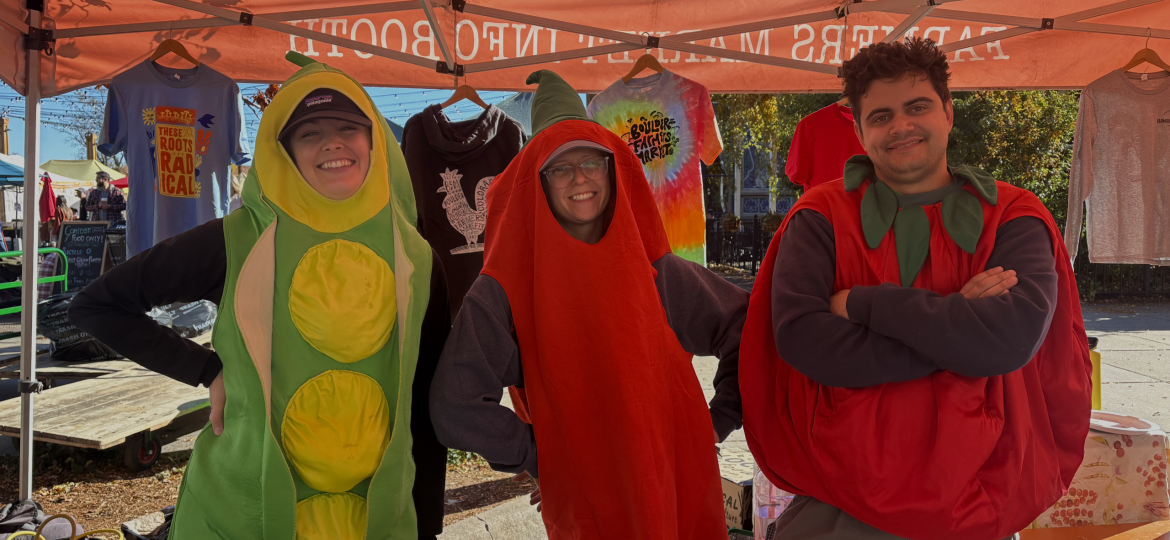
Boulder County Farmers Market workers pose for a photo in their festive vegetable costumes on Oct. 25. (Blair Coldrick/The Bold)
How the Boulder County Farmers Market tackles food insecurity
By Blair Coldrick
Early on Saturday mornings as the sun crests over the Flatirons, 13th Street fills with a crowd for the Boulder County Farmers Market. Vendors arrange their tents full of everything from carrots and squashes, to freshly baked bread and samosas. A man sings and plays guitar, children dance and the crowd meanders through the tents with canvas bags in tow.
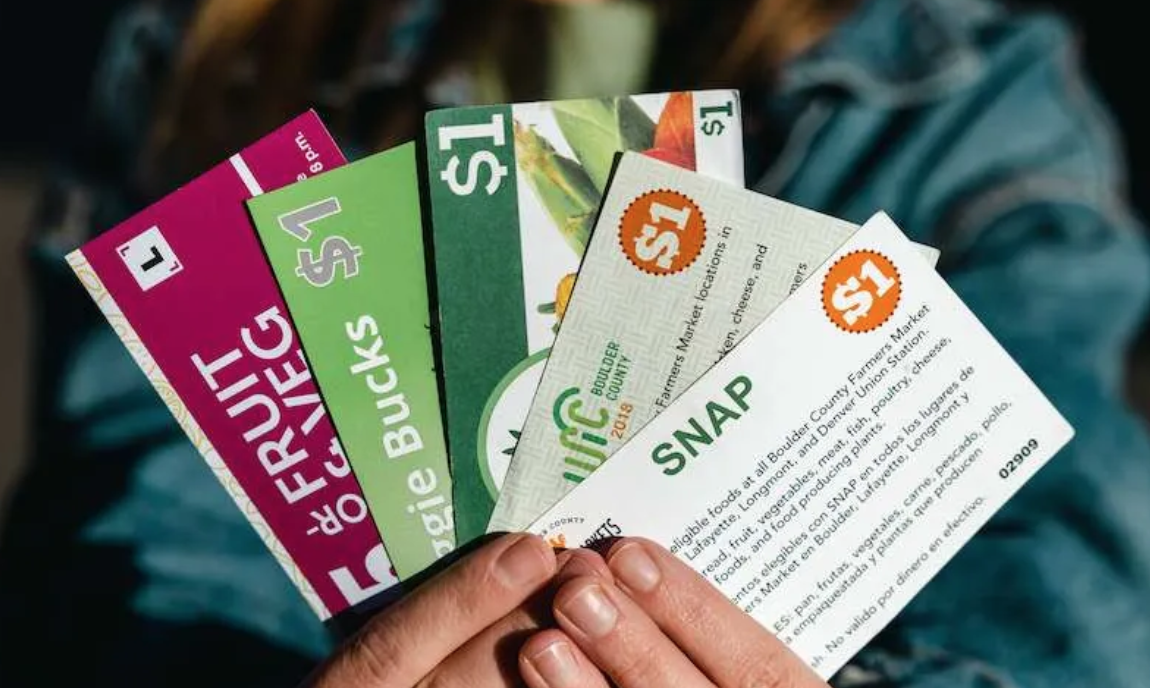
Samantha Ritter is a food access manager who works at the market’s information booth, handing out cash coupons to those eligible for the Supplemental Nutrition Assistance Program (SNAP).
“We see the same people every week and watch their kids grow up,” Ritter said.
Since 1987, the farmers market has grown from farmers selling produce out of their trucks to a city block full of tents that go beyond typical produce to include artisanal cheeses, Wagyu beef, Italian olive oil and handmade soaps. The market is a crucial link for residents who rely on government food assistance to feed themselves and their families.
SNAP coupons can be used to shop at both the in-person markets and through the farmers market’s online Food Hub.
Born during the COVID-19 pandemic, the Food Hub is like an online grocery store where local farmers and ranchers sell their products all-year-round. This helps the farmers stay in business and gives residents access to their food, even during winter months when the market on 13th Street is closed.
According to Food Hub Assistant Manager Daisy Mills, the goal is simple; make local food available to everyone.
“Our mission is to uplift and enhance our local food system through retail, wholesale and food access,” Mills said. “That means getting food out there through as many avenues as possible, from CU Dining Services to early-childhood centers.”
Through the online hub, shoppers fill digital carts much like any other e-commerce site. They then can pick up their groceries at a designated pickup site or get it delivered by volunteer drivers. Shoppers can also receive Double Up Food Bucks that match up to $20 in food and vegetables each week.
“Most of our customers are maxing this out each week and really see the value in that,” Mills said.
At the farmers market info booth, Ritter asks a couple of simple questions before handing someone the cash coupons.
“We collect information like zip code and household data so that we can see how many people and children we have served and then ask for the last six digits of their card, so we know there is no duplication,” Ritter said.
Apparently, more people are using these benefits than expected. According to Ritter, the market facilitates $300,000 to $500,000 each year in food access transactions that circulate directly through local farms and vendors.
“Something like 70 to 80% of the people using these programs wouldn’t be at the market if we didn’t have them,” Ritter said. “They simply couldn’t afford it.”
Several vendors accept SNAP money coupons, such as Andy Breiter, the founder of Grama Grass and Livestock, a regenerative meat company.
“It feels vital to me, not trying to raise a product that’s just for a certain class of people,” Breiter said. “Feeding somebody low nutrition and asking them to try to get themselves out of a rough place isn’t fair.”
As this story was going to print, the Associated Press reported that two federal judges ruled the the Trump Administration must continue to fund SNAP benefits during the government shutdown, even if it means using contingency funds. The rulings came a day before the U.S. Department of Agriculture planned to freeze payments to SNAP because it said it could no longer keep funding it due to the shutdown.
According to the Emergency Family Assistance Association, one in eight Boulder residents is affected by food insecurity. The Boulder County Farmers Market is doing what it can to support customers through these hard times.
“Right now, the market is looking into trying to subsidize for our customers in some way through fundraising and see if there is something we can do to help fill that gap,” Ritter said.
At 2pm, the farmers market on 13th Street comes to a close. The crowds disperse. Vendors pack up their crates, folding tables and tents. The Boulder County Farmers Market runs through November 22, the Saturday before Thanksgiving.
Students who receive SNAP and are impacted by the government shutdown can seek help at CU by emailing basicneeds@colorado.edu. The university is helping students with SNAP applications. In addition, you can reach out to CU’s Basic Needs Center or to Hunger Free Colorado for statewide information.
Edited by Lily Young-Stallings