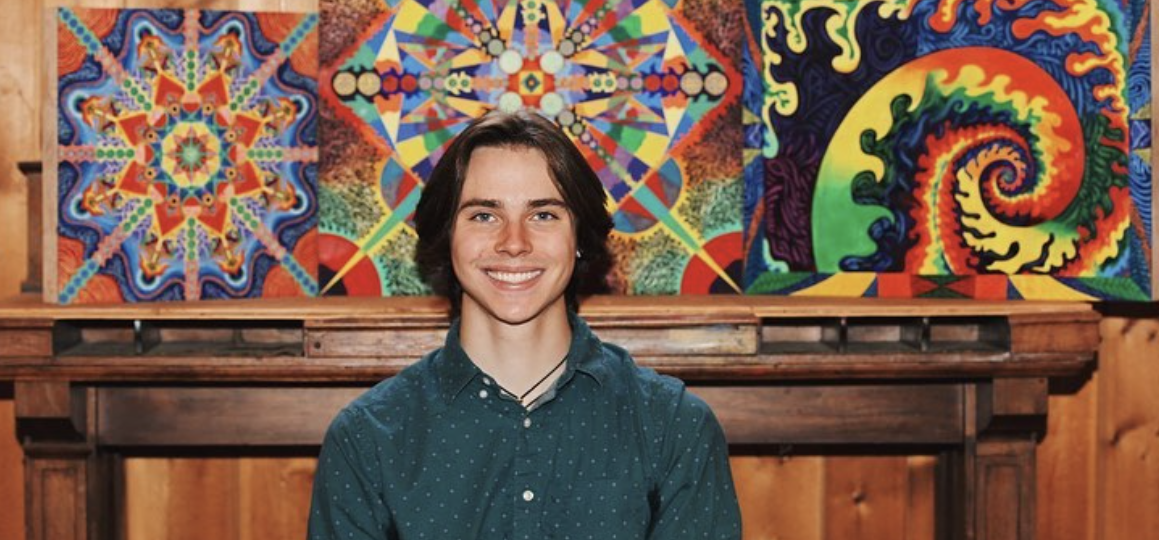
Blake Duris posing in front of three of his psychedelic paintings. Screenshot taken from @blakedurisart on Instagram.
Art, addiction and ayahuasca: an obscure path to recovery
By Nick Ambrosio
As Blake Duris carefully lines up his brush to his easel, vibrant colors and kaleidoscopic patterns begin to bring life to his canvas. The former CU Boulder student attempts to visualize the concept of infinity using symmetrical layers and three-dimensional fields of depth.
“I use fractal imagery to convey that life is ever-expanding and ever-growing,” Duris said. “It will always continue and will never cease to exist.”
Growing up in Littleton, Duris has always been creative. He began making art while in school, but the thematics of his work drastically differed from the existential explorations he creates today.
“I started like any other artist: drawing animals, sketching in class, just putting whatever was on my mind on paper,” Duris said.
Duris’ art – and life – took a turn during the pandemic. While under quarantine, he started experimenting with drugs. Like most young adults, Duris occasionally enjoyed a few casual drinks or hits of a joint, but he swiftly began to climb the narcotic ladder. This led him to use more illicit substances like Psilocybin mushrooms, LSD and cocaine.
Michael Vitulano is a licensed psychologist based in Denver.
“Addiction isn’t common with psychedelics, but when it does occur, it is very difficult to ditch,” he said.
Duris broke this pattern, and his relationship with psychedelics grew dangerous.
“I almost died a few times,” Duris said. “My roommates, friends and family all noticed how wild my behavior was, and I decided to take a holistic approach to my sobriety.”
During his sophomore year at the University of Colorado Boulder, Duris packed his things, bought a plane ticket to Peru, and underwent ayahuasca therapy.
According to the National Health Institute, ayahuasca is an Amazonian plant-based tea used to treat mental health problems and stimulate personal and spiritual growth. The herbal blend contains Dimethyltryptamine, or a purified hallucinogen, which makes it a form of psychedelic.
While few clinical studies have been done on the effects of ayahuasca, neurophysiologists Daniel Brierley and Colin Davidson found the drug balances a substance user’s overstimulated dopamine pathways. This may make it easier for users to wean off drugs like alcohol and cocaine.
“The limited available evidence suggests that ayahuasca may be beneficial in the treatment of dependence associated with alcohol or other drugs of abuse,” they concluded in their study.
However, ayahuasca may also result in side effects such as vomiting, nausea, psychotic episodes, seizures, respiratory and cardiac arrest and even death.
Luckily for Duris, though, ayahuasca changed him for the better.
“He just went from a really uncomfortable place to a place that he seems to be thriving in,” said Natalie Slaybaugh, a longtime friend of Duris.
The ayahuasca experience also gave Duris purpose in his art. He now hopes to inspire others struggling with addiction and their mental health to find therapy in artistic expression.
“I’m trying to bring out the beauty in existence and show people what life could really be,” he said.
Edited by Keeley Haynes