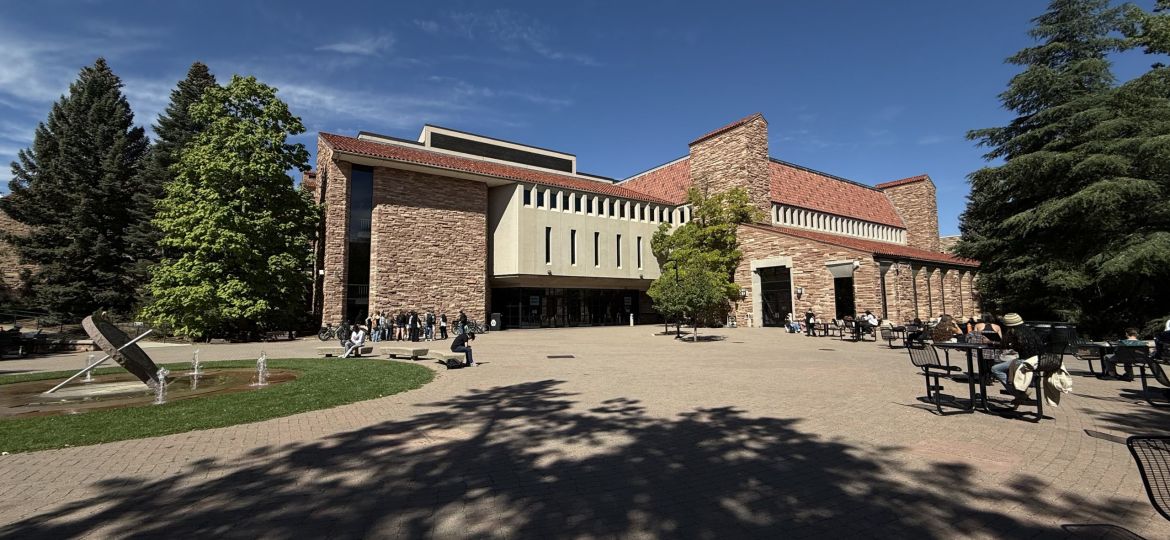
Photo caption: Norlin Library was the site of two hoaxes in the first month of the semester. (Photo by Patrick Dawson/The Bold)
Shooting of Charlie Kirk and recent hoax threats dissolve feelings of campus safety
By Patrick Dawson
Schools continue to be a hotspot for gun violence in America. Recent shootings show that the trend is not slowing down.
On Sept. 10, pro-Trump influencer Charlie Kirk was fatally shot while hosting a political debate at a university in Orem, Utah. Kirk is one of the most outspoken right-wing figures in politics. The gunman, 22-year-old Tyler Robinson, was positioned on a rooftop about 400 yards away. He shot Kirk in the neck. Kirk instantly jolted back and lost consciousness. The large crowd of onlookers scattered. A few hours later, Kirk was pronounced dead.
Almost simultaneously, another shooting was happening at Evergreen High School near Denver. A 16-year-old student shot and critically wounded two of his classmates and then reportedly shot and killed himself.
In less than one hour’s time, two more schools became the grizzly scene of more gun violence. According to the American Academy of Pediatrics, there were 1,453 school shootings in the U.S. between 1997 and 2022. So far this year, there have been 109 school shootings resulting in 33 deaths, according to the non-profit gun violence tracker Everytown For Gun Safety.
“It’s clear to anyone with eyes that there is a problem,” said Jessica Hall, a senior public relations major at the University of Colorado Boulder. “Especially being in Colorado, it almost seems like we are sort of a hotspot for this stuff. We had the murders at UCCS when I was a sophomore, and then we had the two hoaxes in the first four weeks here.”
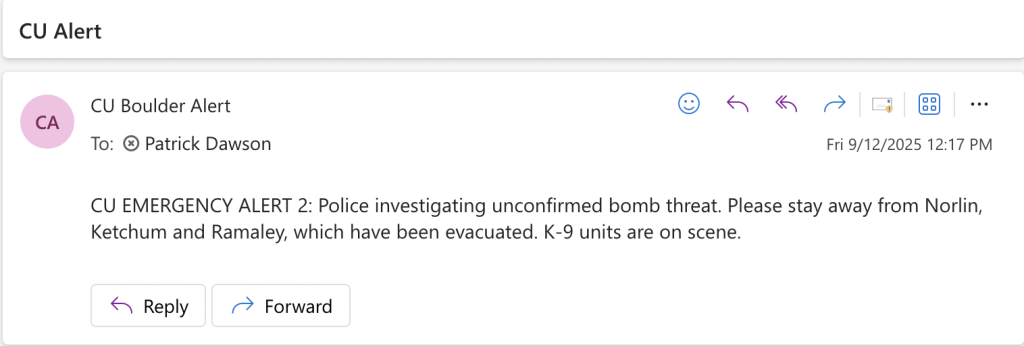
On Aug. 25, the University of Colorado Boulder was targeted by a false report of a gunman at Norlin Library. On Sept. 12, two days after Kirk’s killing, the university received false bomb threats in three buildings: Ketchum, Ramaley and again at the library.
“I haven’t felt overly anxious,” said finance major Amber Weber who works at the library’s front desk. “We have a really good team here, and for the three years I’ve worked here, we haven’t had too many incidents. But it was definitely odd.”
The university has measures in place to handle emergencies, but students are wondering what can be done to prevent further incidents.
“We understand that recent events are distressing and we want to take a moment to outline some of our security efforts,” the university said in a statement released to The Bold. “The Division of Public Safety takes a comprehensive approach that goes beyond traditional policing by integrating security services, emergency management, threat assessment, event planning, and 24/7 operations.”
The statement did not directly mention the Kirk killing, the Evergreen High School shooting or either of the hoax threats at CU.
“I felt like the police response in both situations was appropriate, but it was definitely disappointing with how scattered and late a lot of information from the school’s end was communicated,” Hall said.
Emergency alerts in both hoaxes were apparently sent out quickly, but some students reported not getting them at the same time as their friends. Others said they only got an email when they signed up for both email and text alerts.
“We were lucky it was only a hoax, and the cops on scene did their jobs,” Hall said. “But if something dangerous was happening, they would’ve been minutes behind on the information.”
The university encourages concerned students to seek help with the University’s Office of Victim Assistance.
Edited by Rue Murray