

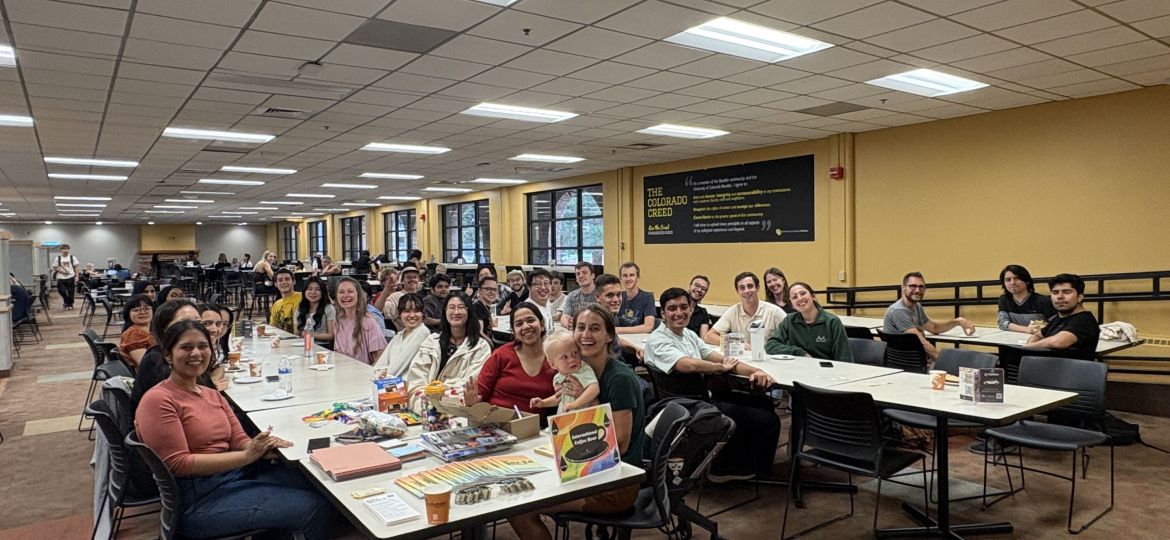
Photo caption: Students gather for International Coffee Hour in the University Memorial Center on Sept. 12. (Photo courtesy of Dana Kernan)
International students face uncertainty as visa restrictions intensify
By Katelyn Whitcomb
As Pablo Aramburu begins his fall semester at the University of Colorado Boulder, the sixth-year Ph.D. student imagines a scenario where his student visa status may be jeopardized. Originally from Guadalajara, Mexico, Aramburu moved to the U.S. to research experimental quantum computing. The Vannevar Bush Faculty Fellowship funds Aramburu’s research, but his funding may halt as the Trump administration intensifies visa vetting processes.
“Imagine you’re funding this person – me – under federal money for five years, only to decide you’re canceling their visa,”Aramburu said. “What do you do with all of that investment, that research, that degree, that knowledge? Do you let it go away?”
In June, the U.S. State Department issued new guidelines for international student visa holders revealing a rigorous vetting process. All F, M and J visa holders are required to surrender privacy of social media accounts and can anticipate delayed approval.
On July 25, visa appointments became mandatory for all academic visa holders. The CU Boulder International Student and Scholar Services website issued an alert announcing all visa applicants must interview to obtain and renew their visas in the fall. The director of the program, Diana Salazar, explains the nuances.
“Immigration policies are really complex, and their impact really depends on each individual situation,” Salazar said. “We try to make sure that people understand that so they don’t get anxious.”
With the crackdown on visas, the number of international students studying in the U.S. is projected to decline and that is expected to affect Colorado’s economy. According to the U.S. Global Leadership Coalition, international students enrolled in Colorado colleges and universities contributed $404 million to the state’s economy in the 2023-2024 academic year. With a decrease in international students this fall, the state is projected to lose $63 million.
CU Boulder also braces for a loss in campus culture.
“The loss of any of the diverse views international students bring into the classroom is a detriment to the whole university because we lose their voice,” Salazar said. “The more diverse experiences we have here on campus enhances the whole experience for everybody.”
CU Boulder isn’t the only school being impacted by these protocol changes. Jadyn Marais, a second-year student at Austin Community College in Texas, says the status of her F-1 visa is unknown.
“You could have a visa situation like me where you have to be here, you can’t work an appropriate amounts of hours and you may not be able to travel,” she said. “It’s quite disheartening.”
The changes to visa processes make it difficult for international students to feel secure in their legal status. In April, 22 international students had their visas revoked across CU’s four campuses. Several of those students abandoned their studies and returned to their home countries to avoid detention. Experiences like these heighten anxieties among international students, as they never know when their life could be uprooted in an instant.
“It takes less time to tear down a house than to build one,” Aramburu said.
Story edited by Keeley Haynes.

Article was very informative. Especially the information regarding the economic impact on the University and State. Direct impact on students and their research was impactful.